
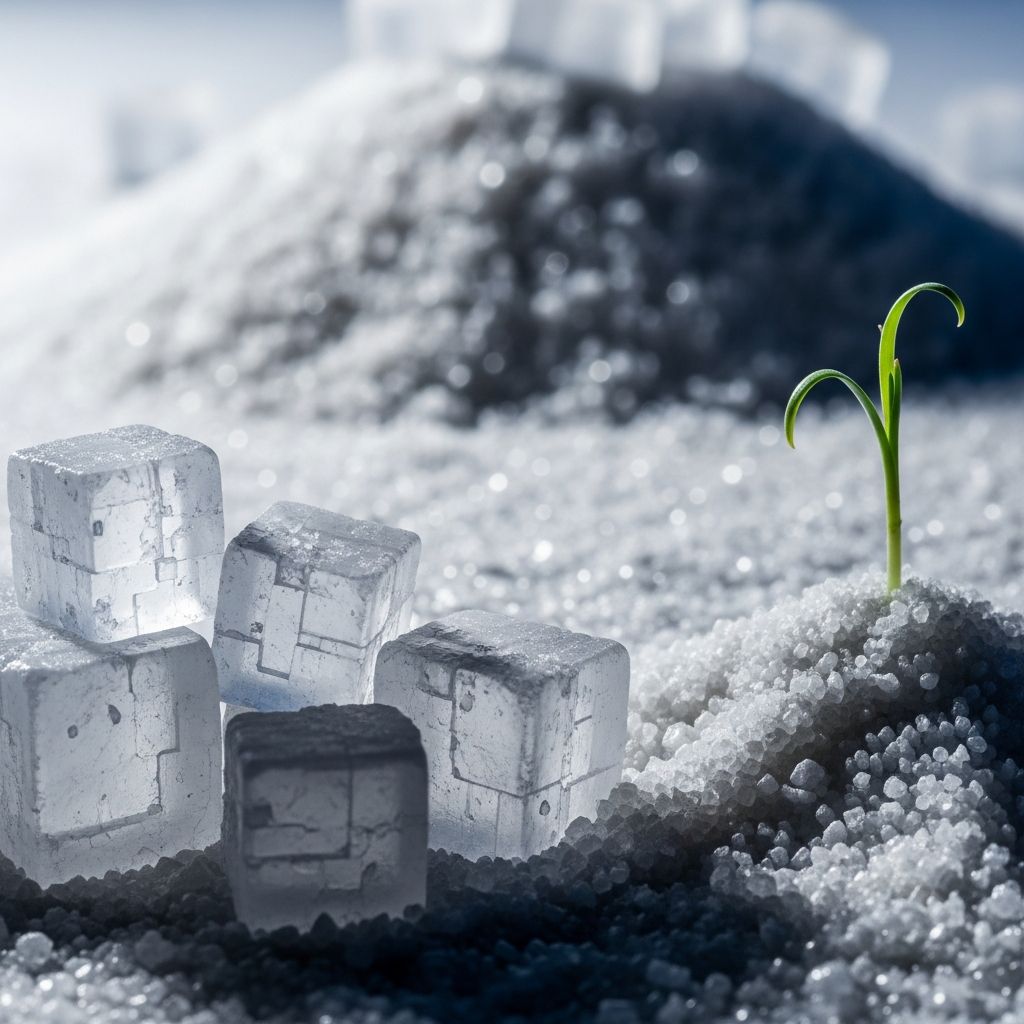
Table salt, a staple in kitchens worldwide, is primarily sodium chloride (NaCl), appearing as fine, white cubic crystals. It is heavily processed from underground deposits, making it nearly pure NaCl with additives for functionality and health benefits.
The Chemical Foundation of Table Salt
At its core, table salt is sodium chloride, formed by the ionic bond between sodium (Na+) and chloride (Cl-) ions. This compound manifests as isometric cubic crystals, which give it a uniform, fine-grained texture ideal for shakers. Chemically, it is 40% sodium and 60% chloride by weight, essential electrolytes that regulate fluid balance, muscle function, nerve impulses, and blood pressure.
Natural salt originates from evaporated seawater or salt springs, but table salt undergoes extensive refining to remove impurities and trace minerals, resulting in 99.9% purity. This refinement process ensures consistency but strips away elements like magnesium or potassium found in less processed salts.
How Table Salt is Produced and Processed
Unlike sea salt derived from evaporated ocean water, table salt is mined from ancient underground deposits left by prehistoric seas. These deposits are extracted, crushed, and purified through processes like vacuum evaporation, which creates tiny, densely packed crystals.
Key processing steps include:
- Mining: Salt is drilled and blasted from deposits deep underground.
- Refining: Impurities such as dirt, rocks, and other minerals are removed via washing and screening.
- Drying and Grinding: The salt is dried and ground into fine granules for uniform distribution.
- Additive Incorporation: Iodine and anti-caking agents are blended in.
This results in a product that flows freely and dissolves rapidly, perfect for everyday use.
Additives in Table Salt: Iodine and Anti-Caking Agents
Most table salt is iodized, with potassium iodide or iodate added since the 1920s to combat iodine deficiency and goiter, particularly in iodine-poor soil regions like the Great Lakes area. Iodine supports thyroid health, an essential nutrient often obtained through diet but fortified in salt for public health.
Anti-caking agents, such as calcium silicate or cornstarch, prevent clumping in humid conditions by absorbing moisture. While some detect a slight metallic taste from iodine, these additives ensure practical usability without compromising core flavor.
Table Salt vs. Other Common Salts: A Detailed Comparison
Table salt differs from kosher and sea salts in texture, processing, and application. Here’s a breakdown:
| Property | Table Salt | Kosher Salt | Sea Salt |
|---|---|---|---|
| Source | Mined underground | Mined, less refined | Evaporated seawater |
| Grain Size | Fine, uniform cubes | Large, flaky | Coarse crystals or flakes |
| Additives | Iodine, anti-caking | Usually none | Minimal, trace minerals |
| Sodium Content | ~40% by weight | Similar by weight | Similar, less by volume |
| Best Uses | Baking, shakers, liquids | Grilling, pinching | Finishing, texture |
Kosher salt’s larger grains dissolve slower, offering texture control, while sea salt retains minerals for subtle flavors but may contain impurities like microplastics. Nutritionally, all provide equivalent sodium; trace minerals in sea salt are insignificant for health.
Culinary Applications: Why Table Salt Excels in the Kitchen
The fine grains of table salt dissolve quickly and evenly, making it indispensable for baking where precision matters. In batters, doughs, or brines, it integrates seamlessly without grittiness.
Common uses include:
- Seasoning sauces, soups, and dressings for uniform flavor.
- Precise measurements in recipes—1 tsp table salt equals about 1.5 tsp Morton kosher or 2 tsp Diamond Crystal kosher.
- Salt shakers, as small particles flow through tiny holes.
- Preserving foods by inhibiting bacterial growth through osmosis.
While specialty salts add flair, table salt’s reliability suits most cooking needs.
Health Implications: Sodium, Iodine, and Moderation
Sodium chloride aids hydration and nerve function but excess intake raises blood pressure by retaining fluids. Both table and sea salt deliver identical sodium per gram—about 2,300 mg per teaspoon—far exceeding daily limits for many.
Iodized table salt provides a reliable iodine source, preventing deficiencies linked to thyroid issues. However, those with hypertension should measure by weight, not volume, as coarser salts yield less sodium per spoonful. Focus on whole foods over processed items heavy in hidden salt.
Environmental and Purity Considerations
Mining table salt has a lower environmental footprint than sea salt evaporation, which can involve energy-intensive processes or contamination risks. Refined table salt avoids ocean pollutants like heavy metals or microplastics sometimes found in sea varieties.
Purity testing ensures safety; government standards mandate low impurity levels. Opt for reputable brands to guarantee quality.
Storage and Handling Tips for Optimal Freshness
Store table salt in cool, dry places to prevent caking despite additives. Glass or ceramic shakers work best; avoid metal if iodine taste is a concern. If clumping occurs, add rice grains to absorb moisture—a traditional hack.
For baking accuracy, use a scale; volume differences between salts can alter recipes significantly.
Frequently Asked Questions (FAQs)
Is iodized table salt safe for daily use?
Yes, it provides essential iodine without excess risk for most people, supporting thyroid health as per public health guidelines.
Can I substitute sea salt for table salt in baking?
Not ideally; coarser grains lead to uneven distribution and texture issues. Use fine table salt for precision.
Does table salt have more sodium than sea salt?
No, both have the same sodium by weight (40%), though sea salt’s volume may contain less due to crystal size.
Why does my table salt taste metallic?
This can stem from iodine additives; non-iodized versions are available for purer flavor.
Is table salt natural?
It derives from natural deposits but is heavily refined, removing minerals unlike minimally processed sea salt.
Advanced Uses: Beyond the Kitchen
Table salt’s versatility extends to cleaning (as a mild abrasive), de-icing roads, and water softening. In labs, its predictable properties make it a standard for solutions. Historically, it preserved meats and enabled trade, earning the term ‘salary’ from Roman soldiers’ salt rations.
In fermentation, salt controls microbes, producing sauerkraut or kimchi. Medically, saline solutions (0.9% NaCl) hydrate intravenously.
Choosing the Right Salt for Your Needs
For everyday seasoning and baking, stick with table salt. Experiment with kosher for meats or sea salt for finishing dishes. Health-conscious cooks prioritize low-sodium diets over salt type. Always consult dietary guidelines from sources like the American Heart Association.
References
- Table Salt Versus Kosher Salt: What is the Difference? — Jacobsen Salt Co. 2023. https://jacobsensalt.com/blogs/resources/table-salt-versus-kosher-salt-what-is-the-difference
- What is the difference between table salt and sea salt? — Michigan State University Extension. 2022-06-28. https://www.canr.msu.edu/news/what_is_the_difference_between_table_salt_and_sea_salt
- Know the Common Substance: Table Salt (Sodium chloride, NaCl) — National Center for Biotechnology Information (PMC). 2014. https://pmc.ncbi.nlm.nih.gov/articles/PMC4170357/
- Sea Salt vs Table Salt: What’s the Difference? — The Health Sciences Academy. 2023. https://thehealthsciencesacademy.org/sea-salt-vs-table-salt-whats-the-difference/
- Sea salt vs. table salt: What’s the difference? — Mayo Clinic. 2023-08-09. https://www.mayoclinic.org/healthy-lifestyle/nutrition-and-healthy-eating/expert-answers/sea-salt/faq-20058512
- What’s the Difference Between Kosher Salt, Table Salt, and Sea Salt? — Cook’s Illustrated (YouTube transcript). 2020. https://www.youtube.com/watch?v=kWepM1PAvAM
- Salt vs. sodium: What are they, what’s the difference, and why do we care? — University of Illinois Extension. 2023. https://schoolnutrition.extension.illinois.edu/blog/40
- Is sea salt healthier than table salt? — Mayo Clinic Health System. 2023-01-20. https://www.mayoclinichealthsystem.org/hometown-health/speaking-of-health/is-sea-salt-healthier-than-table-salt

- Integrated M.A. in Applied Linguistics, University of Hyderabad
- 5+ years in editorial, instructional, SEO, and research-based writing
Sneha is a relationships and lifestyle writer with a strong foundation in applied linguistics and certified training in relationship coaching. She brings over five years of writing experience to theskillvault, crafting thoughtful, research-driven content that empowers readers to build healthier relationships, boost emotional well-being, and embrace holistic living. Her writing and insights reflect the belief that beauty, happiness, and wellness…