
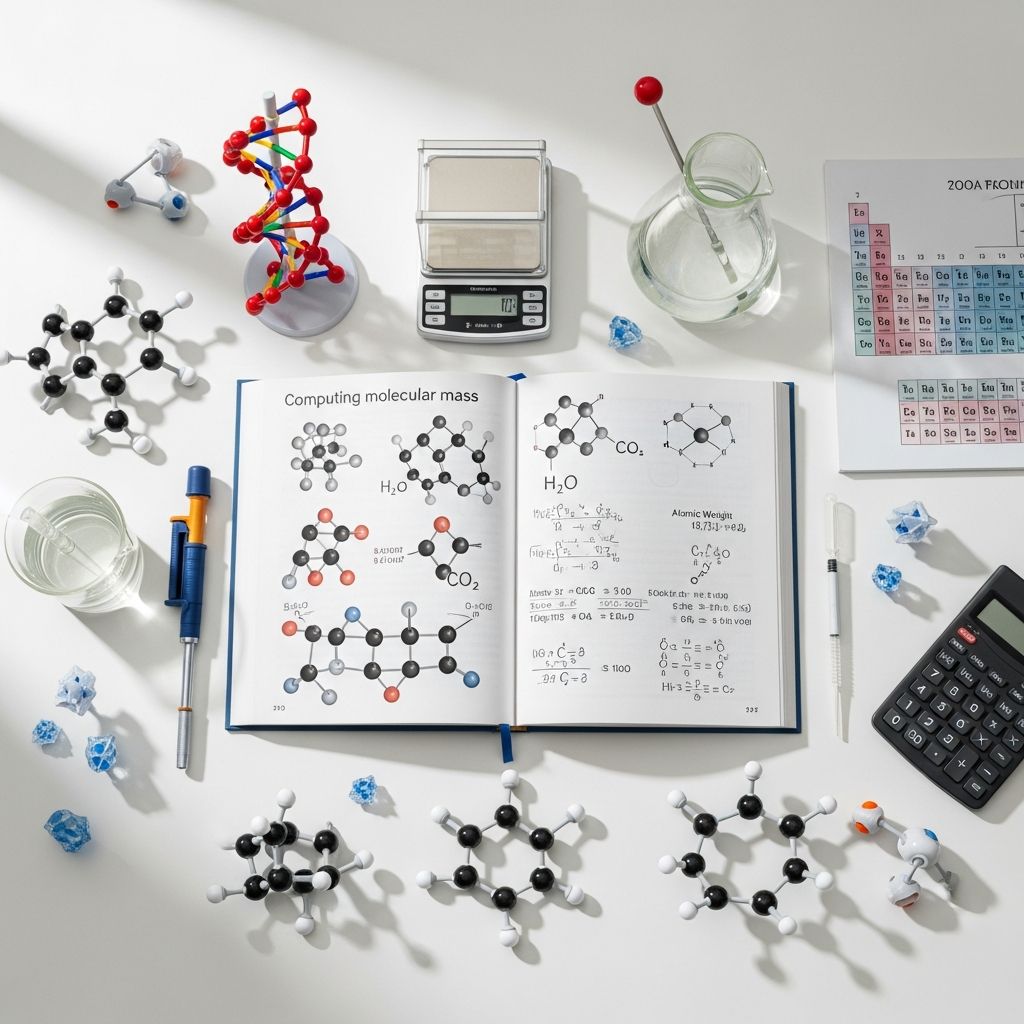
Understanding Molecular Mass Fundamentals
Molecular mass, also recognized as molar mass, molecular weight, and gram formula mass, represents a core competency in chemistry education and practice. This measurement quantifies the mass in grams of one mole of a substance, providing essential information for chemical reactions, stoichiometric calculations, and laboratory procedures. Whether working in academic settings, industrial chemistry, pharmaceuticals, or materials science, the ability to accurately determine molecular mass forms the foundation for numerous downstream calculations and predictions.
The relationship between molecular mass and atomic structure is straightforward yet powerful. Each element possesses a characteristic atomic mass, derived from the weighted average of its naturally occurring isotopes. When elements combine to form compounds, their individual atomic masses combine to create the total molecular mass. Understanding this additive principle allows chemists to predict molecular properties, calculate reaction yields, and determine compound compositions.
The Three-Phase Computational Approach
Calculating molecular mass follows a systematic methodology that remains consistent regardless of compound complexity. This structured approach ensures accuracy and reduces computational errors. The process divides naturally into three distinct phases, each building upon the previous stage.
Phase One: Identifying Elemental Atomic Masses
The initial step requires accessing a periodic table to locate the atomic mass for each element present in the chemical formula. The periodic table provides standardized atomic mass values, typically expressed in atomic mass units (amu). These values represent weighted averages accounting for naturally occurring isotope distributions. Modern periodic tables display atomic masses with varying decimal precision, commonly presenting values to two or three decimal places for practical laboratory applications.
For single-element substances, this step completes the majority of the calculation. For instance, sodium (Na) displays an atomic mass of 22.99 amu on the periodic table. This same value, when expressed with g/mol units, becomes the molar mass: 22.99 g/mol. The conversion from amu to g/mol occurs through the molar mass constant, establishing the fundamental relationship between atomic-scale measurements and macroscopic quantities.
Phase Two: Accounting for Element Quantities
Compounds contain specific numbers of each element, indicated by subscripts in chemical formulas. When no subscript appears, one atom of that element is present. This phase requires multiplying each element’s atomic mass by the number of atoms present in the compound. The subscripts, though small in appearance, significantly impact final calculations and demand careful attention during computation.
For compounds with polyatomic groups enclosed in parentheses, the external subscript applies to all elements within the parenthesis. For example, in calcium hydroxide Ca(OH)₂, the external subscript of 2 multiplies through both oxygen and hydrogen atoms within the parentheses. This requires multiplying the number of oxygen atoms (1) by 2, yielding 2 oxygen atoms total, and similarly multiplying hydrogen atoms (1) by 2, yielding 2 hydrogen atoms total. Overlooking this multiplication represents a common computational error requiring deliberate attention.
Phase Three: Aggregating and Expressing Results
The final computational step involves summing all individual element contributions. After multiplying each element’s atomic mass by its subscript-indicated quantity, adding these products yields the total molecular mass. The result requires appropriate unit designation: grams per mole (g/mol). This standardized unit communicates that the reported value represents the mass in grams of exactly one mole of the substance, establishing the critical link between molecular-scale and laboratory-scale quantities.
Simple Compound Calculations: Single-Atom Substances
Single elements represent the simplest molecular mass determination. Sulfur (S) exists naturally as individual atoms in many contexts, requiring only location on the periodic table. With an atomic mass of 32.066 amu, sulfur’s molar mass directly converts to 32.066 g/mol. Neon (Ne), with an atomic mass of 20.18 amu, similarly yields a molar mass of 20.18 g/mol. This direct correspondence makes single-element calculations ideal entry points for understanding the broader concept.
However, some elements exist naturally as diatomic molecules or polyatomic assemblies. Oxygen gas (O₂) contains two bonded oxygen atoms. Rather than using atomic oxygen’s mass of 16.00 amu, calculating the molecular mass requires doubling this value: 2 × 16.00 = 32.00 g/mol. Similarly, ozone (O₃) contains three oxygen atoms, yielding 3 × 16.00 = 48.00 g/mol. Sulfur often exists as S₈, requiring multiplication: 8 × 32.07 = 256.56 g/mol. Recognizing these natural molecular forms prevents significant calculation errors.
Intermediate Compounds: Binary and Ternary Systems
Binary compounds containing two elements demand careful attention to subscripts but remain relatively straightforward. Water (H₂O) contains two hydrogen atoms and one oxygen atom. The calculation proceeds as follows:
- Hydrogen: 2 atoms × 1.008 amu/atom = 2.016 amu
- Oxygen: 1 atom × 16.00 amu/atom = 16.00 amu
- Total molecular mass: 2.016 + 16.00 = 18.016 g/mol
Methanol (CH₃OH) introduces slight complexity with mixed subscripts. The formula indicates one carbon, four hydrogens (three from the methyl group plus one from the hydroxyl group), and one oxygen:
- Carbon: 1 × 12.01 = 12.01
- Hydrogen: 4 × 1.008 = 4.032
- Oxygen: 1 × 16.00 = 16.00
- Total: 32.042 g/mol
Ternary and higher-component compounds follow identical principles. Sodium carbonate (Na₂CO₃) contains multiple sodium atoms requiring multiplication:
- Sodium: 2 × 22.99 = 45.98
- Carbon: 1 × 12.01 = 12.01
- Oxygen: 3 × 16.00 = 48.00
- Total: 105.99 g/mol
Complex Compounds: Polyatomic Groups and Nested Parentheses
Compounds containing polyatomic ions present an additional layer of complexity requiring careful parenthesis handling. Ammonium carbonate, (NH₄)₂CO₃, contains nested subscripts demanding systematic evaluation. The external subscript of 2 multiplies all atoms within the parentheses:
- Nitrogen atoms: 1 × 2 = 2 total
- Hydrogen atoms: 4 × 2 = 8 total
- Carbon atoms: 1 (no parentheses enclosure)
- Oxygen atoms: 3 (no parentheses enclosure)
Computing the mass:
- Nitrogen: 2 × 14.01 = 28.02
- Hydrogen: 8 × 1.008 = 8.064
- Carbon: 1 × 12.01 = 12.01
- Oxygen: 3 × 16.00 = 48.00
- Total: 96.094 g/mol
Calcium phosphate, Ca₃(PO₄)₂, demonstrates similarly complex parenthetical handling. The external subscript 2 applied to the phosphate group (PO₄) yields 2 phosphorus atoms and 8 oxygen atoms total, while calcium remains unaffected by parentheses:
- Calcium: 3 × 40.08 = 120.24
- Phosphorus: 2 × 30.97 = 61.94
- Oxygen: 8 × 16.00 = 128.00
- Total: 310.18 g/mol
Practical Applications and Relevance
Molecular mass calculations extend far beyond academic exercises. In pharmaceutical development, determining drug molecular weights proves essential for dosage calculations and bioavailability predictions. Environmental chemists utilize molecular mass to convert between mass measurements and molar quantities when analyzing pollutant concentrations. Materials scientists employ these calculations when designing compounds with specific properties. Food scientists apply molecular mass principles when formulating products and determining nutritional content accuracy.
The relationship between molecular mass and other chemical quantities amplifies its practical importance. Converting between mass and moles requires dividing the sample mass by the molar mass, producing the mole quantity. Subsequently, multiplying moles by Avogadro’s number (6.022 × 10²³) yields the number of individual particles. This chain of conversions allows chemists to navigate seamlessly between laboratory-scale masses and molecular-scale quantities, enabling precise predictions and measurements.
Common Calculation Errors and Prevention Strategies
Systematic errors frequently occur during molecular mass calculations, often stemming from oversight rather than conceptual misunderstanding. The most prevalent error involves mishandling polyatomic group subscripts. When parentheses enclose multiple atoms, the external subscript must multiply each internal atom count. Writing down subscripts before calculation prevents errors. Another common mistake involves forgetting implicit subscripts of 1 when elements appear without explicit notation.
Periodic table accuracy significantly impacts results. Using outdated atomic mass values produces systematically incorrect answers. Modern periodic tables provide standardized values, typically to appropriate precision for educational and professional calculations. Additionally, confusion between atomic mass (in amu) and atomic mass number (counting protons and neutrons) causes errors. Atomic mass values on periodic tables already account for natural isotope distributions and appear in decimal form.
Calculation verification through dimensional analysis ensures unit consistency and computational accuracy. The process naturally produces g/mol units when multiplying atomic mass values (expressed with implicit amu units) by subscript quantities and summing. If results lack proper units or display unreasonable magnitudes, recalculation with explicit attention to the fundamental steps typically reveals the error.
Reference Tables for Quick Calculations
| Compound | Chemical Formula | Elemental Composition | Molar Mass (g/mol) |
|---|---|---|---|
| Water | H₂O | 2 H, 1 O | 18.02 |
| Glucose | C₆H₁₂O₆ | 6 C, 12 H, 6 O | 180.16 |
| Sodium Chloride | NaCl | 1 Na, 1 Cl | 58.44 |
| Ammonia | NH₃ | 1 N, 3 H | 17.03 |
| Carbon Dioxide | CO₂ | 1 C, 2 O | 44.01 |
Frequently Asked Questions
Q: What is the difference between molecular mass and formula mass?
A: Formula mass applies to ionic compounds, while molecular mass applies to covalent compounds containing discrete molecules. The calculation method remains identical; the terminology reflects the compound’s bonding nature.
Q: Why do I need to use atomic mass instead of mass number?
A: Atomic mass accounts for the natural distribution of isotopes and their relative abundances. Mass numbers, being whole integers counting nucleons, would produce inaccurate results that don’t reflect real molecular properties.
Q: Can molecular mass be less than the mass of a single atom it contains?
A: No. Molecular mass represents the sum of constituent atomic masses. Since all values are positive and additive, the total necessarily exceeds any individual component.
Q: How many significant figures should I report in molecular mass calculations?
A: Typically report to four significant figures, matching the precision of standard periodic table values. Context and available data may justify additional or fewer figures in specific situations.
Q: Does molecular mass change with temperature or pressure?
A: No. Molecular mass is an intrinsic property determined solely by elemental composition and remains invariant across different physical conditions.
References
- How to Calculate Molar Mass (Molecular Weight) — Conquer Chemistry. Accessed April 2026. https://conquerchemistry.com/2017/07/26/calculate-molar-mass/
- Formula Mass and Molar Mass of Compounds — LibreTexts Chemistry, College of the Canyons. Accessed April 2026. https://chem.libretexts.org/Courses/College_of_the_Canyons/Chem_201:_General_Chemistry_I_OER/03:_Molecules_and_Compounds/3.06:_Formula_Mass_and_Molar_Mass_of_Compounds
- Molar Mass Formula — BYJU’S. Accessed April 2026. https://byjus.com/molar-mass-formula/
- Molar Mass — Introductory Chemistry, UEN PressBooks. Accessed April 2026. https://uen.pressbooks.pub/introductorychemistry/chapter/molar-mass/
- Worked Example: Calculating Molar Mass and Number of Moles — Khan Academy. Accessed April 2026. https://www.khanacademy.org/science/hs-chemistry/x2613d8165d88df5e:stoichiometry-and-the-mole/x2613d8165d88df5e:moles-and-molar-mass/v/worked-example-calculating-molar-mass-and-number-of-moles

- Integrated M.A. in Applied Linguistics, University of Hyderabad
- 5+ years in editorial, instructional, SEO, and research-based writing
Sneha is a relationships and lifestyle writer with a strong foundation in applied linguistics and certified training in relationship coaching. She brings over five years of writing experience to theskillvault, crafting thoughtful, research-driven content that empowers readers to build healthier relationships, boost emotional well-being, and embrace holistic living. Her writing and insights reflect the belief that beauty, happiness, and wellness…