
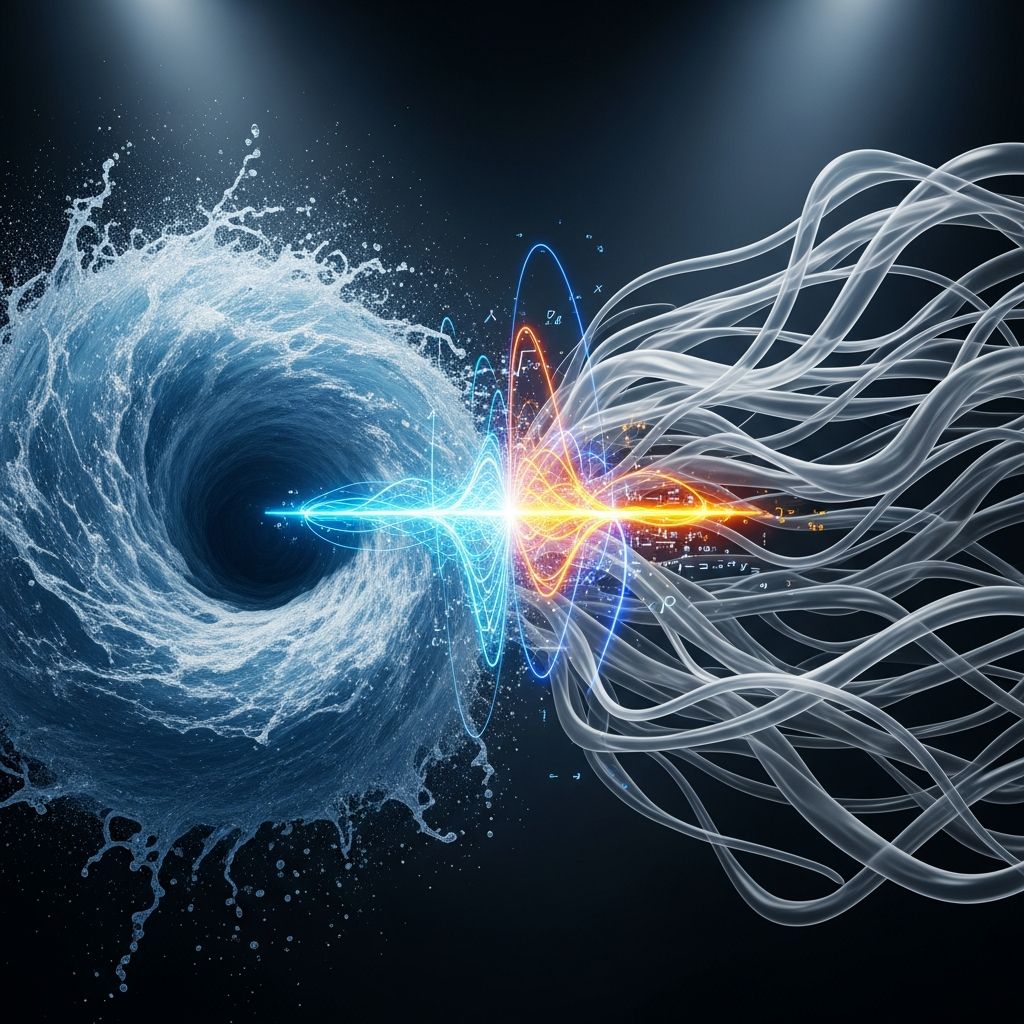
Fluid dynamics stands as a cornerstone of modern physics and engineering, delving into the behavior of liquids and gases as they move. This field examines how forces influence fluid flow, enabling innovations from aircraft design to blood circulation models. By understanding fluid motion, scientists and engineers predict and control phenomena ranging from ocean currents to airflow over wings.
Defining the Essence of Moving Fluids
At its core, fluid dynamics investigates how fluids—substances that deform continuously under shear stress, like water or air—respond to motion. Unlike solids, fluids cannot resist shear forces indefinitely and instead flow to adapt to their containers. This study calculates critical properties such as velocity, pressure, density, and temperature across space and time.
Key characteristics define fluids in motion. They exhibit viscosity, a measure of internal friction resisting flow, and can be compressible (density changes with pressure, e.g., gases) or incompressible (density constant, e.g., water). The continuum assumption treats fluids as continuous media, ignoring molecular discreteness for macroscopic analysis.
- Ideal fluids: Non-viscous, incompressible, with no friction—simplifying theoretical models.
- Real fluids: Possess viscosity, leading to energy dissipation and complex behaviors.
Fluid dynamics builds on fluid mechanics, focusing specifically on motion rather than static states. Its principles apply universally, from microscopic blood vessels to planetary atmospheres.
Foundational Principles and Conservation Laws
The bedrock of fluid dynamics rests on three conservation laws: mass, momentum, and energy. These axioms, rooted in classical mechanics, use the Reynolds transport theorem to track changes in control volumes—imaginary regions enclosing fluid flow.
| Law | Integral Form Insight | Differential Form |
|---|---|---|
| Conservation of Mass | Net mass flux into control volume equals rate of mass increase inside | Continuity equation: ρ remains constant for incompressible flow |
| Conservation of Momentum | Force balance equals momentum change rate | Navier-Stokes equations incorporating pressure and viscous forces |
| Conservation of Energy | Energy input/output matches internal energy change | First law of thermodynamics for fluids |
These laws manifest in two forms: integral for finite volumes and differential for point-wise analysis via Stokes’ theorem. Newton’s second law governs parcel dynamics, balancing inertial and viscous forces quantified by the Reynolds number (Re): Re = (ρ v L)/μ, where ρ is density, v velocity, L length scale, μ viscosity. Low Re (<<1) signals viscous-dominated creeping flow; high Re indicates inertia-driven turbulence.
Flow Regimes: From Smooth to Chaotic
Fluid motion splits into laminar and turbulent regimes, distinguished by streamline patterns. Laminar flow features smooth, parallel paths with velocity peaking centrally and slowing near walls due to viscosity. Turbulent flow shows chaotic eddies, mixing efficiently but increasing drag.
The equation of continuity ensures constant mass flow for incompressible fluids: A₁v₁ = A₂v₂, where A is cross-sectional area and v velocity. Narrowing pipes accelerate flow, as seen in hoses.
- Laminar: Predictable, low-speed; Re < 2000 in pipes.
- Turbulent: Unpredictable, high-speed; Re > 4000.
- Transitional: Unstable intermediate zone.
The boundary layer—a thin region near surfaces where velocity gradients are steep—arises from fluid ‘sticking’ (no-slip condition), affecting drag and heat transfer.
Bernoulli’s Principle: Linking Speed, Pressure, and Height
Daniel Bernoulli’s 1738 insight reveals an inverse speed-pressure relationship in steady, incompressible, inviscid flow along streamlines: P + (1/2)ρv² + ρgh = constant. Faster flow lowers pressure, explaining wing lift and Venturi effects.
Applications abound:
- Aviation: Low pressure atop wings generates lift.
- Medicine: Blood flow models in arteries.
- Industry: Carburetors and aspirators.
Limitations apply to real viscous flows, yet it approximates many scenarios effectively.
Mathematical Backbone: Navier-Stokes and Beyond
The Navier-Stokes equations encapsulate momentum conservation, coupling velocity fields with pressure and viscosity. For incompressible flow: ρ(Dv/Dt) = -∇P + μ∇²v + f, where Dv/Dt is material derivative. Solving these nonlinear partial differentials demands computational fluid dynamics (CFD) for complex geometries.
Simplifications include Euler equations (inviscid) and potential flow theory for irrotational cases. Turbulence modeling uses Reynolds-averaged Navier-Stokes (RANS) or large eddy simulations.
Real-World Applications Across Industries
Fluid dynamics powers diverse fields. In aerodynamics, it optimizes aircraft and vehicles for minimal drag. Hydrodynamics designs efficient ships and turbines harnessing water flow.
Environmental uses track pollutant dispersion and weather patterns. In biomedicine, it simulates cardiovascular flows, aiding stent design. Energy sectors leverage it for pipeline efficiency and wind farm layouts.
| Field | Key Application | Benefit |
|---|---|---|
| Aerospace | Wing design | Increased lift, fuel savings |
| Automotive | Airflow optimization | Reduced drag, better MPG |
| Weather Forecasting | Atmospheric modeling | Accurate predictions |
| Medicine | Blood flow analysis | Improved diagnostics |
Everyday examples include shower curtains sucked inward by low-pressure flow and smoke rising smoothly before billowing turbulently.
Advanced Topics: Turbulence and Computational Tools
Turbulence, with its multiscale vortices, remains fluid dynamics’ grand challenge. Transition hinges on Re, instabilities amplifying disturbances. Modeling employs k-ε or LES approaches in CFD software like ANSYS Fluent.
Multiphase flows (e.g., bubbly air-water) and non-Newtonian fluids (e.g., blood, paints) extend principles, incorporating volume fractions and shear-thinning.
Frequently Asked Questions (FAQs)
What distinguishes fluid dynamics from fluid statics?
Fluid dynamics studies moving fluids, while statics analyzes stationary ones, like pressure in submerged objects.
How does Reynolds number predict flow type?
Re compares inertia to viscosity: low for laminar, high for turbulent flows.
Why do airplanes fly according to Bernoulli?
Air speeds faster over curved wings, dropping pressure and creating upward lift force.
Can fluid dynamics explain ocean currents?
Yes, combining density gradients, wind stress, and Earth’s rotation via Coriolis effect.
What role does CFD play today?
CFD simulates complex flows numerically, essential for engineering without physical prototypes.
References
- Fluid dynamics – Wikipedia — Wikipedia contributors. 2026-04-01. https://en.wikipedia.org/wiki/Fluid_dynamics
- What Is Fluid Dynamics? | Live Science — Live Science. 2023-11-15. https://www.livescience.com/47446-fluid-dynamics.html
- Fluid Dynamics 101: Basics to Understanding How Fluids Flow — Electric Solenoid Valves. 2024-05-20. https://www.electricsolenoidvalves.com/blog/fluid-dynamics-101-basics-to-understanding-how-fluids-flow/
- Fluid Dynamics | Science | Research Starters — EBSCO. 2025-02-10. https://www.ebsco.com/research-starters/science/fluid-dynamics
- 14.7: Fluid Dynamics – Physics LibreTexts — OpenStax. 2024-08-01. https://phys.libretexts.org/Bookshelves/University_Physics/University_Physics_(OpenStax)/Book:_University_Physics_I_-_Mechanics_Sound_Oscillations_and_Waves_(OpenStax)/14:_Fluid_Mechanics/14.07:_Fluid_Dynamics
- 9.3: Fluid Dynamics – YouTube — Chad’s Prep. 2023-09-12. https://www.youtube.com/watch?v=k_eNLvijR0o

- Integrated M.A. in Applied Linguistics, University of Hyderabad
- 5+ years in editorial, instructional, SEO, and research-based writing
Sneha is a relationships and lifestyle writer with a strong foundation in applied linguistics and certified training in relationship coaching. She brings over five years of writing experience to theskillvault, crafting thoughtful, research-driven content that empowers readers to build healthier relationships, boost emotional well-being, and embrace holistic living. Her writing and insights reflect the belief that beauty, happiness, and wellness…