
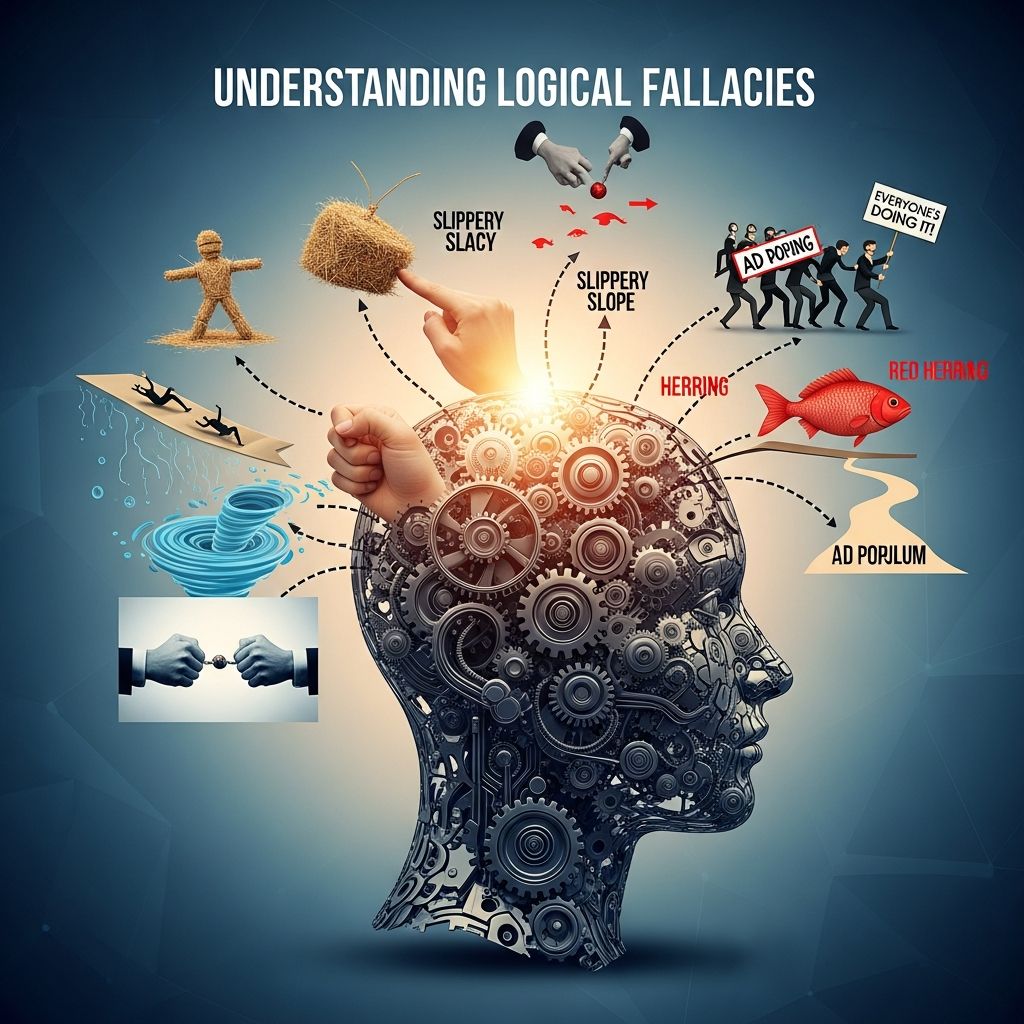
Logical fallacies represent fundamental errors in reasoning that undermine the validity of arguments, often appearing persuasive on the surface but collapsing under scrutiny. These flaws can occur unintentionally through poor logic or deliberately to manipulate opinions, making it crucial for effective communication and decision-making to recognize them.
Defining Logical Fallacies and Their Impact
At its core, a logical fallacy is a deceptive argument where the conclusion does not logically follow from the premises provided. Unlike factual inaccuracies, which can be corrected with evidence, fallacies involve structural defects in reasoning that render the entire claim unsupported. They pervade everyday discourse, from political speeches and advertisements to casual conversations, potentially leading to misguided beliefs and poor choices.
The impact of logical fallacies extends beyond individual arguments; they erode trust in public discourse and hinder problem-solving. For instance, in legal settings, spotting fallacies ensures fair trials by preventing irrelevant distractions from the evidence. In education and business, training in fallacy detection fosters clearer thinking and more productive collaborations.
Categorizing Errors in Logic: Formal vs. Informal
Logical fallacies divide into two primary categories: formal and informal. Formal fallacies stem from invalid logical structures, regardless of content, such as affirming the consequent (if A then B; B is true; therefore A is true). These are detectable through strict deductive analysis.
Informal fallacies, more common in natural language, arise from content issues like irrelevant premises or ambiguous terms. They subdivide into groups based on defects, including relevance (introducing unrelated points), presumption (assuming unproven facts), and ambiguity (shifting word meanings). Understanding this distinction helps in dissecting complex arguments systematically.
Common Relevance Fallacies That Derail Discussions
Relevance fallacies divert attention from the core issue by introducing extraneous elements. The red herring is a prime example, where an arguer shifts focus to an unrelated topic to evade the original point. For example, in a debate on climate policy, mentioning economic costs without evidence linking them directly might distract from environmental data.
Another is the ad hominem attack, targeting the person’s character instead of their argument. Claiming “You can’t trust her climate views because she’s a celebrity” ignores the substance of her evidence-based claims. These tactics exploit emotions over logic, common in heated exchanges.
- Red Herring: Introduces irrelevant topics to mislead.
- Ad Hominem: Attacks the arguer personally.
- Appeal to Popularity (Bandwagon): Argues a claim is true because many accept it, e.g., “Everyone buys this product, so it must be the best.”
Presumption Fallacies: Assuming the Unproven
Presumption fallacies build arguments on unestablished assumptions, begging the question by restating the conclusion as a premise. “This policy is unjust because it’s unfair” circularly assumes unfairness without proof.
The slippery slope presumes a minor action inevitably leads to extreme outcomes without causal evidence. “If we allow this small tax increase, soon we’ll have total government control” lacks demonstrated links between steps. Such arguments prey on fear, often seen in policy debates.
Appeal to Ignorance claims truth from absence of disproof: “No one has proven ghosts don’t exist, so they must be real.” This shifts the burden of proof improperly.
Ambiguity and Generalization Pitfalls
Ambiguity fallacies exploit vague language. Equivocation uses a word in multiple senses, like “He’s a real banker (reliable person) who works at the bank (financial institution), so trust his financial advice.”
Generalization errors overextend from limited samples. Hasty generalization jumps to broad conclusions from insufficient evidence: “I met two rude Parisians, so all French people are rude.” The opposite, straw man, misrepresents an opponent’s position for easy refutation: exaggerating a moderate stance as extreme.
| Fallacy | Description | Example |
|---|---|---|
| Hasty Generalization | Broad claim from small sample | “Two bad experiences mean all are bad.” |
| Straw Man | Distorts opponent’s view | “You want regulations? So you hate freedom!” |
| False Dichotomy | Forces false either/or choice | “You’re with us or against us.” |
Causation Errors: Mistaking Correlation for Cause
Fallacies of causation wrongly infer links. Post hoc ergo propter hoc assumes sequence implies causation: “I wore my lucky socks and won; the socks caused the win.” Cumulative errors like “gambler’s fallacy” expect random events to balance: “Red came up five times; black is due.”
These appear in pseudoscience and superstitions, underscoring the need for controlled evidence in claims of cause.
Real-World Applications: Fallacies in Media and Politics
In media, bandwagon fallacies fuel trends: “Millions use this diet; it works.” Politics employs slippery slopes against reforms and ad hominem against rivals. Recognizing these empowers voters and consumers.
Academic writing demands fallacy-free arguments; Purdue OWL emphasizes avoiding them for credible essays. Legal arguments, per Cornell’s Legal Information Institute, falter on fallacies like red herrings that distract juries.
Strategies to Detect and Avoid Logical Fallacies
To spot fallacies, question premises’ relevance and support for the conclusion. Ask: Does this logically follow? Is evidence provided? Tools like Scribbr’s lists aid identification.
- Examine structure: Valid form? Relevant content?
- Check for emotional appeals over facts.
- Seek counterexamples or alternative explanations.
- Practice with examples from daily life.
Avoiding fallacies involves clear premises, solid evidence, and addressing counterarguments directly. Critical thinking courses, often using resources like Purdue OWL, build these skills.
Frequently Asked Questions (FAQs)
What is the difference between a logical fallacy and a factual error?
A logical fallacy flaws the reasoning structure, while a factual error misstates evidence; the former invalidates the argument regardless of facts.
Are all informal fallacies intentional?
No, they can arise from sloppy thinking or language, though some are used deliberately to persuade.
How can I improve my argument to avoid fallacies?
Use evidence-based premises, define terms clearly, and test conclusions against alternatives.
Why are slippery slope arguments problematic?
They assume unproven chains of events without evidence linking steps, often invoking unfounded fears.
Can logical fallacies appear in writing?
Yes, especially in persuasive essays; academic guides stress rigorous logic for validity.
Building Stronger Arguments in Everyday Life
Mastering logical fallacies transforms debates, writing, and decisions. By dissecting arguments for flaws, individuals contribute to informed societies. Resources from universities like Purdue and Nevada-Reno offer exercises for practice. Ultimately, fallacy awareness promotes intellectual honesty and robust discourse.
References
- Logical Fallacies | Definition, Types, List & Examples — Scribbr. 2023-10-12. https://www.scribbr.com/fallacies/logical-fallacy/
- 15 Logical Fallacies to Know, With Definitions and Examples — Grammarly. 2024-05-15. https://www.grammarly.com/blog/rhetorical-devices/logical-fallacies/
- Logical Fallacy — Cornell Law School Legal Information Institute. 2023-01-01. https://www.law.cornell.edu/wex/logical_fallacy
- List of Fallacies — Wikipedia (for classification overview; primary sources preferred). 2026-04-01. https://en.wikipedia.org/wiki/List_of_fallacies
- Irrationally Yours—An Introduction to Logical Fallacies — American Academy of Actuaries. 2022-11-20. https://actuary.org/article/irrationally-yours-an-introduction-to-logical-fallacies/
- Logical Fallacies — Purdue OWL, Purdue University. 2024-09-10. https://owl.purdue.edu/owl/general_writing/academic_writing/logic_in_argumentative_writing/fallacies.html

- Integrated M.A. in Applied Linguistics, University of Hyderabad
- 5+ years in editorial, instructional, SEO, and research-based writing
Sneha is a relationships and lifestyle writer with a strong foundation in applied linguistics and certified training in relationship coaching. She brings over five years of writing experience to theskillvault, crafting thoughtful, research-driven content that empowers readers to build healthier relationships, boost emotional well-being, and embrace holistic living. Her writing and insights reflect the belief that beauty, happiness, and wellness…