
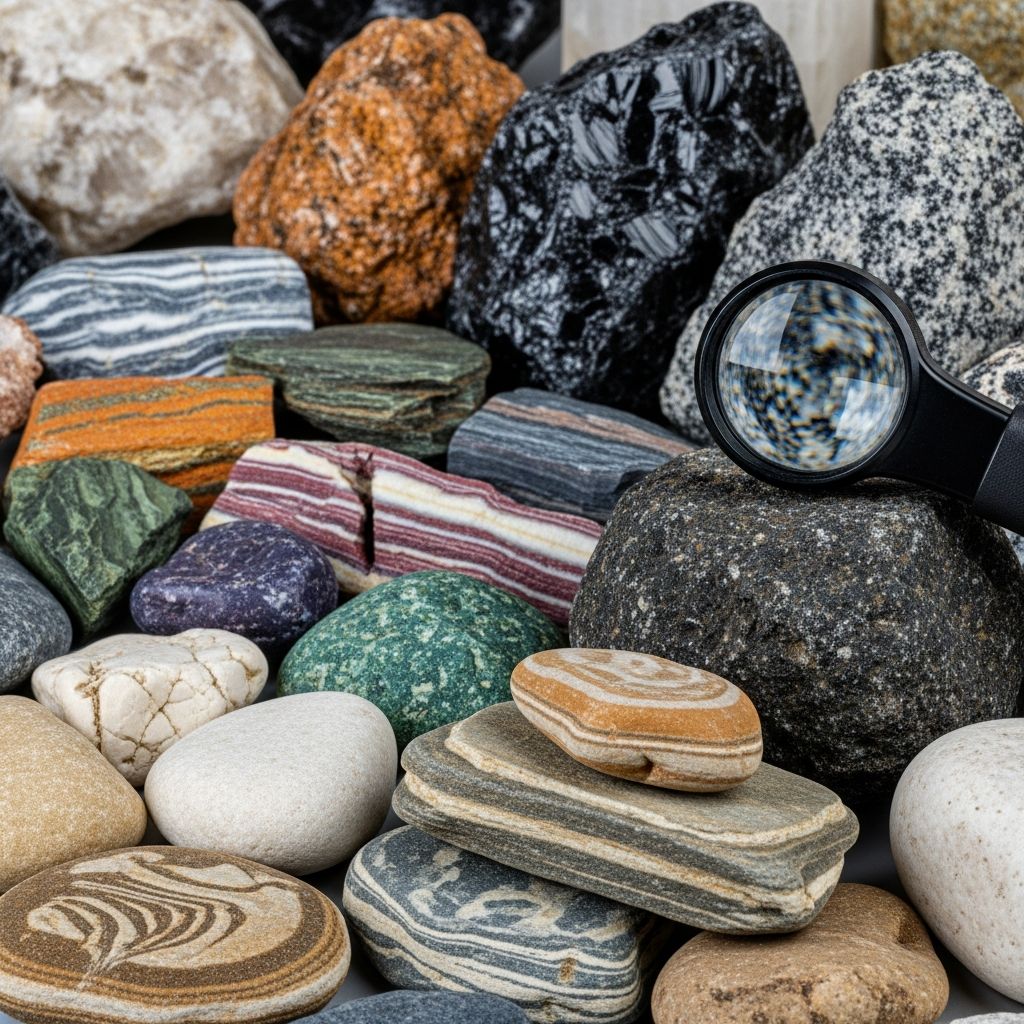
Identifying rocks and minerals is a fascinating skill that reveals the Earth’s hidden stories. By examining physical characteristics, anyone can distinguish between common specimens found in nature. This guide provides a structured approach using reliable properties like color, hardness, and texture.
Understanding Rocks Versus Minerals
Rocks form from natural processes and consist of one or more minerals, while minerals are uniform solids with specific chemical compositions and crystalline structures. Rocks are classified into igneous, sedimentary, and metamorphic types based on origin, whereas minerals are identified by intrinsic traits. Grasping this distinction is foundational for accurate analysis.
For instance, granite is an igneous rock made of quartz, feldspar, and mica minerals. Recognizing individual mineral components within rocks enhances overall identification.
Essential Tools for Field and Lab Work
Basic equipment simplifies rock study. Key items include:
- Streak plate: Unglazed porcelain tile for testing powder color.
- Hand lens or magnifying glass: 10x magnification reveals crystal details.
- Hardness kit: Common objects like fingernail (2.5), penny (3.5), and steel nail (6.5).
- Magnet: Detects iron-bearing minerals.
- Acid bottle: Dilute HCl for carbonate reactions.
These tools, often portable, enable on-site assessments without advanced lab access.
Step 1: Evaluate External Appearance
Begin with visual inspection. Note the sample’s size, shape, and overall form. Rocks may appear massive, layered, or vesicular (with gas bubbles). Minerals often display geometric crystals.
Color: While appealing, color varies due to impurities and is unreliable alone. Azurite consistently shows deep blue, but quartz ranges from clear to smoky. Use color as an initial clue.
| Mineral Example | Typical Color | Variability |
|---|---|---|
| Quartz | Clear, white | High (impurities cause colors) |
| Malachite | Green | Low |
| Hematite | Black to red | High |
Step 2: Test for Streak
Streak reveals the mineral’s true color when powdered. Rub the sample on a streak plate; the residue indicates identity. Hematite, varying from metallic gray to red, always yields a reddish streak.
White streaks are common for colorless minerals, so contrast with black streak plates for accuracy. This test outperforms visual color for many specimens.
Step 3: Assess Luster and Sheen
Luster describes light reflection: metallic (shiny like metal), vitreous (glassy), dull (earthy), or pearly. Galena has metallic luster, while kaolinite is dull.
- Metallic: Opaque, reflective (e.g., pyrite).
- Non-metallic: Subdivided into vitreous, resinous, greasy.
Observe under different lighting to confirm.
Step 4: Measure Hardness with Mohs Scale
Hardness gauges scratch resistance, standardized by the Mohs scale (1-10). Friedrich Mohs developed this in 1812, using reference minerals.
| Hardness | Reference Mineral | Common Test |
|---|---|---|
| 1 | Talc | Fingernail |
| 2.5 | Gypsum | Fingernail |
| 3.5 | Calcite | Penny |
| 5.5 | Apatite | Knife blade |
| 7 | Quartz | Steel file |
| 10 | Diamond | Only scratches itself |
Test progressively: if a penny scratches it, hardness is below 3.5. Quartz (7) scratches glass but not topaz (8).
Step 5: Examine Cleavage and Fracture
Cleavage is breakage along flat planes due to atomic structure. Count planes and angles: mica shows perfect basal cleavage (one plane), halite cubic (three at 90°).
Fracture occurs without cleavage: conchoidal (shell-like, e.g., quartz) or uneven. Not all minerals cleave; quartz fractures irregularly.
- Perfect cleavage: Smooth, mirror-like planes.
- Uneven fracture: Jagged breaks.
Step 6: Check Crystal Habit and Form
Crystal habit describes growth patterns: prismatic (elongated), tabular, acicular (needle-like), or botryoidal (grape-like clusters). Feldspar often forms blocky crystals, aiding rock classification.
Habits persist despite size variations, revealing mineral identity.
Step 7: Additional Diagnostic Tests
Specific Gravity: Density relative to water. Galena (7.5) feels heavy; use water displacement for precision.
Magnetism: Magnetite attracts magnets strongly.
Effervescence: Calcite fizzes with dilute acid due to CO2 release, indicating carbonates.
Combine tests for confirmation; no single property suffices.
Identifying Major Rock Types
Igneous Rocks
Formed from cooled magma. Coarse-grained (plutonic, e.g., granite with visible quartz/feldspar) vs. fine-grained (volcanic, e.g., basalt). Glassy textures in obsidian.
Sedimentary Rocks
Layered from sediments. Clastic (sandstone), chemical (limestone), or biogenic. Grains visible under magnification; no interlocking crystals.
Metamorphic Rocks
Altered by heat/pressure. Foliated (gneiss with banded minerals, schist with mica layers) or non-foliated (marble from limestone).
Use a hand lens to differentiate crystals (igneous/metamorphic) from grains (sedimentary).
Practical Field Techniques
Collect ethically: note location, avoid protected areas. Clean samples gently. Photograph from multiple angles with scale. Cross-reference with field guides post-testing.
USGS notes photos alone insufficient; hands-on examination essential.
Common Mistakes to Avoid
- Relying solely on color.
- Ignoring context (location informs likelihood).
- Confusing rocks with minerals.
- Overlooking magnification for texture.
Frequently Asked Questions (FAQs)
What is the first property to test on a new rock?
Start with color and luster for quick clues, then streak and hardness for reliability.
Can I identify rocks without tools?
Limited to basic visuals like texture and layering, but tools like a fingernail for hardness greatly improve accuracy.
How do I tell limestone from marble?
Both fizz with acid; limestone has grains/fossils, marble shows crystals and foliation.
Is streak always different from color?
No, but for variable minerals like hematite, streak is consistent and diagnostic.
Why use Mohs scale over others?
It’s simple, uses common references, and field-friendly despite not being linear.
Advanced Tips for Collectors
Join local geology clubs for hands-on workshops. Use apps for preliminary IDs, but verify with physical tests. Label collections with properties and origin for reference.
Expand to fluorescence or UV response for rare minerals, though basic properties cover 90% of common finds.
References
- Identifying Rocks and Minerals – Using Physical Properties — Miacademy & MiaPrep Learning Channel. 2023. https://www.youtube.com/watch?v=M4rzNUZFV4w
- Glad You Asked: How Do Geologists Identify Minerals? — Utah Geological Survey. 2023-10-01. https://geology.utah.gov/map-pub/survey-notes/glad-you-asked/how-do-geologists-identify-minerals/
- How to Identify Rocks — YouTube (Educational Video). 2023. https://www.youtube.com/watch?v=cyBLmW5k06c
- Practical Rock & Mineral Identification — Currently Rockhounding. 2024-01-15. https://currentlyrockhounding.com/practical-rock-mineral-identification/
- Identifying Minerals — Geoscience Australia via Google Arts & Culture. 2023. https://artsandculture.google.com/story/identifying-minerals-geoscience-australia/QgXh9pyyxhIYKQ?hl=en
- Rock Key — Mineralogical Society of America. 2022-05-20. http://www.minsocam.org/msa/collectors_corner/id/rock_key.htm
- Can you identify my rock or mineral? — U.S. Geological Survey. 2025-03-12. https://www.usgs.gov/faqs/can-you-identify-my-rock-or-mineral

Medha Deb is an editor with a master's degree in Applied Linguistics from the University of Hyderabad. She believes that her qualification has helped her develop a deep understanding of language and its application in various contexts. Medha specializes in the areas of beauty, health, sports, and wellness and is committed to ensuring that the content on the website is…