
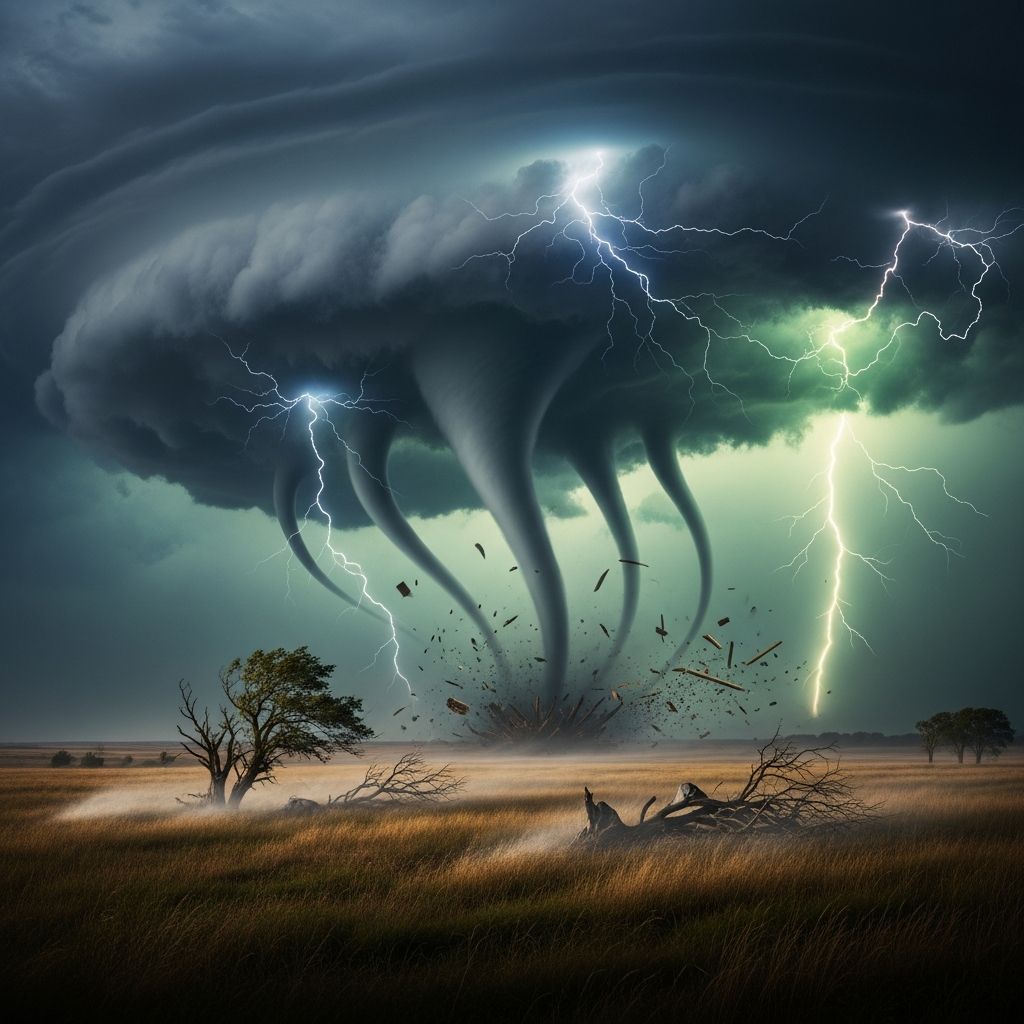
Tornadoes produce some of the most frightening natural sounds on Earth, often described in vivid terms by survivors and meteorologists alike. These powerful vortices generate a symphony of noise that can serve as a critical warning for those in their path.
The Science Behind Tornado Noises
The acoustics of a tornado stem from its intense wind speeds and the chaotic interaction with the environment. At the core, high-velocity winds create low-frequency rumbles as air rushes into the vortex, much like the inflow jet feeding the base of the twister. Factors such as the tornado’s size, strength, and proximity dramatically alter the sound profile.
- Wind Shear Dynamics: Rotational winds exceeding 200 mph produce continuous vibrations that propagate as deep, resonant booms.
- Debris Interaction: Objects caught in the funnel amplify noise through collisions and friction.
- Scale Variations: Larger, multi-vortex tornadoes emit broader frequency ranges compared to slender rope tornadoes.
Meteorological research indicates that the primary sound waves are infrasonic, below human hearing thresholds, but the audible components dominate close encounters.
Common Descriptions from Survivors
Individuals who have faced tornadoes firsthand offer consistent yet varied accounts of the auditory assault. The most prevalent comparison is to a freight train barreling nearby, capturing the relentless rumble.
| Description | Common Analogies | Associated Conditions |
|---|---|---|
| Continuous Rumble | Freight train, distant thunder | Approaching from afar |
| Loud Whoosh | Waterfall, open car windows at high speed | Intensifying inflow jet |
| Deafening Roar | Jets taking off, hellish cacophony | Direct overhead passage |
| Explosive Cracks | Power lines snapping, trees breaking | Urban or forested areas |
James Martinez, a resident of Bowie, Maryland, endured an EF-1 tornado that brought a tree crashing through his home. He described a ‘loud rumbling noise’ followed by a ‘huge boom,’ underscoring how secondary effects like structural failures contribute to the terror.
Differentiating Tornado Sounds from Other Storms
Not all severe weather roars signal a tornado; distinguishing them can mean the difference between sheltering unnecessarily and missing a real threat. Thunderstorms produce sharp cracks and rolling booms, while tornadoes maintain a steadier, more ominous undertone.
- Thunderstorm: Intermittent peals with pauses.
- Tornado: Uninterrupted freight-train grind, escalating steadily.
- Hail: Pattering or thudding on surfaces, often preceding wind noise.
Storm chasers like those in Crowell, Texas, noted the distinct ‘inflow jet’ sound—air sucking into the tornado’s base—setting it apart from mere gust fronts.
Historical Accounts and Recent Outbreaks
Tornado sounds have echoed through history, from the 1936 Gainesville, Georgia outbreak to modern events. In April 2024, a massive twister near Minden, Iowa, unleashed a ‘deafening roar’ that left chasers in stunned silence, likened to a waterfall by meteorologist Andrew Pritchard.
Another harrowing recording from Westmoreland, Kansas, on April 30, 2024, captured what storm chaser Aaron Jayjack called the ‘scariest tornado sound ever,’ a raw, escalating fury that defined his career’s most intense chase.
Warnings: Sirens, Alerts, and Auditory Cues
Beyond natural sounds, modern technology provides lifesaving auditory warnings. Tornado sirens wail in piercing cycles, while apps like FOX Weather deliver push notifications. Always prioritize official Tornado Warnings over ambient noises.
- Seek shelter immediately upon hearing sirens or alerts.
- Recognize escalating rumbles as secondary confirmation.
- Avoid windows to mitigate debris risks amplified by sound-induced panic.
Acoustic Analysis: What Recordings Reveal
Advancements in audio capture by storm chasers offer scientific insights. Spectrograms of tornado audio show dominant low-frequency peaks around 50-100 Hz, aligning with freight train vibrations. These recordings demystify the ‘voice of the tornado,’ proving its consistency across events.
In urban settings, debris multiplies noise levels, creating a ‘tremendous roar’ that mimics a strong thunderstorm but with unrelenting intensity.
Safety Strategies When You Hear the Roar
Hearing a tornado approach demands swift action. The sound often provides mere seconds to minutes of warning, so preparation is key.
- Interior Shelter: Lowest level, away from windows—bathtub or closet ideal.
- Protective Gear: Helmets or pillows shield against flying objects.
- Community Plans: Drills ensure families respond cohesively to siren or rumble cues.
Post-event, the eerie silence following the roar signals the all-clear, but structural assessments are crucial.
Frequently Asked Questions (FAQs)
Do all tornadoes sound the same?
No, sounds vary by size, location, and intensity. Rural twisters may rumble quietly, while urban ones roar from debris.
Can you hear a tornado from miles away?
Rarely; the characteristic rumble becomes audible within 1-2 miles, depending on terrain and wind.
Why do tornadoes sound like trains?
The steady, powerful chug of wind and debris mimics a train’s rhythmic roar on tracks.
Is the freight train sound always present?
Not exclusively; some report whooshes or jets, but train analogy is most common.
What should I do if I hear tornado noises without sirens?
Monitor weather apps or radio for confirmation and seek shelter preemptively.
Psychological Impact of Tornado Sounds
The primal fear triggered by these sounds is evolutionary, alerting humans to imminent danger. Studies on disaster survivors note heightened PTSD risks from auditory trauma, emphasizing mental health support post-event.
Training ears to recognize patterns through simulations can reduce panic, turning sound from foe to ally in survival.
References
- What do tornadoes sound like? — FOX Weather. 2024-04-26. https://www.foxweather.com/learn/what-do-tornadoes-sound-like
- Hear the ROAR of a Tornado – YouTube — Meteorologist Andrew Pritchard. 2024-04-26. https://www.youtube.com/watch?v=khnrV1JFYLA
- Scariest Tornado Sound Ever Recorded RAW AS IT HAPPENED — Jayjack Storm Trax. 2024-04-30. https://www.youtube.com/watch?v=kCHtyXWvtas
- Tornado Basics — NOAA Storm Prediction Center. 2023-05-15. https://www.spc.noaa.gov/faq/tornado/

Medha Deb is an editor with a master's degree in Applied Linguistics from the University of Hyderabad. She believes that her qualification has helped her develop a deep understanding of language and its application in various contexts. Medha specializes in the areas of beauty, health, sports, and wellness and is committed to ensuring that the content on the website is…