
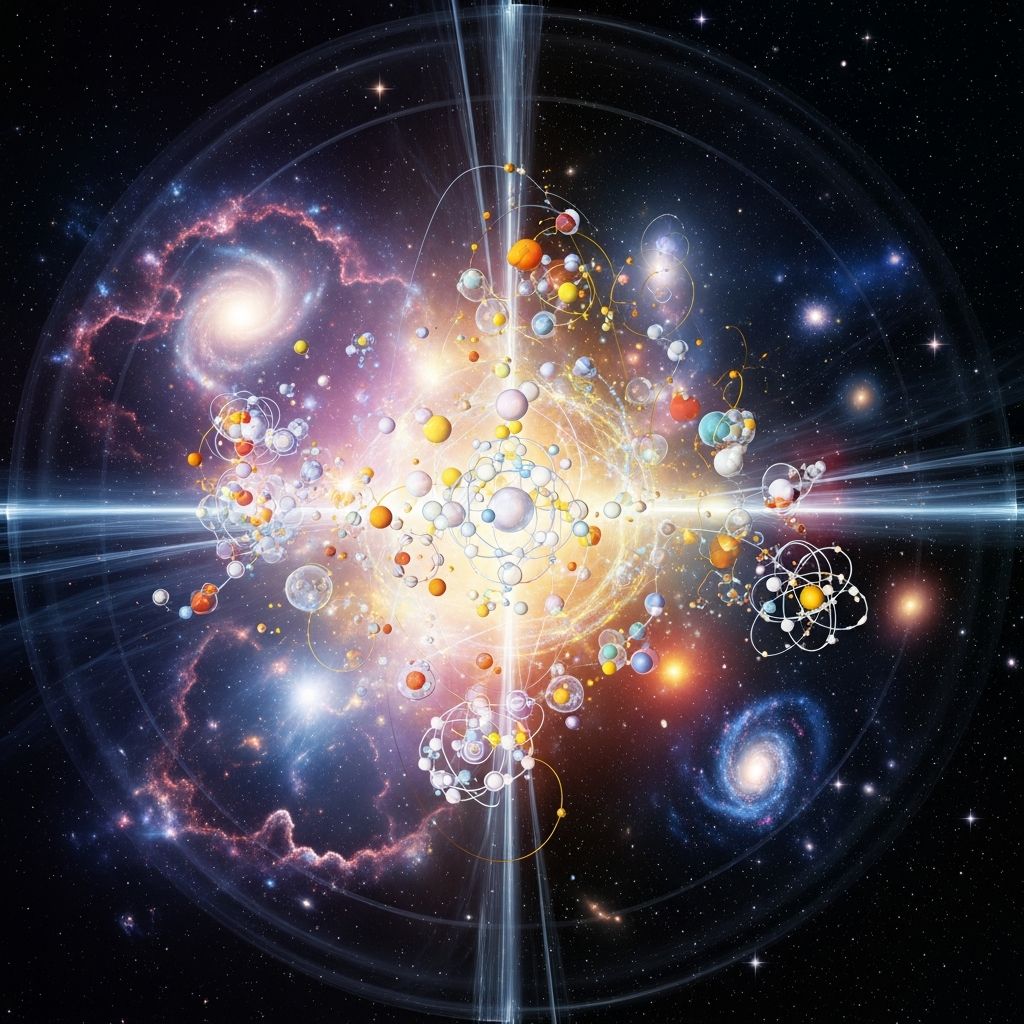
Matter forms the tangible foundation of the universe, encompassing everything from microscopic particles to vast celestial bodies. Defined as any substance with mass that occupies space, it underpins all physical phenomena we observe daily.
Core Definition and Fundamental Properties
At its essence, **matter** is material substance characterized by two primary properties: mass and volume. Mass quantifies the amount of matter in an object, resisting changes in motion, while volume measures the space it occupies. These attributes distinguish matter from energy, though they interplay in forming reality.
Physical objects, whether a rock or a cloud, consist of matter composed ultimately of atoms and molecules. This classical view, rooted in physics and chemistry, holds that anything touchable or measurable possesses these traits.
- Mass: Intrinsic property measured in kilograms, determining gravitational pull.
- Volume: Three-dimensional extent, calculable via displacement or geometric formulas.
- Inertia: Tendency to maintain motion or rest, tied to mass.
Building Blocks: From Particles to Atoms
Matter’s structure descends to elementary levels. **Quarks** and **leptons**—fundamental fermions—combine to form protons, neutrons, and electrons. Quarks cluster into protons and neutrons (baryons), which with electrons form atoms, the basic units of elements.
Atoms feature a nucleus of protons and neutrons orbited by electrons. Protons carry positive charge, electrons negative, and neutrons neutrality, ensuring atomic stability. There are 118 known element types, each defined by proton count.
| Particle | Type | Role in Matter |
|---|---|---|
| Quarks | Fermion | Form protons/neutrons |
| Leptons (e.g., Electron) | Fermion | Orbit nucleus |
| Protons | Hadron | Nucleus, define element |
| Neutrons | Hadron | Nucleus, stabilize |
Molecules arise when atoms bond, like H₂O from hydrogen and oxygen, creating compounds. Bulk matter—tables, air, oceans—results from vast atom/molecule aggregates.
States of Matter: Diverse Manifestations
Matter manifests in multiple **states** or phases, transitioning via energy changes like heating or cooling. The primary states are solid, liquid, gas, and plasma, each with distinct particle arrangements.
- Solid: Fixed shape/volume; particles vibrate in lattice.
- Liquid: Fixed volume, fluid shape; particles slide past each other.
- Gas: Neither fixed shape/volume; particles move freely, far apart.
- Plasma: Ionized gas; charged particles conduct electricity, common in stars.
Phase transitions—melting, boiling—involve breaking intermolecular forces. For instance, ice to water requires added heat energy.
Advanced Perspectives: Beyond Classical Matter
Modern physics refines definitions. **Ordinary matter** (baryonic) comprises ~5% of the universe, made of atoms. Dark matter, inferred from gravitational effects, lacks electromagnetic interaction but influences galaxies. (Note: While not directly observable, its existence is supported by cosmic microwave background data.)
Quantum views treat matter as wave-particle duality, but macroscopically, it retains mass-volume traits. Antimatter, with opposite-charged particles like positrons, mirrors matter properties.
Properties and Measurable Characteristics
Matter exhibits **physical properties** (density, color, melting point) and **chemical properties** (reactivity, flammability). Density, mass per volume, exemplifies this: ρ = m/V.
Extensive properties scale with quantity (mass, volume); intensive remain constant (density, temperature). These aid identification and classification.
Matter in the Cosmos: Scale and Composition
The observable universe is predominantly matter and energy. Stars, planets, and interstellar gas are atomic matter. Elements form via nucleosynthesis: hydrogen/helium from Big Bang, heavier via fusion.
Everyday examples abound: water (liquid molecule), diamond (solid carbon lattice), air (gas mixture), lightning (plasma).
Historical Evolution of Matter Concept
Ancient philosophers posited basic substances (earth, air, fire, water). John Dalton’s 1808 atomic theory proposed indivisible atoms of varying masses, birthing modern chemistry.
20th-century quantum mechanics and Standard Model revealed quarks/leptons, expanding definitions to include exotic states like Bose-Einstein condensates at near-absolute zero.
Practical Implications and Experiments
Understanding matter drives technology: semiconductors from doped silicon atoms, plasmas in fusion research. Simple home experiments confirm properties—e.g., air’s matter status via balloon displacement.
- Fill balloon: Feels mass, occupies space.
- Measure ice melt: Volume change proves phase shift.
- Observe evaporation: Liquid to gas transition.
Frequently Asked Questions (FAQs)
What is the simplest definition of matter?
Matter is any substance with mass that occupies space, including solids, liquids, gases, and plasmas.
Are light and sound matter?
No, light is electromagnetic energy without rest mass; sound is pressure waves in matter, not matter itself.
What fraction of the universe is ordinary matter?
About 5%, with dark matter (~27%) and dark energy (~68%) comprising the rest, per cosmic observations.
Can matter be created or destroyed?
In chemical reactions, no—conserved per law of conservation of mass. Nuclear reactions convert mass to energy (E=mc²).
What are exotic states of matter?
Bose-Einstein condensates, quark-gluon plasma; achieved under extreme conditions like ultra-low temperatures or high energies.
Conclusion: Matter’s Enduring Mystery
Matter’s study reveals the universe’s intricacy, from quark dances to galactic structures. Ongoing research into dark components promises deeper insights, affirming matter’s central role.
References
- Matter | Definition, Physics, Characteristics, States, Examples, & Facts — Encyclopædia Britannica. 2023-10-12. https://www.britannica.com/science/matter
- Matter (physics) | Physics | Research Starters — EBSCO. 2024-01-15. https://www.ebsco.com/research-starters/physics/matter-physics
- Matter — Wikipedia (informed primary sources). 2026-04-01. https://en.wikipedia.org/wiki/Matter
- What is Matter? Science for Kids — STEAM Powered Family. 2023-05-20. https://www.steampoweredfamily.com/what-is-matter/
- 3.2: What is Matter? — Chemistry LibreTexts. 2024-08-10. https://chem.libretexts.org/Bookshelves/Introductory_Chemistry/Introductory_Chemistry_(LibreTexts)/03:_Matter_and_Energy/3.02:_What_is_Matter
- What is Matter? — U.S. Nuclear Regulatory Commission. 2022-11-05. https://www.nrc.gov/reading-rm/basic-ref/students/science-101/what-is-matter
- What is matter? It’s not as basic as you’d think. — Popular Science. 2023-09-18. https://www.popsci.com/science/what-is-matter/

Medha Deb is an editor with a master's degree in Applied Linguistics from the University of Hyderabad. She believes that her qualification has helped her develop a deep understanding of language and its application in various contexts. Medha specializes in the areas of beauty, health, sports, and wellness and is committed to ensuring that the content on the website is…