
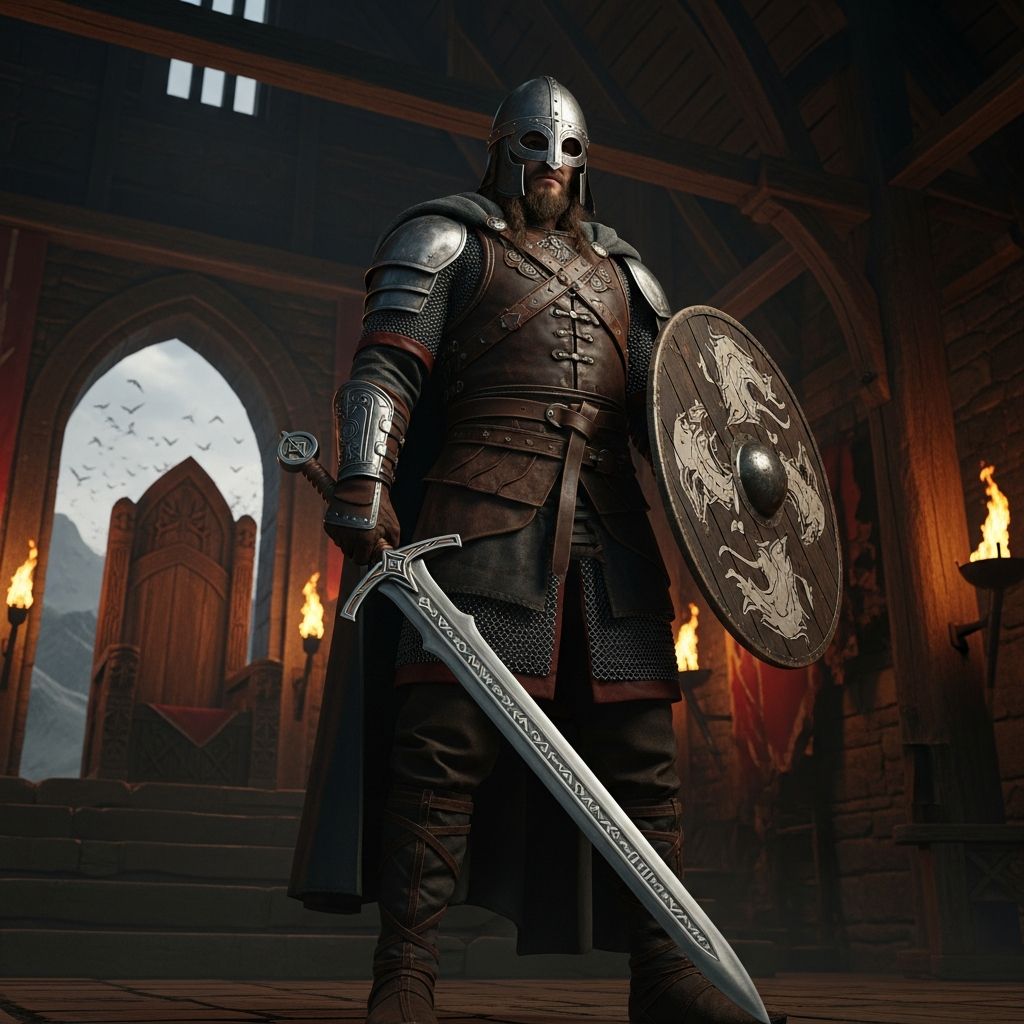
The Foundations of Western Epic Literature
Beowulf represents one of the most significant achievements in the history of European literature, standing as the oldest known work of considerable length composed in a Germanic language. This monumental poem, crafted by an anonymous Old English poet between the 8th and 11th centuries, captures the essence of early medieval warrior culture and provides invaluable insights into the values, fears, and aspirations of Anglo-Saxon society. The narrative unfolds across three major conflicts that chronicle the evolution of its protagonist from an ambitious young warrior to a wise but aging king, creating a comprehensive portrait of heroism across different life stages.
The poem’s setting in pagan Scandinavia during the 5th and 6th centuries grounds the narrative in a specific historical period while maintaining a timeless quality that has resonated with readers across more than a millennium. Through the adventures of Beowulf and his struggles against supernatural adversaries, the poem explores fundamental human concerns: the nature of courage, the bonds of loyalty, the inevitability of mortality, and the search for enduring glory.
The Tripartite Structure: Three Battles Defining a Hero’s Arc
The architecture of Beowulf revolves around three distinct confrontations, each marking a crucial chapter in the protagonist’s life. This tripartite structure allows the poet to examine heroism from multiple perspectives and demonstrates how the values of courage and honor remain constant even as physical capabilities inevitably decline with age.
The Initial Conflict with Grendel
The poem opens in Denmark, where King Hrothgar has constructed Heorot, a magnificent mead hall symbolizing prosperity, civilization, and community. Within this space of celebration and joy, Hrothgar’s warriors gather to feast, sing, and reaffirm their bonds of fellowship. However, this jubilation attracts the attention of Grendel, a monstrous creature living in the surrounding swamplands, whose nature appears fundamentally incompatible with human merriment and social connection. The noise and happiness of Heorot torment Grendel, driving him to launch a campaign of terror against the Danish people.
For twelve years, Grendel conducts relentless nighttime assaults on the great hall, abducting and consuming Hrothgar’s warriors. The Danish warriors prove powerless against this supernatural threat, and the king’s mead hall, once a center of celebration, becomes a place of dread. The psychological weight of this prolonged threat weighs heavily on the entire kingdom. When word of this calamity reaches the young warrior Beowulf of the Geats, he recognizes an opportunity to achieve lasting renown by accepting a challenge that has defeated all previous defenders.
Beowulf sails to Denmark with a small company of warriors and arrives at Heorot with characteristic confidence, famously recounting his past achievements in combat. When Grendel finally arrives for another nocturnal assault, Beowulf demonstrates his supernatural strength by wrestling the monster unarmed, refusing to employ weapons despite the creature’s ferocity. In an extraordinary display of raw power, Beowulf tears Grendel’s arm from its socket. Mortally wounded, the monster retreats to its swampy lair where it perishes. The severed arm, hung as a trophy in Heorot, symbolizes Beowulf’s victory and the restoration of safety to the Danish people.
The Secondary Trial: Confronting Maternal Vengeance
Beowulf’s initial triumph appears to signal the complete resolution of the kingdom’s troubles, yet the poet introduces an unexpected complication that deepens the narrative’s complexity. Grendel’s mother, driven by grief and rage over her son’s death, emerges from the darkness to exact revenge. She attacks Heorot in the night, murdering Aeschere, one of Hrothgar’s most valued advisers and closest companions, before vanishing into the murk from which she came.
This second conflict represents an escalation in the poem’s stakes. Where Grendel attacks indiscriminately, his mother conducts a targeted assassination that demonstrates intelligence, calculation, and deliberate malice. She forces Beowulf and his company to pursue her to her underwater lair, a daunting prospect that tests not merely physical courage but also the hero’s willingness to venture into alien, hostile environments. In her subaqueous cave at the bottom of a murky mere, Beowulf engages in a fierce struggle with Grendel’s mother, ultimately prevailing through the discovery of a giant’s sword hanging within her domain. After killing her, Beowulf discovers Grendel’s corpse and severs the head, which he carries back to Heorot as proof of his achievement.
The magical sword’s blade melts away due to the heat of the monster’s corrupt blood, leaving only the ornamental hilt as a physical relic of the encounter. This detail subtly reminds readers that supernatural forces operate according to laws beyond ordinary understanding, and that even the greatest weapons are ultimately temporary.
The Final Confrontation: Age, Duty, and the Dragon
Fifty years pass after Beowulf’s victories over Grendel and his mother. The hero returns to his homeland, eventually becomes king of the Geats, and rules his people wisely for decades. His early reputation as a monster-slayer transforms into a legacy of measured, effective kingship. However, fate brings one final trial: a slave steals a golden goblet from the hoard of an ancient dragon, and the enraged creature emerges to punish this transgression through wholesale destruction. The dragon systematically burns Geatish villages, spreading terror and devastation across the kingdom.
Recognizing that his people face existential threat, the aging Beowulf resolves to confront the dragon despite his diminished physical capabilities and the near-certainty of his death. Unlike his youthful exuberance in facing Grendel, this final battle reflects a mature warrior’s acceptance of fate and duty. Accompanied by a contingent of warriors, including his young kinsman Wiglaf, Beowulf engages the dragon in a prolonged and brutal struggle markedly different from his earlier victories.
The dragon proves far more formidable than either Grendel or the monster’s mother, possessing both strength and intelligence combined with lethal fire-breathing capability. As the battle progresses, all of Beowulf’s retainers except Wiglaf abandon their lord in fear, violating the sacred bond of loyalty known as comitatus. Wiglaf’s steadfast presence represents the ideal of warrior loyalty, standing in sharp contrast to the cowardice of his companions. Together, Beowulf and Wiglaf slay the dragon, but the creature delivers a mortal wound to Beowulf before its death. The aging king dies moments after achieving victory, his life’s final achievement secured through sacrifice.
Thematic Foundations of Heroic Culture
The Heroic Code and Comitatus
At the philosophical core of Beowulf lies the Germanic heroic code, a system of values that prioritizes courage, loyalty, and honor above all other considerations. The concept of comitatus—the mutual obligation binding warriors to their lord—forms the cement holding warrior society together. A thane (warrior) owed absolute loyalty and willingness to die for his lord, while the lord in turn provided protection, treasure, and the opportunity for glory. When Beowulf’s warriors flee from the dragon, Wiglaf condemns them as violators of this sacred compact, fundamentally reproaching them for their betrayal. This critique underscores how central comitatus remained to Anglo-Saxon warrior identity.
Mortality and the Quest for Eternal Glory
Beowulf grapples persistently with the inevitability of human mortality and the means by which individuals transcend death through lasting renown. The poem emphasizes that physical death, while unavoidable, need not signal the termination of a person’s influence or memory. Warriors seek to achieve deeds sufficiently remarkable that subsequent generations continue to recount them, effectively achieving a form of immortality through remembered glory. Beowulf’s willingness to face the dragon despite certainty of death reflects his understanding that glory-seeking provides meaning transcending mere biological survival.
Civilization Versus Chaos
The poem repeatedly contrasts spaces of human civilization and order with realms of chaos and monstrosity. Heorot embodies civilization—a space of feasting, music, fellowship, and social bonding—while the swamp where Grendel dwells represents chaos, darkness, and alienation from human community. The underwater mere where Grendel’s mother resides further emphasizes the alien nature of the monsters, existing in environments fundamentally removed from human settlement. By vanquishing these creatures, Beowulf temporarily expands the domain of human civilization, though the cyclical nature of the poem suggests such victories remain provisional against the forces of darkness.
Historical and Cultural Significance
Beowulf provides scholars with invaluable evidence regarding Anglo-Saxon warrior culture, social structures, and belief systems. The poem preserves descriptions of mead halls, warfare practices, gift-giving customs, and the intricate social hierarchies that governed early medieval Germanic societies. While the events described occurred in legendary pagan Scandinavia, the poem’s composition and preservation occurred within Christian Anglo-Saxon England, creating fascinating tensions between pagan warrior ethos and Christian morality that permeate the narrative.
The manuscript itself possesses remarkable historical interest. Only a single copy survives, preserved through what appears to be fortunate circumstance rather than deliberate effort. This single manuscript nearly perished in a fire at Ashburnham House in 1731, damaging its edges and rendering some passages illegible. Had this fire spread slightly differently, one of the world’s most important literary works might have vanished entirely.
The Language and Composition of an Epic
Beowulf employs alliterative verse, a poetic technique where successive words begin with the same consonant sound rather than rhyming at line endings. This alliterative structure differs markedly from Romance language poetry traditions that emphasize rhyming couplets or regular meter. The Germanic alliterative tradition creates a distinctive aesthetic with its own musicality and rhythmic patterns. The poet demonstrates sophisticated control over this demanding form while simultaneously developing complex narrative structures and psychological characterization.
The poem’s vocabulary draws heavily on the semantic resources of Old English, employing kennings—metaphorical compounds combining two words to create novel meanings—to describe warriors, battles, and emotions. A sword might be called a “bone-biter” or a warrior a “shield-bearer,” creating vivid imagery through imaginative linguistic compression.
Character Development and Psychological Depth
Beyond the surface narrative of monster-slaying adventures, Beowulf explores complex psychological and emotional dimensions. Hrothgar’s desperation and humiliation in the face of Grendel’s predation receive sympathetic treatment; the king’s inability to protect his own people weighs heavily upon him. Beowulf’s youthful confidence gradually gives way to mature wisdom and acceptance of mortality. Even the monsters possess psychological complexity—Grendel’s rage seems rooted in alienation and inability to participate in human joy, suggesting layers of tragedy beneath the surface monstrosity.
Frequently Asked Questions
Q: When was Beowulf composed, and how do scholars date the poem?
A: Beowulf was written by an anonymous poet between the 8th and 11th centuries, with most scholars favoring composition in the 8th century. Dating relies on linguistic analysis, manuscript evidence, and historical references within the text rather than definitive documentation of authorship or composition date.
Q: How long is the complete Beowulf poem?
A: Beowulf is the longest known work of considerable length in Old English, containing over 3,000 lines of alliterative verse. Complete reading typically requires several hours depending on translation quality and whether accompanying scholarly apparatus accompanies the text.
Q: Are there any reliable modern translations of Beowulf available?
A: Numerous translations exist, ranging from highly literal renderings preserving Old English alliterative patterns to more freely adapted contemporary versions. Respected translations include those by Seamus Heaney, Maria Dahvana Headley, and Stephen Mitchell, each presenting distinct approaches to bridging the linguistic and cultural gap between Old English and modern readers.
Q: What happened to Wiglaf after Beowulf’s death?
A: The poem indicates that Beowulf requested Wiglaf to rule after him, though the text provides limited detail regarding Wiglaf’s subsequent reign or the fate of the Geatish kingdom. The poem concludes by noting that a messenger warns of difficult times ahead for the Geats without their legendary hero.
Q: Why does the dragon attack if the goblet was merely stolen by a slave?
A: The dragon’s extreme reaction illustrates how deeply dragons in Germanic tradition are bound to their treasures. Any violation of the hoard, regardless of the perpetrator’s status or motivation, triggers violent retaliation. The dragon’s possessiveness represents an extreme version of greed and demonstrates how attachment to material wealth can consume a being entirely.
Q: Is Beowulf based on historical events or entirely fictional?
A: The poem blends elements potentially rooted in historical memory with entirely legendary and supernatural components. Figures like Hrothgar and Hygelac may reference real historical rulers, while the monsters and some battles appear wholly fictional. The poem functions as legendary narrative rather than historical chronicle.
References
- Beowulf | Summary, Poem, Characters, Monster, Analysis, & Facts — Britannica. Accessed April 2026. https://www.britannica.com/topic/Beowulf
- Beowulf: Full Poem Summary — SparkNotes. https://www.sparknotes.com/lit/beowulf/summary/
- Beowulf — Wikipedia. Accessed April 2026. https://en.wikipedia.org/wiki/Beowulf
- Beowulf Summary & Analysis — American Literature. https://americanliterature.com/author/anonymous/book/beowulf/summary
- Beowulf by Anonymous Plot Summary — LitCharts. https://www.litcharts.com/lit/beowulf/summary
- Video: Beowulf Story | Characters, Summary & Analysis — Study.com. https://study.com/learn/lesson/video/beowulf-old-english-story-summary-characters.html

- Integrated M.A. in Applied Linguistics, University of Hyderabad
- 5+ years in editorial, instructional, SEO, and research-based writing
Sneha is a relationships and lifestyle writer with a strong foundation in applied linguistics and certified training in relationship coaching. She brings over five years of writing experience to theskillvault, crafting thoughtful, research-driven content that empowers readers to build healthier relationships, boost emotional well-being, and embrace holistic living. Her writing and insights reflect the belief that beauty, happiness, and wellness…