
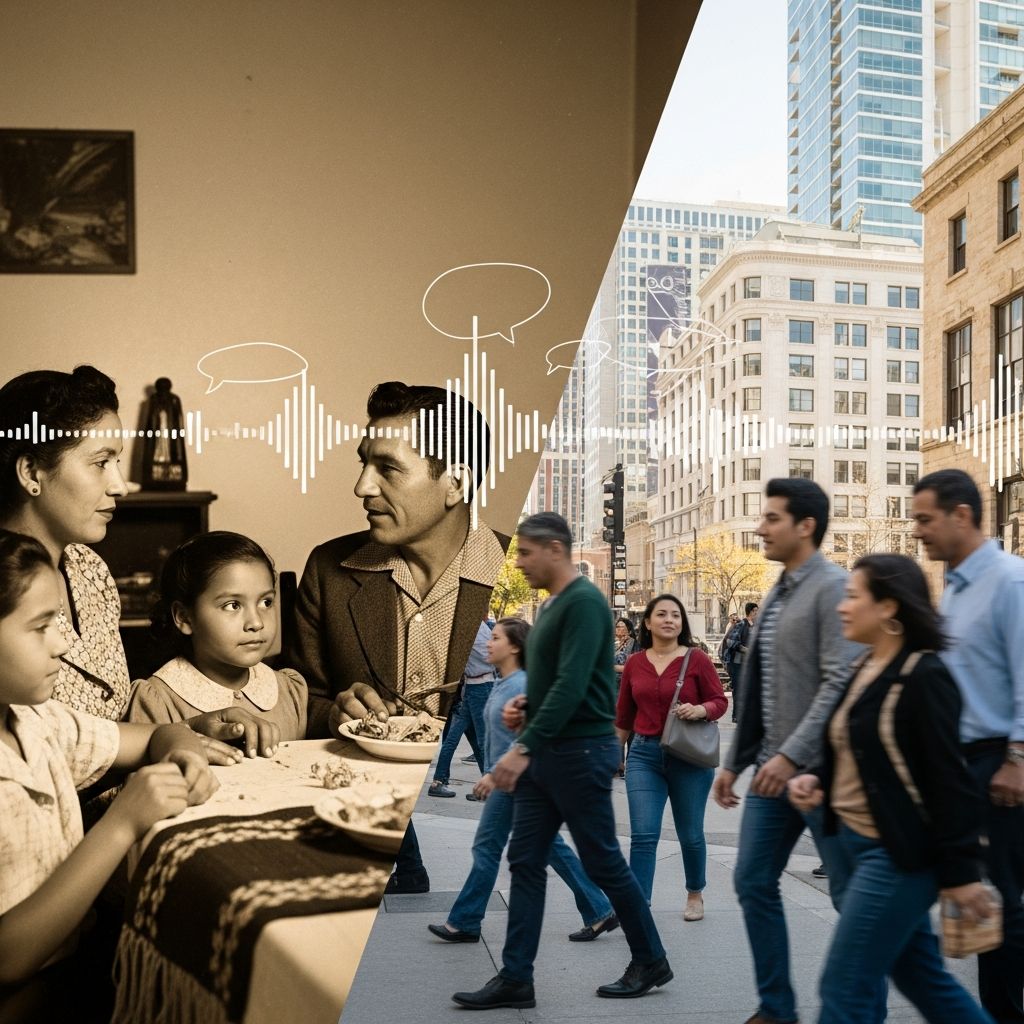
Chicano English represents a vibrant ethnic dialect primarily spoken by Mexican Americans, especially in the Southwestern United States from Texas to California and extending to areas like Chicago. This variety of American English has evolved through deep contact between English and Spanish, forming a stable, native dialect used by both bilingual and monolingual speakers. Unlike casual code-switching seen in Spanglish, Chicano English stands as a fully grammatical system acquired naturally by children in ethnic communities.
Historical Roots and Evolution
The development of Chicano English traces back to early interactions between English settlers and Spanish-speaking populations in the American Southwest during the 19th century. As Mexican Americans formed tight-knit communities, or barrios, children learned English alongside Spanish, blending influences into a unique dialect. Over generations, it transitioned from an interlanguage to an autonomous variety, retaining Spanish phonological echoes while incorporating elements from local Anglo and African American English dialects.
Today, Chicano English thrives in urban centers like Los Angeles’ East LA, where it serves as a marker of cultural pride and resilience. Linguists note its independence from bilingualism; many native speakers have limited Spanish proficiency yet fluently use this dialect. This evolution underscores how language contact forges new varieties that encapsulate community history and social dynamics.
Phonological Characteristics
One of the most striking aspects of Chicano English is its phonology, heavily shaped by Mexican Spanish yet distinctly English in structure. Speakers maintain a phonological inventory similar to local Anglo varieties but exhibit systematic differences. Key features include:
- Vowel shifts: The lax /ʊ/ often fronted to /ʉ/, as in ‘book’ sounding closer to ‘beuk’. Monophthongal vowels replace diphthongs, making ‘face’ more like ‘fess’ without the glide.
- Intonation and syllable timing: Spanish-like emphasis on vowels, especially at word starts, turns ‘today’ into ‘tuhdaeh’ and ‘below’ with a prominent initial vowel. Less frequent vowel reduction in unstressed syllables preserves clarity.
- Consonant patterns: Before velar nasals, lax /ɪ/ raises to /i/, so ‘going’ becomes ‘go-ween’. Words like ‘pasta’ shift to ‘pahstah’, echoing Spanish open syllables.
- Unstressed syllable changes: The first syllable in ‘together’ takes a [u] sound, like ‘toogetha’.
These traits create a rhythmic, expressive sound profile that distinguishes Chicano English from Standard American English (SAE), yet native speakers use it effortlessly without foreign accent perceptions. Influences from California Anglo /u/-fronting and African American English further enrich its sound system.
Grammatical Structures and Syntax
Chicano English grammar deviates from SAE in predictable ways, often regularizing complex rules for simplicity. Syntactic hallmarks include:
- Absence of third-person singular -s: ‘He go to the store’ instead of ‘goes’.
- Regularization of past tense: Consistent -ed endings, even for irregular verbs, like ‘knowed’ for ‘knew’.
- Aspectual markers: ‘Barely’ denotes recent past, as in ‘She barely left’ meaning ‘She just left’.
- Zero copula: Omitted ‘is/are’ in present tense, e.g., ‘That my car’.
These patterns reflect contact with Spanish verb systems and parallels with other nonstandard Englishes, but they form a rule-governed system. Variables like social class, gender, and gang affiliation influence feature strength, with working-class speakers showing more pronounced traits.
Lexicon and Vocabulary Innovations
The vocabulary of Chicano English blends English roots with Spanish loans and innovative expressions, fostering a rich lexicon tied to daily life. Common elements include:
- Spanish borrowings: Words like ‘parar’ (to park) or ‘troca’ (truck) integrated seamlessly.
- Unique tags and interjections: ‘Eh’ as a conversational tag (‘It’s hot, eh?’), ‘watcha!’ for ‘look!’.
- Calques and semantic shifts: ‘Barely’ for recency, or emphasis on family terms like ‘carnal’ (brother).
This lexicon not only facilitates communication within communities but also signals ethnic solidarity, distinguishing insiders from outsiders.
Social and Cultural Significance
Beyond linguistics, Chicano English embodies Mexican-American identity, resisting assimilation pressures while navigating bilingual environments. It appears in music (e.g., lowrider rap), media, and activism, amplifying Chicano voices. Myths persist—equating it to ‘broken English’ or learner errors—but research debunks these, affirming its status as a native dialect.
Sociolinguistic studies reveal variation by context: formal settings may shift toward SAE, while barrio talk preserves core features. This code-switching highlights speakers’ linguistic versatility and cultural adaptability.
| Feature | Chicano English Example | SAE Equivalent |
|---|---|---|
| Third-person singular | He walk | He walks |
| Vowel in ‘going’ | Go-ween | Going |
| Recent past | I barely ate | I just ate |
| Intonation | Tuhdaeh (today) | Today |
Regional Variations and Influences
Chicano English varies geographically. East LA accents emphasize urban flair, while Texas varieties incorporate more Southern English traits. Chicago communities blend it with local urban dialects. Spanish influence remains consistent, but proximity to African American English introduces shared features like /u/-fronting. Gender and class also play roles: women and middle-class speakers often moderate extremes.
Despite globalization, the dialect endures, evolving with youth culture and digital media, ensuring its relevance for future generations.
Debunking Common Misconceptions
Several myths undermine Chicano English’s legitimacy:
- Myth: It’s just Spanglish. Reality: Spanglish mixes languages; Chicano English is a consistent English dialect.
- Myth: Spoken only by Spanish L1 learners. Reality: Native to monolingual English speakers too.
- Myth: Inferior to SAE. Reality: Rule-governed and expressive, equal in communicative power.
Frequently Asked Questions (FAQs)
What is Chicano English exactly?
A native dialect of English spoken by Mexican Americans, influenced by Spanish but fully formed and independent.
Is Chicano English the same as a Spanish accent?
No, it’s a systematic dialect with native fluency, not accented learner English.
Where is Chicano English most commonly spoken?
Primarily in the US Southwest (California, Texas) and cities like Chicago.
Can non-Mexican Americans speak Chicano English?
While rooted in Mexican-American communities, features can appear in diverse Latino groups through contact.
How does Chicano English impact education?
Recognizing it as a valid dialect aids bilingual education and reduces bias in classrooms.
This exploration of Chicano English reveals a dynamic dialect that bridges heritage and innovation, essential for understanding America’s linguistic mosaic. (Word count: 1678)
References
- MultiCSD – Chicano English — MultiCSD. Accessed 2026. https://sites.google.com/view/multicsd/global-languages/chicano-english?authuser=0
- Chicano English – Wikipedia — Wikipedia Contributors. 2026-04-04. https://en.wikipedia.org/wiki/Chicano_English
- Chicano English? – Dialect Blog — Dialect Blog. 2011-11-07. http://dialectblog.com/2011/11/07/chicano-english/
- Dialect influence on California Chicano English — Purdue e-Pubs (Fought 2003). 2003. http://docs.lib.purdue.edu/cgi/viewcontent.cgi?article=1006&context=plas
- Column: Do you say today or tuhdaeh? The intricacies of Chicano English — Calo News. 2024. https://www.calonews.com/news/lifestyle/column-do-you-say-today-or-tuhdaeh-the-intricacies-of-chicano-english/article_273e3a90-e3ff-11ef-9f3b-0f82c53e7c2d.html
- Chicano English Slides — Stanford University (Fought 2003). Accessed 2026. https://stanford.edu/class/linguist159/materials/slides/Chicano_English.pdf

Medha Deb is an editor with a master's degree in Applied Linguistics from the University of Hyderabad. She believes that her qualification has helped her develop a deep understanding of language and its application in various contexts. Medha specializes in the areas of beauty, health, sports, and wellness and is committed to ensuring that the content on the website is…