
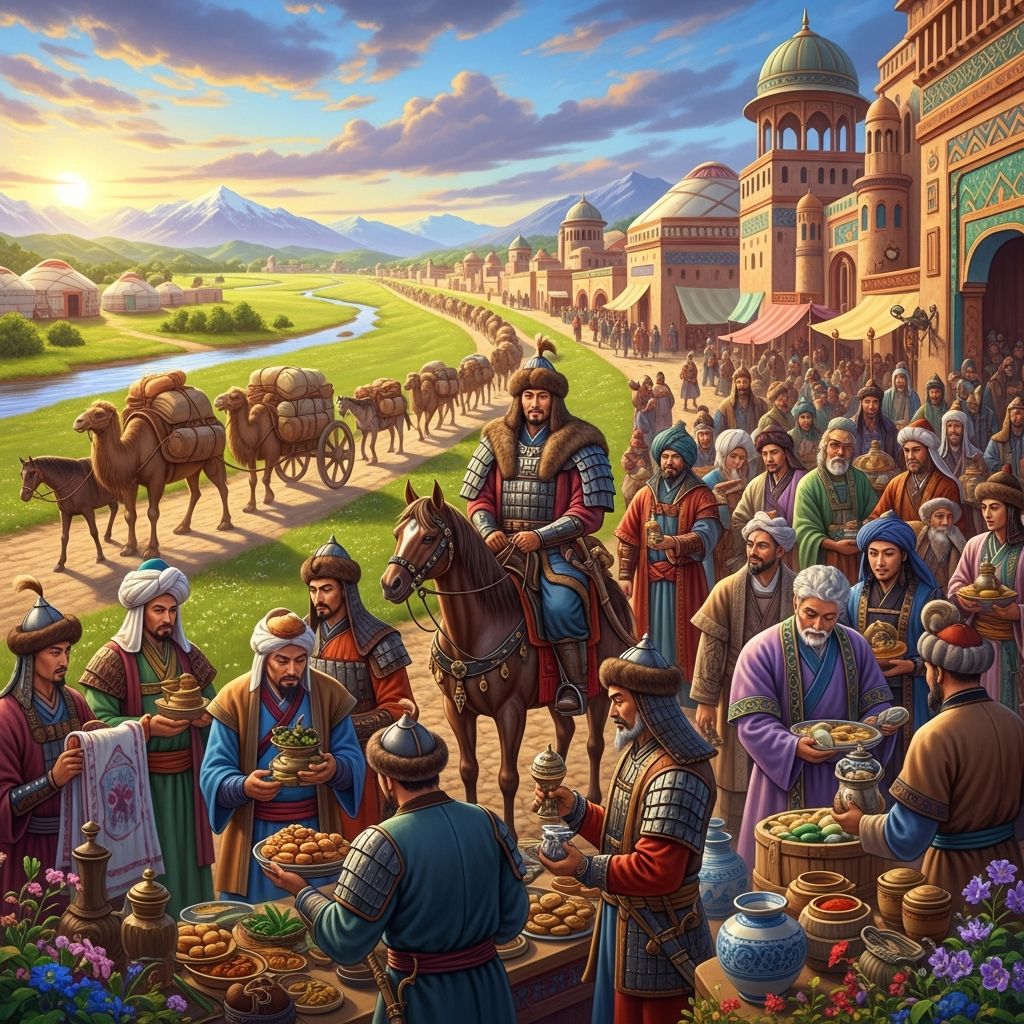
The Pax Mongolica, often translated as the “Mongol Peace,” marked a transformative era in world history during the 13th and 14th centuries. This period of relative stability across the vast Mongol Empire facilitated unprecedented exchanges of goods, ideas, and technologies between East and West, reshaping global interactions.
Genesis of the Mongol Empire Under Genghis Khan
The foundations of the Pax Mongolica were laid by Temüjin, better known as Genghis Khan, who unified the fragmented nomadic tribes of the Mongolian steppe in 1206. Born around 1162, Genghis Khan rose from humble origins amid tribal warfare to forge the largest contiguous land empire in history, spanning from the Pacific Ocean to Eastern Europe.
Genghis Khan’s military genius lay in his innovative tactics, including the use of highly mobile cavalry, psychological warfare, and merit-based promotions regardless of birth. His conquests began with the unification of Mongol and Turkic tribes, followed by invasions into China, Central Asia, and Persia. By his death in 1227, the empire covered immense territories, setting the stage for further expansions under his successors.
- Key Military Innovations: Composite bows for long-range accuracy, feigned retreats to lure enemies, and siege engineering adopted from conquered peoples.
- Administrative Reforms: Introduction of the Yam postal system for rapid communication across the empire.
- Population Impact: Conquests caused massive displacements and deaths, estimated at up to 40 million lives, creating a power vacuum that enabled centralized Mongol control.
Expansion and Division into Major Khanates
Following Genghis Khan, his sons and grandsons continued the expansions. Ögedei Khan (r. 1229–1241) invaded Eastern Europe, reaching as far as Hungary and Poland in 1241. Kublai Khan established the Yuan Dynasty in China (1271–1368), while other branches formed the Golden Horde in Russia, the Chagatai Khanate in Central Asia, and the Ilkhanate in Persia.
Despite political fragmentation into these four khanates, a shared Mongol identity and loose confederation maintained overarching stability until the mid-14th century. This unity was crucial for the Pax Mongolica, as it ensured safe passage across Eurasia despite internal rivalries.
| Khanate | Region | Key Ruler | Duration |
|---|---|---|---|
| Yuan Dynasty | China/Mongolia | Kublai Khan | 1271–1368 |
| Golden Horde | Russia/Eastern Europe | Batu Khan | 1240s–1502 |
| Chagatai Khanate | Central Asia | Chagatai Khan | 1220s–1370 |
| Ilkhanate | Persia/Middle East | Hülegü Khan | 1256–1335 |
Mechanisms of Stability: Law, Tolerance, and Infrastructure
The Pax Mongolica’s hallmark was enforced peace through the Yassa, Genghis Khan’s legal code. This Great Law prohibited feudal infighting, ensured religious tolerance, and mandated harsh punishments for crimes against travelers or traders. Mongols did not impose their shamanistic beliefs, allowing Christianity, Islam, Buddhism, and Confucianism to coexist.
Infrastructure like the Yam relay stations—networks of horse stations every 25-30 miles—enabled messages to travel 200 miles per day, facilitating administration and trade security. Safe roads free from bandits, protected by Mongol garrisons, transformed perilous routes into reliable highways.
- Religious Policy: Freedom of worship promoted loyalty from diverse subjects, fostering cultural synthesis.
- Taxation System: Low tariffs (typically 5%) on Silk Road trade encouraged commerce.
- Military Enforcement: Swift reprisals against rebellions maintained order.
Revitalizing the Silk Road: Trade Boom Across Eurasia
The Pax Mongolica supercharged the ancient Silk Road, linking China to the Mediterranean. Merchants like Marco Polo traveled safely from Venice to Khanbaliq (Beijing) in the 1270s, documenting exotic goods and wonders. Trade volumes surged, introducing Europeans to spices, porcelain, silk, and paper.
From East to West flowed Chinese inventions like gunpowder, the compass, and printing. Westward luxuries included glassware, woolens, and horses. This exchange laid groundwork for the Renaissance and Age of Exploration.
Maritime extensions via the conquered southern Chinese ports opened Indian Ocean routes to Persia and Africa, amplifying global connectivity.
Cultural and Technological Cross-Pollination
Beyond commerce, the era sparked profound intellectual exchanges. Muslim scholars learned Chinese pharmacology, while Chinese healers adopted Middle Eastern surgery. Nestorian Christians and Franciscan missionaries proselytized freely, with some Mongol khans showing interest in conversion.
Travelers like Ibn Battuta (Muslim explorer) and William of Rubruck (European envoy) traversed the empire, spreading knowledge. Art, astronomy, and mathematics flourished in multicultural hubs like Tabriz and Samarkand.
- Technological Transfers: Gunpowder to Europe accelerated warfare; windmills from Persia to China.
- Scientific Advances: Shared calendars and medical texts improved agriculture and health.
- Artistic Fusion: Persian miniatures influenced Chinese painting styles.
The Shadow Side: Destruction and Disease
Paradoxically, the peace stemmed from devastating wars. Mongol hordes depopulated regions, with cities like Baghdad (1258) razed, killing hundreds of thousands. This terror induced surrenders, stabilizing rule but at immense human cost.
The era ended amid fragmentation and the Black Death (1340s), originating in Central Asia and spreading via trade routes to devastate Europe, killing 30-60% of populations. Plague marked the Pax Mongolica’s close, alongside khanate collapses.
Lasting Legacy in Modern Globalization
Scholars view the Pax Mongolica as globalization’s precursor. It unified Eurasia economically, paving the way for Columbus’s voyages seeking direct Asian routes. Its model of tolerance influenced later empires like the Mughals and Ottomans.
Today, it reminds us how conquest can yield connectivity, though ethical questions persist about ends justifying means.
Frequently Asked Questions (FAQs)
What was the Pax Mongolica?
A period of stability (13th-14th centuries) under Mongol rule enabling safe trade and cultural exchange across Eurasia.
Who founded the Mongol Empire?
Genghis Khan unified tribes in 1206, launching conquests that created the empire.
How did Pax Mongolica affect trade?
It secured Silk Road routes, boosting exchanges of silk, spices, gunpowder, and technologies.
Why did the Pax Mongolica end?
Khanate disintegration, civil wars, and the Black Death spreading via trade routes.
Was religious freedom allowed?
Yes, the Yassa promoted tolerance, aiding diverse cultural integrations.
References
- Overview of the Mongol Empire — Lumen Learning (SUNY World History). Accessed 2026. https://courses.lumenlearning.com/suny-worldhistory/chapter/overview-of-the-mongol-empire/
- Pax Mongolica — Wikipedia. Last edited 2026. https://en.wikipedia.org/wiki/Pax_Mongolica
- Pax Mongolica — The Freedom of Christian Conversion — Hungarian Conservative. 2023-10-15. https://www.hungarianconservative.com/articles/culture_society/pax-mongolica-freedom-of-religion-christian-conversion-mongol-empire-kingdom-of-hungary-history/
- Pax Mongolica — Silk-Road.com. Accessed 2026. https://silk-road.com/artl/paxmongolica.shtml/
- Pax Mongolica – Mongols in World History — Asia for Educators, Columbia University. Accessed 2026. https://afe.easia.columbia.edu/mongols/history/history5.htm
- Genghis Khan, Trade Warrior — Federal Reserve Bank of Richmond. 2021-10-01. https://www.richmondfed.org/publications/research/econ_focus/2021/q4_economic_history

- Integrated M.A. in Applied Linguistics, University of Hyderabad
- 5+ years in editorial, instructional, SEO, and research-based writing
Sneha is a relationships and lifestyle writer with a strong foundation in applied linguistics and certified training in relationship coaching. She brings over five years of writing experience to theskillvault, crafting thoughtful, research-driven content that empowers readers to build healthier relationships, boost emotional well-being, and embrace holistic living. Her writing and insights reflect the belief that beauty, happiness, and wellness…