
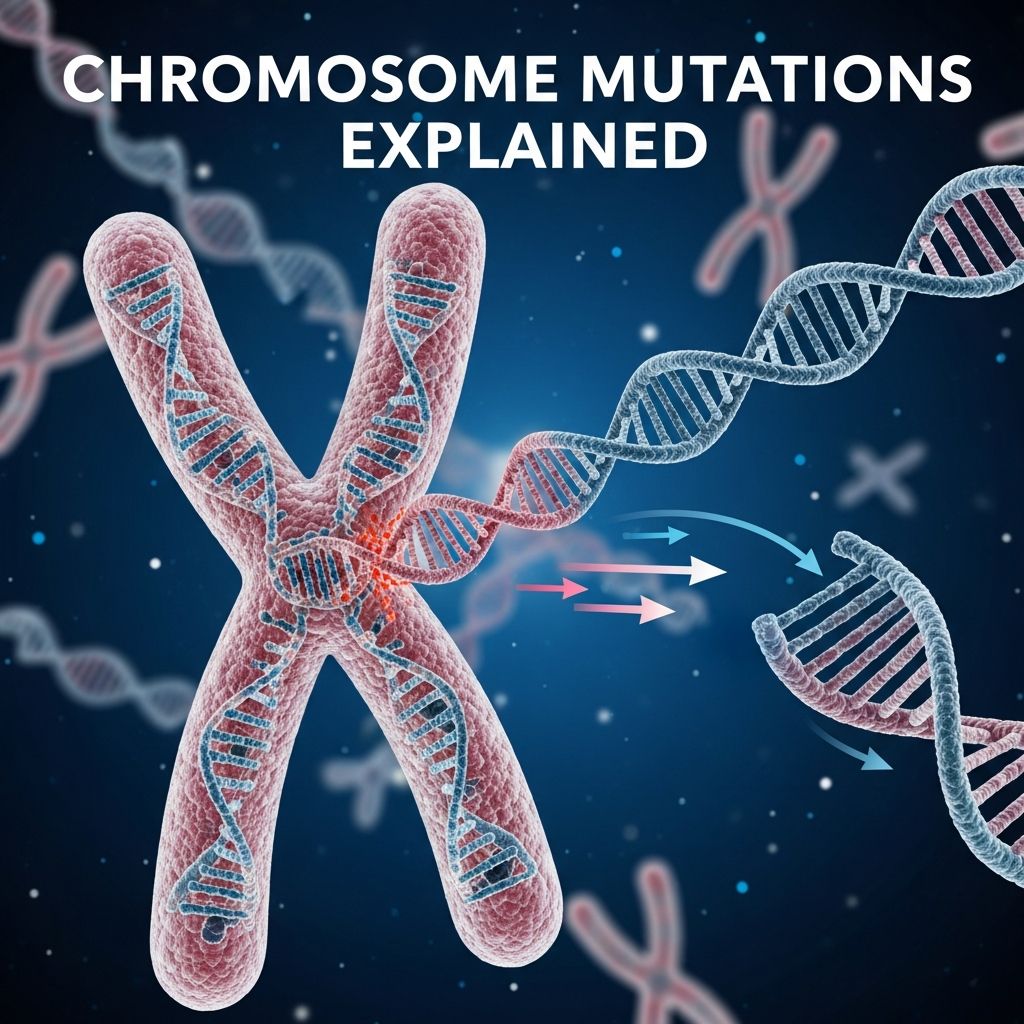
Chromosomes carry the genetic blueprint of life, and alterations to their structure or number can lead to profound biological consequences. These changes, known as chromosome mutations, disrupt normal gene function and expression, often resulting in developmental disorders, diseases, or evolutionary adaptations.
Understanding the Basics of Chromosomal Changes
Chromosome mutations differ from point mutations, which affect single nucleotides, by involving larger segments of DNA or entire chromosomes. They arise during cell division processes like mitosis or meiosis, often due to errors in DNA replication, repair, or chromosome segregation. Factors such as radiation, chemicals, or viral infections can trigger these events.
Mutations are classified into two primary categories: structural mutations, which alter chromosome architecture without changing the total number, and numerical mutations, which modify chromosome count. Both types can be inherited or occur de novo in somatic or germ cells.
Structural Alterations in Chromosomes
Structural mutations reshape chromosome segments through breakage and rejoining. These changes can silence genes, create fusion proteins, or imbalance gene dosage, leading to cellular dysfunction.
Deletions: Loss of Genetic Material
A deletion mutation removes a chromosome segment, ranging from tiny microdeletions to large terminal or interstitial losses. Terminal deletions occur at chromosome ends, while interstitial ones happen internally. This loss, termed partial monosomy, halves gene copies in the affected region, often causing severe phenotypes.
In humans, Cri-du-chat syndrome exemplifies deletion effects, where part of chromosome 5p is missing, leading to a cat-like cry, intellectual disability, and microcephaly. Detection typically requires karyotyping or FISH analysis.
- Types of deletions: Terminal (end loss), interstitial (internal segment), microdeletion (undetectable by standard methods).
- Consequences: Haploinsufficiency, where one gene copy is insufficient for normal function.
Duplications: Extra Copies and Gene Amplification
Duplication creates redundant genetic material, known as partial trisomy. This can occur tandemly (adjacent repeats), in reverse, displaced, or on non-homologous chromosomes. Tandem duplications are common in evolution, amplifying genes for adaptation, like pesticide resistance in insects.
Charcot-Marie-Tooth disease type 1A results from PMP22 gene duplication on chromosome 17, causing demyelination and neuropathy. Unlike deletions, duplications rarely cause lethality but often lead to dosage-sensitive disorders.
| Type | Description | Example |
|---|---|---|
| Tandem | Duplicate next to original | Gene amplification in cancer |
| Displaced | Duplicate moved elsewhere | Developmental anomalies |
| Extrachromosomal | Separate duplicate ring | Oncogene amplification |
Inversions: Flipping the Genetic Sequence
Inversion reverses a chromosome segment’s orientation. Paracentric inversions exclude the centromere, while pericentric ones include it, potentially altering chromosome length or arm ratios. In heterozygotes, inversions suppress recombination, preserving gene blocks.
Though often benign in homozygotes, they cause issues in meiosis, leading to unbalanced gametes. Human examples link inversions to hemophilia A and certain cancers via proto-oncogene disruption.
- Paracentric: No centromere involvement; loop forms in pairing.
- Pericentric: Centromere included; changes chromosome morphology.
Translocations: Segment Swapping Between Chromosomes
Translocations exchange material between non-homologous chromosomes without net loss or gain. Reciprocal translocations swap segments mutually, while Robertsonian fusions join acrocentrics at centromeres, reducing count.
The Philadelphia chromosome (t(9;22)) in chronic myeloid leukemia fuses BCR-ABL, driving uncontrolled proliferation. Carriers may have normal phenotypes but risk unbalanced offspring.
| Type | Mechanism | Health Impact |
|---|---|---|
| Reciprocal | Mutual exchange | Cancer, infertility |
| Robertsonian | Centromere fusion | Down syndrome variant |
| Non-reciprocal | One-way shift | Gene dosage imbalance |
Numerical Changes in Chromosome Sets
Numerical mutations alter chromosome quantity, termed heteroploidy. They stem from nondisjunction, where chromosomes fail to separate properly.
Aneuploidy: Abnormal Chromosome Counts
Aneuploidy involves gain (hyperploidy) or loss (hypoploidy) of specific chromosomes. Trisomy (extra one, 2n+1) and monosomy (missing one, 2n-1) are common. Down syndrome (trisomy 21) features intellectual disability, heart defects, and characteristic facies.
Turner syndrome (45,X) is monosomy X, causing short stature and infertility. Most aneuploids are embryonic lethal.
- Trisomy 21: 1 in 700 births; maternal age-related.
- Klinefelter (47,XXY): Male hypogonadism, tall stature.
Polyploidy: Multiples of the Genome
Polyploidy multiplies entire sets: triploid (3n), tetraploid (4n). Common in plants (e.g., seedless watermelons), rare and lethal in animals due to imprinting issues.
Plant polyploids exhibit gigantism and hybrid vigor, aiding agriculture. Human triploidy causes severe defects and miscarriage.
Causes and Detection Methods
Nondisjunction, breakage from mutagens, or replication errors cause mutations. Karyotyping visualizes gross changes; microarray and NGS detect micro-variations.
Health Implications and Evolutionary Role
Mutations drive genetic diseases (e.g., cancer via translocations) but also evolution by creating variation. Plants benefit from polyploidy; animals suffer.
Frequently Asked Questions (FAQs)
What causes chromosome mutations?
They result from errors in cell division, environmental mutagens, or inherited factors, primarily during meiosis or mitosis.
Can chromosome mutations be cured?
No cures exist, but management includes therapies, prenatal screening, and emerging gene editing like CRISPR.
Are all chromosome mutations harmful?
No, some are neutral or beneficial, especially duplications in evolution and polyploidy in plants.
How common is Down syndrome?
About 1 in 700 live births, increasing with maternal age.
What is the difference between structural and numerical mutations?
Structural alters shape; numerical changes count.
References
- Chromosomal mutation – Definition and Examples — Biology Online. 2023. https://www.biologyonline.com/dictionary/chromosomal-mutation
- Chromosomal Mutations: Causes, Types & Examples Explained — Microbe Notes. 2023-10-15. https://microbenotes.com/chromosomal-mutation/
- Types of mutations and their notations — Khan Academy. 2024. https://www.khanacademy.org/test-prep/mcat/biomolecules/genetic-mutations/a/types-of-mutations-and-their-notations
- Types of Chromosome Mutations — JRC. 2018. https://jrc.ac.in/working_folder/DOWNLOAD-D-12-180-618C074D5A0B8.pdf
- Chromosome Abnormalities Fact Sheet — Genome.gov (National Human Genome Research Institute). 2023-05-16. https://www.genome.gov/about-genomics/fact-sheets/Chromosome-Abnormalities-Fact-Sheet

- Integrated M.A. in Applied Linguistics, University of Hyderabad
- 5+ years in editorial, instructional, SEO, and research-based writing
Sneha is a relationships and lifestyle writer with a strong foundation in applied linguistics and certified training in relationship coaching. She brings over five years of writing experience to theskillvault, crafting thoughtful, research-driven content that empowers readers to build healthier relationships, boost emotional well-being, and embrace holistic living. Her writing and insights reflect the belief that beauty, happiness, and wellness…