
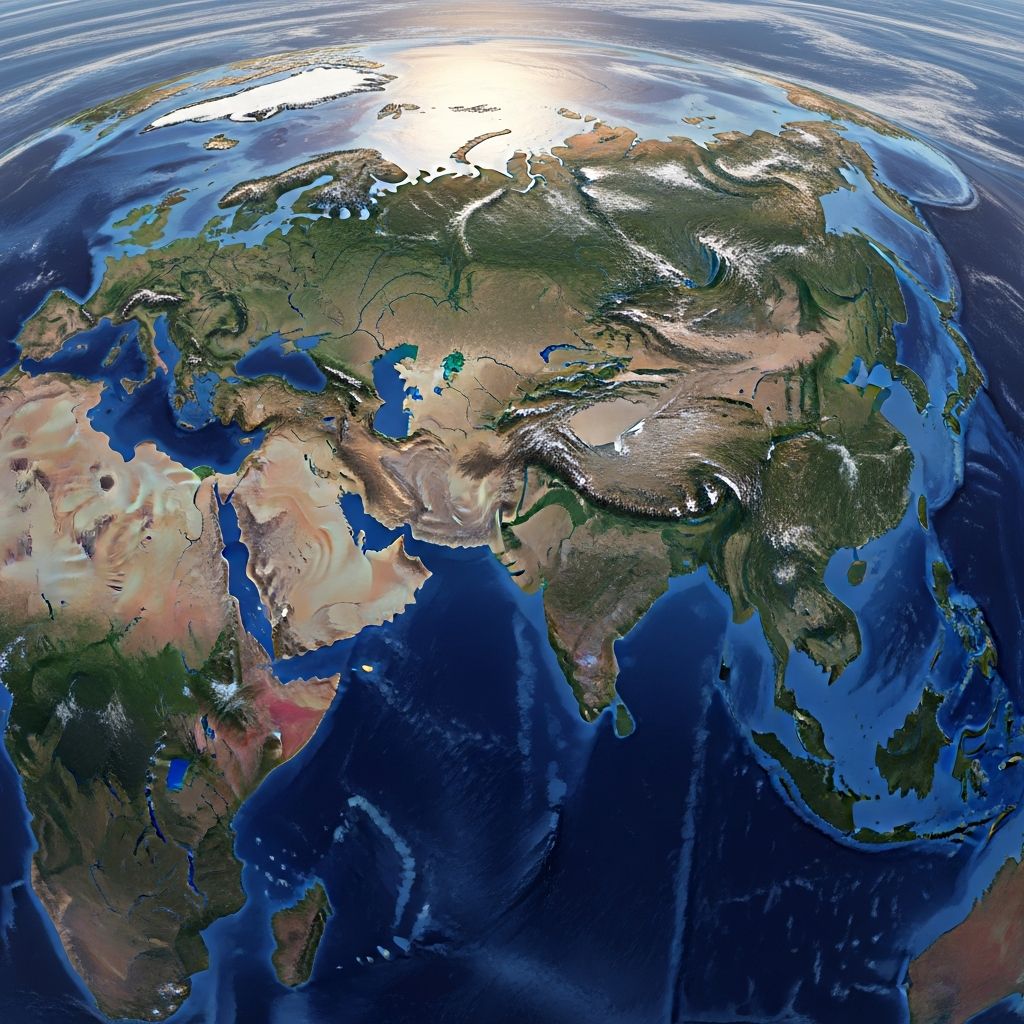
Eurasia stands as the planet’s most expansive continuous landmass, seamlessly linking the traditional continents of Europe and Asia into a single geological entity covering roughly 55 million square kilometers. Home to over 5 billion inhabitants—about 70% of the global population—this supercontinent influences weather patterns, trade routes, and international power balances like no other region.
Defining Eurasia’s Immense Scope
Geologically, Eurasia forms a unified supercontinent without a major water barrier separating Europe from Asia, challenging the conventional two-continent model. This vast area stretches from Portugal’s Atlantic shores in the west to Japan’s Pacific islands in the east, and from Russia’s Arctic tundra in the north to the Indian Ocean’s southern edges. Representing 36.2% of Earth’s land surface, its scale dwarfs other continents, fostering diverse ecosystems and human civilizations.
The term “Eurasia,” a blend of “Europe” and “Asia,” emerged in the 19th century but gained traction in 20th-century geopolitics to describe this interconnected realm. Physically, it resides mostly in the Northern and Eastern Hemispheres, with extensions into Maritime Southeast Asia depending on boundary definitions.
Navigating the Europe-Asia Boundary
Despite its continuity, Eurasia is culturally divided into Europe and Asia along a conventional line that prioritizes history over geology. This demarcation begins at the Arctic Ocean, follows the Ural Mountains and Ural River southward, skirts the Caspian Sea’s west side via the Kuma-Manych Depression, crosses the Sea of Azov and Kerch Strait into the Black Sea, then traces the Caucasus Mountains and Turkish Straits.
- Ural Mountains and River: Natural divide in western Russia, marking Europe’s eastern edge.
- Caspian Sea and Depressions: Lowland separators leading to the Black Sea.
- Caucasus Range: Towering barrier assigning its northern slopes to Europe and south to Asia.
- Turkish Straits (Bosporus, Dardanelles): Waterways funneling into the Aegean Sea, completing the line.
These boundaries are arbitrary; Russia, for instance, spans both sides, with 77% of its territory in Asia yet most population in Europe. Scholars debate inclusions like the Caucasus isthmus, firmly placing it in Asia.
Geological Foundations and Dramatic Landscapes
Eurasia’s terrain results from tectonic collisions forming mountain chains like the Himalayas, where the Indian plate crashes into the Eurasian plate. Vast plains dominate the west, including Europe’s rolling fields and Siberia’s endless steppes, while plateaus rise in Central Asia, such as Tibet’s high-altitude expanse.
Major rivers carve through this diversity: Europe’s Danube, Rhine, and Volga sustain agriculture; Asia’s Yangtze, Yellow, and Mekong power economies; Siberia’s Ob, Yenisei, and Lena drain northward. Volcanic activity dots the east, from Kamchatka’s fiery peaks to Indonesia’s ring of fire extensions.
| Region | Key Features | Area (sq km) |
|---|---|---|
| Western Plains | Fertile lowlands, rivers | ~10 million |
| Central Plateaus | Tibet, Pamirs; arid highs | ~15 million |
| Eastern Mountains | Himalayas, Altai; peaks over 8,000m | ~20 million |
| Northern Tundra | Permafrost, taiga forests | ~10 million |
This table approximates regional breakdowns, highlighting Eurasia’s topographic variety driving its climatic zones.
Climate Diversity Across the Supercontinent
Eurasia’s size yields extreme climates: Arctic chills grip Siberia with -50°C winters, while India’s monsoon tropics exceed 40°C. Mediterranean warmth bathes southern Europe; steppes experience continental swings; deserts parch Central Asia’s Gobi and Taklamakan.
Monsoon systems drench South and Southeast Asia, fueling rice paddies, whereas the jet stream influences Europe’s mildness and Russia’s harshness. Climate change amplifies these contrasts, melting permafrost and intensifying monsoons.
Population Powerhouse and Urban Giants
With 5 billion residents across 90+ countries, Eurasia dominates demographically. Density peaks in the Indo-Gangetic plain (India’s 400+ million) and China’s eastern belt, contrasting Siberia’s sparse millions.
Transcontinental giants like Russia (17 million sq km, split Europe-Asia) and Turkey straddle divides. Urban hubs—Tokyo (37 million metro), Delhi (32 million), Shanghai (29 million)—epitomize megacity growth, alongside Europe’s Paris, Moscow, and Istanbul.
Geopolitical Dynamics and Power Centers
Eurasia’s heartland theory posits control here equates to world dominance, as articulated by Mackinder. Russia envisions it encompassing former Soviet states like Belarus, Kazakhstan, and Central Asia. “Greater Eurasia” alliances link Russia, China, and Central Asia against Western blocs.
The Silk Road Economic Belt under China’s Belt and Road Initiative revives ancient trade, connecting 60+ countries. EU integration contrasts with Shanghai Cooperation Organisation rivalries, underscoring Eurasia’s multipolar tensions.
Historical Layers Shaping Modern Eurasia
Human history unfolds across Eurasia: cradle of agriculture in Mesopotamia and Yellow River valleys; Mongol Empire’s 13th-century sweep; Silk Road’s cultural exchanges. World wars pivoted on its plains; Cold War divided it ideologically.
Post-1991, Central Asia’s five republics emerged, blending Islamic heritage with Soviet legacies. Today, energy corridors from Caspian oil to Siberian gas fuel global markets.
Eurasia’s Biodiversity and Environmental Pressures
From Siberian tigers to Himalayan snow leopards, Eurasia’s habitats host 20% of global species. Yet, deforestation, overgrazing, and pollution threaten: Aral Sea shrinkage exemplifies water crises.
Conservation efforts span transboundary parks in the Altai and protected wetlands along the Danube.
Frequently Asked Questions (FAQs)
Is Eurasia a single continent?
Geophysically, yes—it’s one landmass without separating seas, though culturally split into Europe and Asia.
What countries straddle Europe and Asia?
Russia, Turkey, Kazakhstan, and Georgia have territories in both.
How many people live in Eurasia?
Over 5 billion, about 70% of world population across 90+ nations.
What defines the Europe-Asia border?
Ural Mountains, Caspian Sea, Caucasus, and Turkish Straits form the traditional line.
Why is Eurasia geopolitically vital?
It houses superpowers like China, Russia, India, and the EU, controlling key resources and trade routes.
References
- Eurasia | Definition, Meaning, & Countries — Encyclopædia Britannica. 2023. https://www.britannica.com/place/Eurasia
- What is Eurasia? — Mission Eurasia. 2023. https://missioneurasia.org/what-is-eurasia/
- Geography of Eurasia | Countries, Map & Physical Features — Study.com. 2023. https://study.com/academy/lesson/geography-of-eurasia-countries-map-physical-features.html
- Eurasia — Wikipedia. 2026-04-04. https://en.wikipedia.org/wiki/Eurasia
- What Is Eurasia? – International Policy Zone — YouTube (International Policy Zone). 2023. https://www.youtube.com/watch?v=1CtnYAJodys
- WHAT IS EURASIA #geography #eurasia — YouTube (TOPBrain GK). 2025-01-01. https://www.youtube.com/watch?v=UIrNOoGgOh4

Medha Deb is an editor with a master's degree in Applied Linguistics from the University of Hyderabad. She believes that her qualification has helped her develop a deep understanding of language and its application in various contexts. Medha specializes in the areas of beauty, health, sports, and wellness and is committed to ensuring that the content on the website is…