
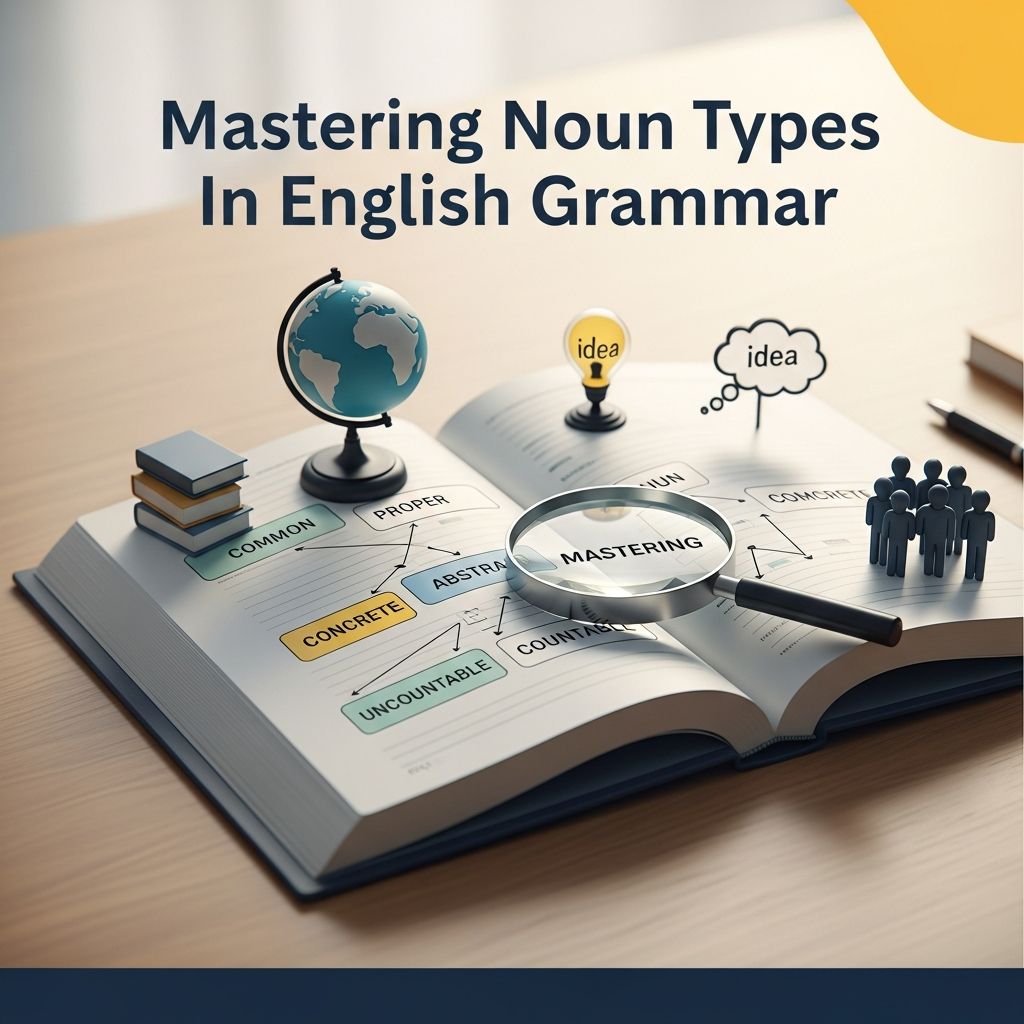
Nouns form the backbone of English sentences, naming everything from people and places to ideas and emotions. Understanding their various types helps in constructing clear, precise communication. This guide explores the diverse categories of nouns, offering definitions, examples, and usage tips drawn from established grammar principles.
Fundamental Categories: Common vs. Proper Nouns
At the core of noun classification lie common nouns and proper nouns. Common nouns denote general items, such as “city” or “teacher,” without specifying any particular one. They remain lowercase unless starting a sentence.
Proper nouns, conversely, identify specific entities and always begin with a capital letter. Examples include “London” for a city or “Albert Einstein” for a person. These nouns pinpoint unique references, distinguishing them from their common counterparts.
| Type | Description | Examples |
|---|---|---|
| Common Noun | General term | dog, river, book |
| Proper Noun | Specific name | Rover, Nile, Harry Potter |
Countable and Uncountable Nouns: Quantifying the World
Countable nouns refer to items that can be counted individually and often take plural forms. Think of “apple” becoming “apples” or “car” to “cars.” They pair well with numbers and quantifiers like “many” or “few”.
In contrast, uncountable nouns (also called mass nouns) represent substances or concepts not easily divided into units. Words like “water,” “information,” or “furniture” lack plurals and use quantifiers such as “some” or “much.” To count uncountables, we often add units: “a glass of water”.
- Countable: chair (chairs), idea (ideas)
- Uncountable: rice, advice, luggage
Tangible vs. Intangible: Concrete and Abstract Nouns
Concrete nouns name objects detectable by the senses—sight, touch, sound, taste, or smell. “Table,” “music,” and “chocolate” fall here because you can perceive them physically.
Abstract nouns describe intangible qualities, states, or ideas beyond sensory detection. Concepts like “happiness,” “democracy,” or “beauty” embody this type. They often derive from adjectives or verbs, enriching expressive language.
Distinguishing these aids in vivid writing: use concrete nouns for descriptions and abstracts for emotions or philosophies.
Groups as One: Collective Nouns
Collective nouns label groups functioning as a single unit, such as “family,” “team,” or “flock.” In American English, they typically take singular verbs (“The team is winning”), while British English may use plurals (“The team are winning”) depending on context.
- People: audience, committee
- Animals: herd, swarm
- Objects: bunch, stack
Combined Words: Compound Nouns
Compound nouns merge two or more words into one noun, like “toothbrush,” “mother-in-law,” or “ice cream.” They can be hyphenated, separate, or fused, with meaning shifting based on combination.
Recognizing these prevents confusion; for instance, “bus stop” is a place, unlike “stop” alone.
Gendered and Action-Derived Nouns
Gender-specific nouns indicate male or female, such as “actor” (male) or “actress” (female). Modern usage favors gender-neutral terms like “flight attendant” over “stewardess”.
Gerunds are verb forms ending in “-ing” acting as nouns: “swimming” in “Swimming is fun.” They denote actions as concepts. Verbal nouns similarly derive from verbs but lack verb properties, like “destruction” from “destroy.”
Singular, Plural, and Possessive Forms
Nouns also vary by number: singular for one (“child”), plural for more (“children”). Regular plurals add “-s” or “-es”; irregulars change, like “man/men” or remain same (“sheep”).
Possessive nouns show ownership via apostrophes: “dog’s bone” (singular), “dogs’ bones” (plural).
| Singular | Plural | Possessive Singular | Possessive Plural |
|---|---|---|---|
| cat | cats | cat’s | cats’ |
| man | men | man’s | men’s |
Advanced Structures: Noun Phrases and Clauses
Noun phrases combine nouns with modifiers, e.g., “the fluffy white cat.” They function as single nouns in sentences.
Noun clauses are dependent clauses acting as nouns: “What she said surprised me,” where the clause is the subject.
Practical Applications in Writing and Speech
Mastering noun types elevates writing. Mix concrete and abstract for balance; use collectives carefully for agreement; opt for precise compounds. In speech, countable/uncountable awareness avoids errors like “less books” (should be “fewer books”).
Exercises: Identify types in sentences or convert plurals. This builds intuition over time.
Frequently Asked Questions (FAQs)
What is the difference between countable and uncountable nouns?
Countable nouns can be numbered and pluralized (e.g., “two cars”), while uncountable cannot (e.g., “some water”).
Are gerunds always nouns?
Yes, when ending in “-ing” and functioning as subjects/objects, like “Dancing tires me.” They differ from present participles.
How do I form irregular plurals?
They change form: foot/feet, child/children, mouse/mice. Memorize common ones.
Can abstract nouns be pluralized?
Rarely, but possible in contexts like “many fears” meaning types of fear.
What makes a noun compound?
It’s two+ words forming a single concept, e.g., “notebook” or “passerby.”
References
- Types of Nouns: Explanation and Examples — Grammar Monster. 2023. https://www.grammar-monster.com/lessons/nouns_different_types.htm
- Noun | Meaning, Types & Examples – Lesson — Study.com. 2024-01-15. https://study.com/academy/lesson/what-are-nouns-definition-types-examples.html
- What Is a Noun? Definition, Types, and Examples — Grammarly. 2025-03-10. https://www.grammarly.com/blog/parts-of-speech/nouns/
- 10 Types Of Nouns Used In The English Language — Thesaurus.com. 2024. https://www.thesaurus.com/articles/what-are-the-types-of-nouns

- Integrated M.A. in Applied Linguistics, University of Hyderabad
- 5+ years in editorial, instructional, SEO, and research-based writing
Sneha is a relationships and lifestyle writer with a strong foundation in applied linguistics and certified training in relationship coaching. She brings over five years of writing experience to theskillvault, crafting thoughtful, research-driven content that empowers readers to build healthier relationships, boost emotional well-being, and embrace holistic living. Her writing and insights reflect the belief that beauty, happiness, and wellness…