
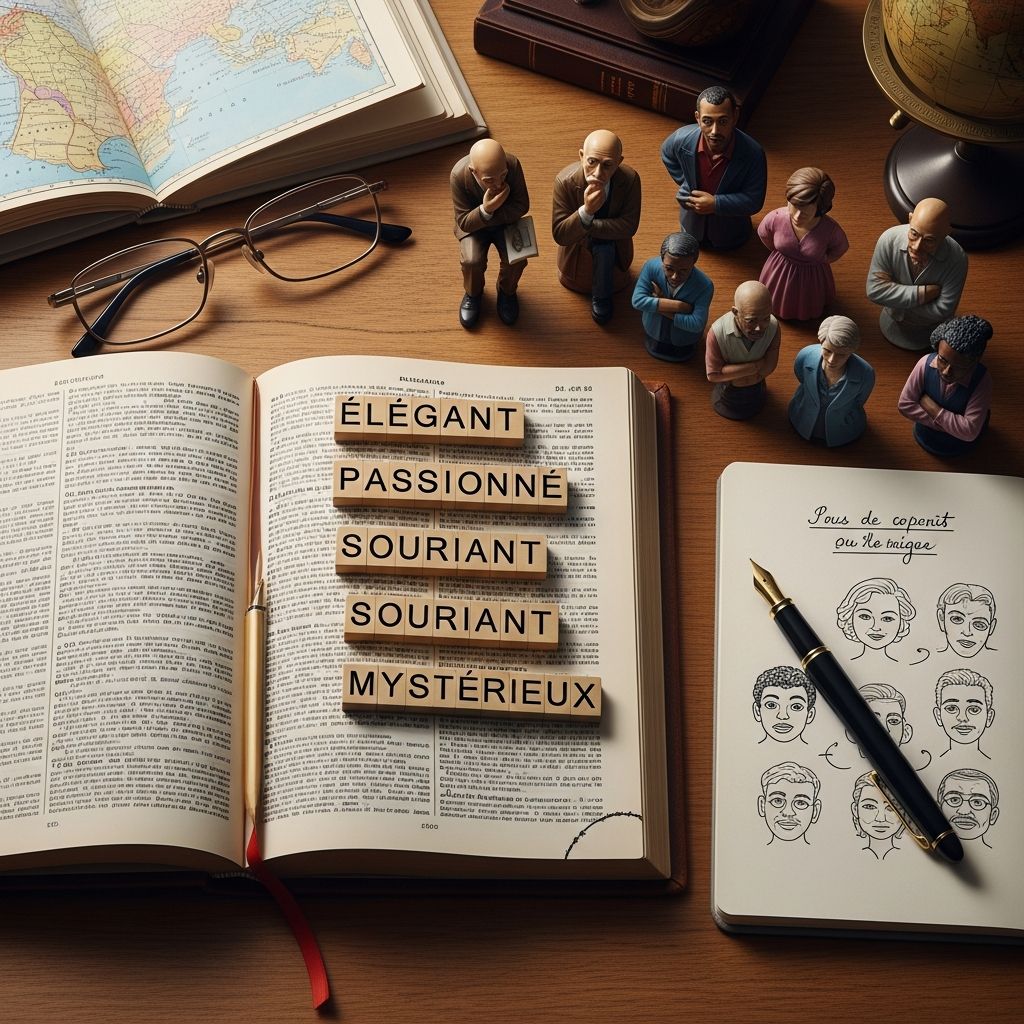
Understanding French Descriptive Vocabulary for People
Communicating effectively in French requires more than just basic grammar—it demands a rich vocabulary for describing the people around us. Whether you’re meeting someone new, writing a character description, or simply having a conversation, knowing how to articulate what someone looks like or their personality traits is fundamental to language proficiency. French offers an extensive array of adjectives and expressions designed specifically for this purpose, each with its own nuances and grammatical considerations.
The ability to describe people in French extends beyond superficial observations. It encompasses understanding how adjectives agree with gender and number, recognizing which adjectives precede nouns and which follow, and learning the subtle differences between similar descriptors. This comprehensive guide explores the various ways to characterize individuals in French, providing learners with practical vocabulary and authentic usage examples.
Physical Characteristics: Foundation of Description
When first meeting someone or providing a detailed account of a person’s appearance, physical descriptors form the foundation of your description. French provides a systematic approach to categorizing and expressing physical traits through adjectives that follow specific grammatical patterns.
Height and Body Structure
Height represents one of the most immediately noticeable characteristics when describing someone. The French language offers several ways to express this dimension:
- Grand/grande means tall and is used to describe people of above-average height
- Petit/petite refers to someone who is short in stature
- De taille moyenne describes someone of average height
Beyond height, body composition vocabulary includes mince (thin or slim), gros/grosse (fat or large), musclé/musclée (muscular), and rond/ronde (round or plump). These adjectives, like most French descriptive words, must agree with the gender and number of the noun they modify. For example: “La femme est mince” (The woman is thin) versus “L’homme est mince” (The man is thin).
Age-Related Descriptors
Accurately describing someone’s age or apparent age requires specific vocabulary. Jeune (young) applies to people in their youth, while vieux, vieil/vieille or âgé/âgée describes older individuals. The adjective “vieux” has a special form “vieil” used before masculine nouns beginning with vowels, as in “un vieil homme” (an old man). For more formal or respectful contexts, “âgé” or “âgée” proves preferable to “vieux,” particularly when discussing elders.
Facial Features and Appearance
Describing facial features requires vocabulary beyond basic appearance. Hair color includes blond/blonde (blonde), brun/brune (brown/dark), roux/rousse (red), noir/noire (black), and gris/grise (gray). Eye colors are expressed as yeux bleus (blue eyes), yeux verts (green eyes), yeux bruns (brown eyes), and yeux noisette (hazel eyes).
Skin tone can be described with peau claire (fair skin), peau foncée (dark skin), or peau bronzée (tanned skin). Facial structure vocabulary includes joli/jolie (pretty), beau, bel/belle (beautiful or handsome), laid/laide or moche (ugly), and attrayant/attrayante (attractive).
The Grammar of Physical Description
French adjectives follow specific placement rules that distinguish them from English. Most descriptive adjectives, particularly those dealing with physical traits, follow the noun they modify. This represents a fundamental difference from English word order. Consider the examples below:
- “Un homme grand” (A tall man) rather than “Un grand homme” which means “A great man”
- “Une femme intelligente” (An intelligent woman)
- “Les enfants petits” (The small children)
However, several commonly used adjectives precede the noun, including grand, petit, bon, mauvais, beau, joli, and jeune. This irregularity requires conscious memorization and practice to master naturally.
Gender agreement proves essential in French. Masculine singular, feminine singular, masculine plural, and feminine plural forms often differ. For instance: grand/grande/grands/grandes, blond/blonde/blonds/blondes. Some adjectives remain invariable, such as marron (brown, when referring to eye color) and certain compound descriptors.
Personality and Character Assessment
While physical descriptions provide immediate impressions, personality adjectives reveal the deeper dimensions of human character. These traits encompass emotional dispositions, social tendencies, intellectual qualities, and moral characteristics.
Social and Interpersonal Traits
How people interact with others defines much of their personality. Sympathique or sympa (friendly, nice) describes someone approachable and pleasant. Antipathique indicates the opposite—someone unappealing or disagreeable. Gentil/gentille (kind, gentle) conveys warmth and consideration, while brutal/brutale suggests harshness or rudeness.
Social engagement vocabulary includes sociable (sociable, enjoys company), timide (shy, reserved), bavard/bavarde (talkative, chatty), and calme (calm, peaceful). Extraverti/extravertie describes outgoing personalities, while introverti/introvertie characterizes more inward-focused individuals. Réservé/réservée suggests someone who maintains emotional or social distance.
Intellectual and Creative Qualities
Describing someone’s mental capacities and creative inclinations requires specialized vocabulary. Intelligent/intelligente denotes cognitive ability, while stupide indicates the opposite. Créatif/créative describes innovative thinkers, and artistique applies to those with artistic sensibilities. Studieux/studieuse characterizes dedicated learners, while paresseux/paresseuse describes laziness or lack of motivation.
Ingénieux/ingénieuse indicates cleverness or resourcefulness, and débrouillard/débrouillarde suggests someone who finds practical solutions. Pragmatique describes realistic, practical thinking, while rêveur/rêveuse suggests someone inclined toward idealism or daydreaming.
Emotional and Behavioral Characteristics
Emotional dispositions significantly shape personality perception. Courageux/courageuse (brave, courageous) describes fortitude, while peureux/peureuse indicates fearfulness. Patient/patiente characterizes tolerance and forbearance, whereas impatient/impatiente suggests restlessness. Calme indicates emotional stability, while nerveux/nerveuse suggests anxiety or irritability.
Généreux/généreuse describes giving and selfless individuals, and avare suggests stinginess or miserliness. Optimiste characterizes positive outlooks, while pessimiste indicates negative perspectives. Honnête describes honesty and integrity, while malhonnête suggests dishonesty or deception.
Advanced Personality Vocabulary
Beyond basic traits, French offers sophisticated descriptors for nuanced character assessment. Charismatique describes magnetic, compelling personalities that attract others. Dynamique indicates energy and initiative, while énergique suggests vigor and enthusiasm. Inerte or amorphe describes passivity or lack of dynamism.
Fidèle (faithful, loyal) characterizes dependability and constancy, while volage suggests inconstancy. Jaloux/jalouse indicates jealousy or possessiveness, and confiant/confiante describes self-assurance. Perfectionniste denotes those who demand excellence, while laxiste characterizes those with relaxed standards.
Discret/discrète describes tactful or unobtrusive individuals, while indiscret/indiscrète suggests those who pry or reveal secrets. Sincère indicates honesty and authenticity, while faux/fausse or hypocrite suggests pretense or deceit.
Marital Status and Social Categories
Beyond personality and appearance, French includes vocabulary for social status. Marié/mariée describes married individuals, while célibataire refers to single people. Divorcé/divorcée indicates divorced status, and veuf/veuve describes widowed individuals. Fiancé/fiancée applies to engaged couples.
Practical Application: Constructing Descriptions
Effectively describing people combines physical and personality descriptors in coherent statements. A complete description might follow this pattern: subject + linking verb + series of adjectives. For example: “Mon ami est grand, sympathique et créatif” (My friend is tall, friendly, and creative). Multiple adjectives typically appear in a particular order: size/shape, age, color, origin, material characteristics, then personality traits.
Common Descriptive Phrases
Certain fixed expressions facilitate description:
- “C’est une personne…” (He/she is a person who…)
- “Il/Elle a…” (He/She has…)
- “Il/Elle est…” (He/She is…)
- “C’est quelqu’un de…” (He/She is someone who is…)
These structures allow flexible, natural-sounding descriptions. “C’est quelqu’un de très sympathique” (He/She is someone very nice) proves more colloquial than simply stating “Il/Elle est très sympathique,” though both communicate the same meaning.
Gender and Number Agreement in Practice
| English | Masculine Singular | Feminine Singular | Masculine Plural | Feminine Plural |
|---|---|---|---|---|
| Tall | grand | grande | grands | grandes |
| Intelligent | intelligent | intelligente | intelligents | intelligentes |
| Brave | courageux | courageuse | courageux | courageuses |
| Creative | créatif | créative | créatifs | créatives |
| Friendly | amical | amicale | amicaux | amicales |
Common Challenges in Description
Learners often struggle with several aspects of French descriptive language. First, adjective placement creates confusion—remembering which adjectives precede nouns versus follow them requires consistent practice and reference material. Second, gender agreement, while systematic, demands careful attention to ensure agreement with the noun being modified.
Third, subtle differences between similar adjectives perplex many learners. For instance, gros specifically means fat or large in size, while grand means tall or large in height or importance. Similarly, beau (beautiful/handsome) differs from joli (pretty), with “beau” suggesting impressive magnitude or quality, while “joli” indicates aesthetic pleasingness.
Fourth, the distinction between descriptive adjectives placed before nouns (which typically indicate inherent qualities) versus those placed after (which indicate acquired or distinguishing characteristics) often escapes learners’ attention, yet proves crucial for natural-sounding French.
Frequently Asked Questions (FAQs)
Q: What is the difference between “gentil” and “sympathique”?
A: While both indicate kindness, “gentil” emphasizes gentleness, consideration, and good manners, while “sympathique” describes someone likeable and pleasant in temperament. “Gentil” suggests active kindness in behavior, whereas “sympathique” indicates an appealing personality.
Q: Why do some adjectives like “marron” stay the same for all genders and numbers?
A: Invariable adjectives, including colors derived from nouns (like “marron” from “maroon/chestnut”), don’t change form. Other invariable adjectives include those borrowed from other languages or some modern coinages. Native speakers learn these through exposure and reference.
Q: How do I know whether an adjective comes before or after the noun?
A: Most descriptive adjectives in French follow the noun. However, common adjectives indicating size, beauty, age, and quality typically precede it. The acronym BAGS (Beauty, Age, Goodness, Size) helps remember which types usually come before nouns, though exceptions exist.
Q: Can I use “beau” and “joli” interchangeably?
A: Not entirely. “Beau” conveys grandeur, magnificence, or impressive qualities, while “joli” suggests prettiness and aesthetic appeal. A landscape might be “beau,” but delicate needlework would be “joli.” Context determines which better suits your description.
Q: What should I use for describing personality—”être” or “avoir”?
A: Both work, but serve different purposes. “Être” connects the subject directly to the characteristic: “Il est intelligent” (He is intelligent). “Avoir” focuses on possession of a trait: “Il a une belle personnalité” (He has a beautiful personality). Use “être” with adjectives and “avoir” with nouns or noun phrases.
Q: How do I describe multiple traits without sounding repetitive?
A: List adjectives separated by commas or the conjunction “et” (and). You might say “Elle est intelligente, créative, et sympathique” or “Elle est une personne intelligente, créative et sympathique.” Using the structure “C’est quelqu’un de + adjective” also provides variety in expression.
References
- Basic Descriptions of People in French — The Language Garage. 2024. https://thelanguagegarage.com/basic-descriptions-of-people-in-french/
- 87 Personality Traits in French to Help Describe One’s Character — Berlitz. 2024. https://www.berlitz.com/blog/personality-traits-french
- French Vocabulary: Character and Personality — Talk in French. 2024. https://www.talkinfrench.com/french-vocabulary-character-personality/
- French Personality Traits Vocabulary — Les traits de caractère — French Learner. 2024. https://www.frenchlearner.com/vocabulary/personalities/

Medha Deb is an editor with a master's degree in Applied Linguistics from the University of Hyderabad. She believes that her qualification has helped her develop a deep understanding of language and its application in various contexts. Medha specializes in the areas of beauty, health, sports, and wellness and is committed to ensuring that the content on the website is…