
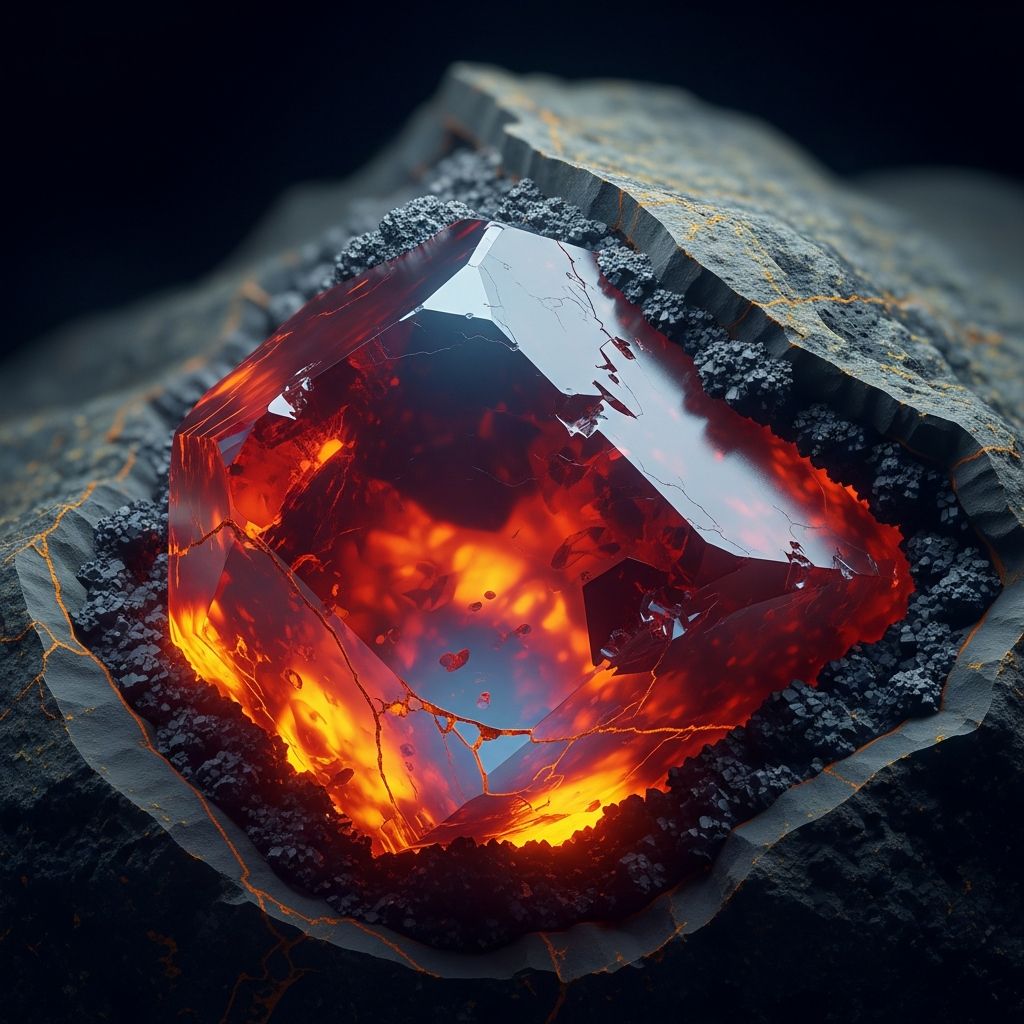
Deep within our planet, a mineral dominates the landscape, comprising nearly 38% of Earth’s total volume, yet it remains largely invisible to surface dwellers. Known as bridgmanite, this high-pressure silicate outstrips all others in sheer abundance, primarily residing in the lower mantle between 660 and 2,900 kilometers beneath the surface. While feldspar rules the crust at around 50%, bridgmanite claims supremacy across the entire Earth. This article delves into bridgmanite’s discovery, contrasts it with crustal leaders like feldspar and quartz, and examines their roles in geology.
The Hidden Champion: Bridgmanite in the Deep Mantle
Bridgmanite, a dense magnesium-iron silicate with the formula (Mg,Fe)SiO3, thrives under extreme pressures and temperatures unattainable near the surface. It forms the bulk of the lower mantle, a layer extending from about 660 km to 2,900 km deep, where conditions transform ordinary minerals into this perovskite-structured powerhouse. Scientists long suspected its existence through seismic data and lab simulations, but naming it required a natural sample.
In 2014, researchers analyzed a meteorite fragment from the Tenham fall in Australia, dating back to 1879. High-resolution imaging revealed tiny grains of bridgmanite, preserved from deep-space origins mirroring Earth’s interior. This breakthrough honored Percy Bridgman, the 1946 Nobel physicist who pioneered high-pressure studies. Bridgmanite’s stability at mantle depths explains its dominance; it cannot survive the journey to the surface via volcanism, remaining locked away.
Dominating the Crust: Feldspar’s Ubiquitous Presence
Shifting focus to the accessible crust (0-35 km deep), feldspar emerges as the undisputed leader, constituting up to 52% by volume. This group of framework silicates, rich in silicon, oxygen, aluminum, and alkali metals like potassium, sodium, or calcium, appears in igneous, sedimentary, and metamorphic rocks.
Feldspars split into two families:
- Plagioclase: Sodium-calcium varieties (e.g., albite to anorthite), common in basalts and gabbros.
- Potassium feldspars: Orthoclase and microcline, key in granites, making up ~12% of the crust.
Geologists prize feldspar for its role in classifying rocks; granite, for instance, derives its name from abundant K-feldspar. Weathering breaks it down into clays, fueling soil formation.
Quartz: The Enduring Silicate Sentinel
Ranking second in crustal abundance at ~12%, quartz (SiO2) embodies resilience. Its tetrahedral silica structure resists chemical breakdown, ensuring prominence in sands, sandstones, and veins. Quartz crystallizes in igneous settings like granites, survives erosion, and accumulates in sedimentary basins.
| Mineral | Crustal % | Key Rocks | Hardness (Mohs) |
|---|---|---|---|
| Feldspar | ~50% | Granite, basalt | 6-6.5 |
| Quartz | ~12% | Sandstone, granite | 7 |
| Clay minerals | Variable | Shales, soils | 1-2 |
This table highlights abundance contrasts; quartz’s superior hardness aids its persistence.
Other Crustal Contenders and Their Roles
Beyond the top duo, several minerals shape Earth’s outer shell:
- Micas (muscovite, biotite): Sheet silicates (~5%) providing rock foliation in metamorphics.
- Calcite (CaCO3): ~4% of crust, forms limestone via marine precipitation, effervesces in acid.
- Clay minerals (kaolinite, illite): Weathering products dominating soils and shales.
- Pyroxene and olivine: Mafic silicates in basalts and mantle peridotite, though olivine alters to serpentine near surface.
- Amphiboles (hornblende): Common in amphibolites and andesites.
Evaporites like gypsum and halite occur in sedimentary basins, while magnetite adds iron oxide to mafic rocks. Pyrite, the ‘fool’s gold,’ litters sediments despite lower abundance.
From Mantle to Surface: Geological Cycling
Earth’s minerals cycle through dynamic processes. Subduction recycles crustal feldspar and quartz into the mantle, potentially reforming as bridgmanite under pressure. Plate tectonics exhumes deep materials, but bridgmanite rarely escapes intact. Volcanism brings mantle olivines to light, quickly oxidizing.
Sedimentary processes concentrate quartz and calcite, forming vast limestone and sandstone layers. Metamorphism recrystallizes everything, yielding mica schists and marbles. This interplay ensures mineral diversity despite bridgmanite’s hegemony.
Why Bridgmanite Matters for Earth Science
Understanding bridgmanite illuminates mantle convection, driving plate tectonics. Its seismic velocity signatures help model Earth’s interior. Lab-synthesized versions inform high-pressure physics, with perovskite structures eyed for solar cells. Meteoritic samples validate models, bridging cosmic and terrestrial geology.
Common Minerals Comparison
| Mineral | Location | Abundance | Key Feature |
|---|---|---|---|
| Bridgmanite | Lower mantle | 38% volume | High-pressure perovskite |
| Feldspar | Crust | 50% crust | Framework silicate group |
| Quartz | Crust | 12% crust | Hard, weathering-resistant |
| Calcite | Crust/sediments | 4% crust | Carbonate, acid-soluble |
Such contrasts underscore context: volume vs. crust.
Challenges in Studying Deep Minerals
Surface sampling biases toward crustal minerals; bridgmanite evades direct access. Diamond anvil cells mimic conditions, but meteorites offer rare glimpses. Seismic tomography infers properties indirectly. Future deep-drilling or advanced spectroscopy may yield more insights.
Frequently Asked Questions (FAQs)
Is bridgmanite found on Earth’s surface?
No, bridgmanite forms only under extreme mantle pressures and destabilizes near the surface. Tiny grains appear in specific meteorites.
What makes feldspar the most common crustal mineral?
Its composition from abundant elements (Si, O, Al, Na, K, Ca) and stability across rock cycles ensure ~50% crustal dominance.
Can we see quartz everywhere?
Yes, in sand beaches, granites, and sandstones; its durability concentrates it in sediments.
How was bridgmanite named?
After Percy Bridgman for high-pressure research; confirmed via 1879 Tenham meteorite analysis in 2014.
Are there more abundant minerals than bridgmanite overall?
No, it comprises ~38% of Earth’s volume, far exceeding crustal leaders.
Mineral Identification Basics
For enthusiasts, key tests include:
- Hardness: Quartz scratches glass (7 Mohs); feldspar does not (6).
- Cleavage: Feldspars show two directions; micas one perfect sheet.
- Reaction: Calcite fizzes in dilute HCl.
- Luster/Streak: Pyrite’s metallic brass vs. magnetite’s black streak.
These traits aid field identification.
References
- 12 Most Common Minerals on Earth — Geology In. 2024-07-12. https://www.geologyin.com/2024/07/12-most-common-minerals-on-earth.html
- Earth’s most common mineral finally gets a name — Science News Explores. 2015-10-27. https://www.snexplores.org/article/earths-most-common-mineral-finally-gets-name
- Bridgmanite: The most abundant mineral on Earth — Science | AAAS. 2014-12-11. https://www.science.org/content/article/bridgmanite-most-abundant-mineral-earth
- The Most Common Minerals on the Earth — Mindat.org. N/A. https://www.mindat.org/a/common_minerals
- You’ve Never Heard of the World’s Most Common Mineral — SciShow (YouTube). 2023-approx. https://www.youtube.com/watch?v=k9XgXyQzEcc

- Integrated M.A. in Applied Linguistics, University of Hyderabad
- 5+ years in editorial, instructional, SEO, and research-based writing
Sneha is a relationships and lifestyle writer with a strong foundation in applied linguistics and certified training in relationship coaching. She brings over five years of writing experience to theskillvault, crafting thoughtful, research-driven content that empowers readers to build healthier relationships, boost emotional well-being, and embrace holistic living. Her writing and insights reflect the belief that beauty, happiness, and wellness…