
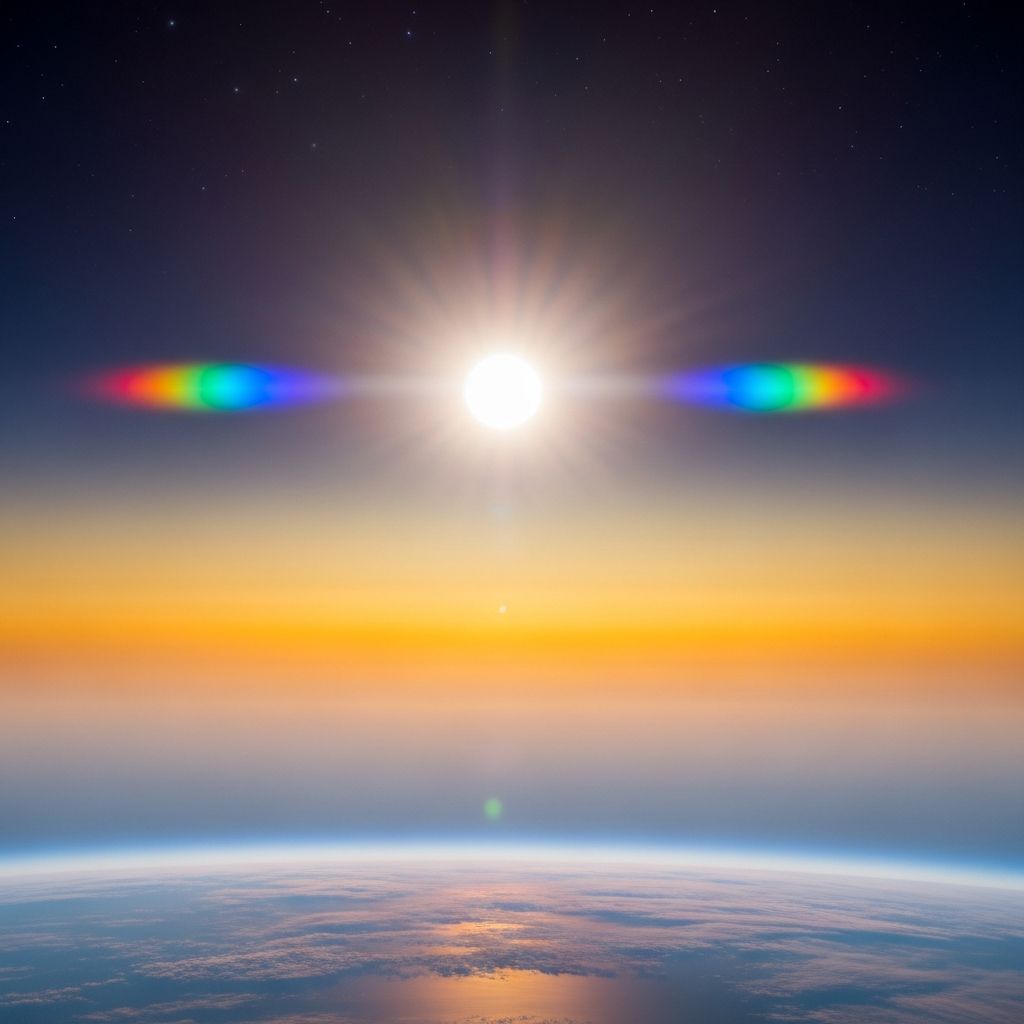
The sun dominates our sky, providing light and warmth essential for life on Earth. Most people describe it as yellow, but is that its actual color? Scientific analysis reveals a more nuanced picture involving stellar emissions, atmospheric effects, and human biology. This article delves into these factors, explaining why our star appears yellow despite emitting light across a broad spectrum.
Understanding the Sun’s Light Spectrum
The sun emits electromagnetic radiation across a vast range, from radio waves to gamma rays. The portion visible to humans spans wavelengths from about 400 to 700 nanometers, corresponding to violet, blue, green, yellow, orange, and red. Within this visible spectrum, the sun’s emission does not peak in yellow as commonly assumed.
Instead, measurements show the peak intensity in the visible range occurs in the green wavelengths, around 500-550 nanometers. This is determined by the sun’s surface temperature of approximately 5,500 Kelvin, which follows a blackbody radiation curve. According to solar physicists, if viewed in space without interference, the sun would appear predominantly white due to the balanced mix of all visible wavelengths.
- Key Spectrum Facts:
- Peak visible emission: Green ( ~520 nm )
- Overall appearance in vacuum: White
- Blackbody temperature: ~5,778 K
- Visible light fraction: Small part of total output
Role of Earth’s Atmosphere in Color Perception
Earth’s atmosphere fundamentally alters how we see the sun. Composed mainly of nitrogen and oxygen, it interacts with sunlight through scattering processes. The primary mechanism is Rayleigh scattering, named after physicist Lord Rayleigh, where gas molecules scatter shorter wavelengths more effectively than longer ones.
Blue and violet light, with shorter wavelengths, scatter dramatically across the sky, making it appear blue during midday. This scattering removes a significant portion of these shorter wavelengths from direct sunlight reaching our eyes. The remaining light, enriched in yellow, orange, and red, gives the sun its familiar warm hue.
| Wavelength Range | Color | Scattering Intensity | Effect on Sun’s Appearance |
|---|---|---|---|
| 400-450 nm | Violet/Blue | High | Scattered out (sky blue) |
| 450-500 nm | Blue/Green | Medium-High | Partially scattered |
| 500-570 nm | Green/Yellow | Medium | Passes through |
| 570-700 nm | Orange/Red | Low | Direct transmission |
At noon, when the sun is overhead, the light path through the atmosphere is shortest, minimizing scattering and making the sun appear whiter or pale yellow. Near sunrise or sunset, the longer path enhances scattering, shifting the appearance to orange or red.
How Human Eyes Interpret Solar Light
Human color vision relies on three types of cone cells in the retina: short-wavelength (S-cones for blue), medium-wavelength (M-cones for green), and long-wavelength (L-cones for red). The brain combines signals from these cones to perceive color.
When viewing the sun, the intense brightness overwhelms the system. Our eyes are less sensitive to violet, and the scattered blue light reduces its contribution. The balanced green peak, combined with transmitted yellow and red, triggers a yellow perception. This is not the sun’s intrinsic color but a result of atmospheric filtering and visual processing.
Astronomers note that astronauts in space, outside the atmosphere, see the sun as white, confirming atmospheric influence.
Debunking the Green Sun Myth
Some claim the sun is green because its spectrum peaks there. However, color perception does not isolate the peak wavelength; it integrates the entire spectrum. A green peak amid white light still yields white overall. Only if the emission were narrowly green would it appear so, which is not the case for our G-type star.
- Myths vs. Facts:
- Myth: Sun peaks in yellow. Fact: Peaks in green.
- Myth: Atmosphere makes it green-filtered white. Fact: Removes blue, enriching yellow-red.
- Myth: Eyes see peak directly. Fact: Brain mixes all wavelengths.
Observing the Sun from Space vs. Earth
Satellite imagery from NASA, like those from the Solar Dynamics Observatory, captures the sun in specific wavelengths, often appearing white or with false colors for analysis. Direct views from orbit confirm its white appearance due to no atmospheric scattering.
On Earth, conditions vary: pollution or dust can enhance yellowing, while clear skies yield a brighter white-yellow. Volcanic eruptions or wildfires introduce aerosols that scatter differently, sometimes reddening the sun further.
Implications for Astronomy and Daily Life
Understanding this color illusion aids astronomy. Filters simulating space views reveal the sun’s true white nature. In daily life, it explains why shadows under midday sun appear bluish (scattered light) while the sunlit areas are yellowish.
This phenomenon extends to other stars: hotter ones appear blue-white, cooler ones red, based on temperature-driven spectra. Our sun’s position makes it appear yellow from our vantage.
Experimental Ways to Verify Sun’s Color
To test this, observe the sun through a neutral density filter (safe viewing essential) at high altitude or use spectrographs. Apps simulating blackbody curves at 5778K show white output. Comparing midday vs. sunset photos illustrates atmospheric effects.
- Safely project sun’s image via pinhole.
- Use diffraction grating for spectrum.
- Compare space photos (NASA) with ground views.
Frequently Asked Questions (FAQs)
What is the sun’s actual color in space?
The sun appears white in space because it emits a balanced spectrum across all visible wavelengths, without atmospheric filtering.
Why does the sky look blue if the sun is yellow?
Blue light scatters in all directions due to Rayleigh scattering, filling the sky, while direct sun path loses blue, appearing yellow.
Is the sun ever truly green?
No, its green peak is part of a broad white spectrum; perception never isolates it as green.
How does sunset change the sun’s color?
Longer atmospheric path scatters more blue/green, leaving red/orange dominant.
Do all people see the sun as yellow?
Most do due to similar vision, but colorblind individuals or varying atmospheric conditions can alter perception.
Advanced Topics: Blackbody Radiation and Stellar Classification
The sun approximates a blackbody, an idealized emitter. Wien’s law predicts peak wavelength inversely proportional to temperature: λ_max = 2.897 × 10^-3 / T (meters/K). For 5778K, this is ~502 nm (green). Stars are classified by spectral type: O (hot, blue), B, A, F, G (sun), K, M (cool, red).
This classification correlates with color: G2V like the sun is white but appears yellow from Earth. Precise measurements use photometry filters (U,B,V,R,I) quantifying fluxes.
Expanding on this, solar irradiance data from NASA shows total output ~1366 W/m² at top of atmosphere, with visible ~43%. Atmospheric transmittance favors longer waves, shifting balance.
Historical Context and Scientific Discovery
Isaac Newton first dispersed sunlight into a spectrum in 1666, revealing colors. Rayleigh formalized scattering in 1871, explaining sky blue. Modern solar physics, via satellites like SOHO and SDO, confirms spectrum details.
Debates on sun’s color persisted; some 19th-century texts called it yellow due to observation, but space era clarified truths.
In summary, the sun’s yellow guise is an atmospheric and perceptual trick on its white, green-peaking light. This knowledge enriches appreciation of our star’s physics.
References
- Much of the sun’s light is green. Why does it look yellow? — Science News Explores (Society for Science). 2025-05-05. https://www.snexplores.org/article/color-sun-light-green-yellow
- What makes the sun look yellow in color and the sky blue? — Encyclopædia Britannica. Accessed 2026. https://www.britannica.com/video/yellow-Sun-sky-blue-light-colours-air/-204059
- Why does the Sun appear Yellow? — AumSum WhatIf (YouTube transcript). Accessed 2026. https://www.youtube.com/watch?v=B8wQVGPhorc
- What Color do YOU think the Sun is? — Stanford Solar Center (NASA-affiliated). Accessed 2026. https://solar-center.stanford.edu/sid/activities/GreenSun.html

Medha Deb is an editor with a master's degree in Applied Linguistics from the University of Hyderabad. She believes that her qualification has helped her develop a deep understanding of language and its application in various contexts. Medha specializes in the areas of beauty, health, sports, and wellness and is committed to ensuring that the content on the website is…