
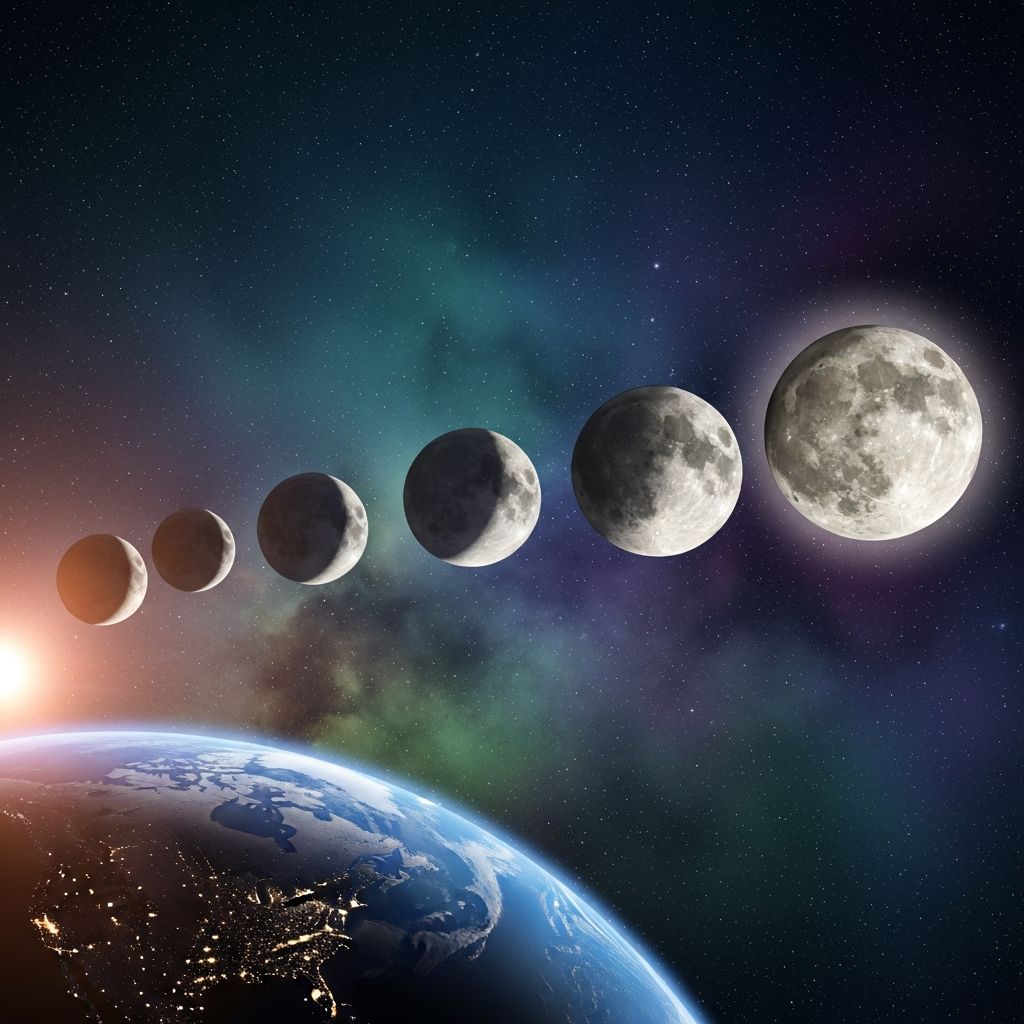
The Moon has captivated humanity for millennia, its ever-changing face a source of wonder, inspiration, and even practical guidance. These transformations, known as lunar phases, result from the interplay of sunlight, Earth’s orbit, and the Moon’s journey around our planet. Understanding them reveals not just celestial mechanics but also deep cultural and scientific insights.
The Science Behind the Moon’s Shape-Shifting
At its core, the Moon doesn’t produce light; it reflects the Sun’s rays. Half of the Moon is always illuminated, but from Earth, we see varying portions due to its orbital position. The Moon completes one orbit around Earth every 27.3 days, but the phases cycle every 29.5 days because Earth orbits the Sun, shifting our perspective slightly each time.
This synodic month, as astronomers call it, divides into eight distinct phases. Primary phases—New Moon, First Quarter, Full Moon, and Last Quarter—mark exact moments when the Moon’s position aligns at 0°, 90°, 180°, and 270° relative to the Sun from Earth’s center. Intermediate phases fill the gaps, creating a smooth transition.
Sequential Journey Through the Eight Phases
Let’s trace the Moon’s cycle starting from invisibility.
1. New Moon: The Hidden Beginning
During the New Moon, the Moon sits between Earth and Sun, its illuminated half facing away from us. It’s nearly invisible, appearing as a faint shadow during the day. This alignment can lead to solar eclipses if perfectly positioned. Perfect for stargazing elsewhere in the sky.
2. Waxing Crescent: First Glimpses of Light
A slim, right-side crescent emerges in the Northern Hemisphere as the Moon pulls ahead in its orbit. Less than half illuminated, it sets soon after sunset, visible briefly in the west.
3. First Quarter: Halfway to Full
Exactly one week in, half the Moon glows—a clear D-shape with the right side lit. Rising at noon and setting at midnight, it’s ideal for observing craters.
4. Waxing Gibbous: Bulging Brightness
More than half illuminated, the Moon swells toward fullness. Rising in the afternoon, it dominates evening skies, revealing intricate details through binoculars.
5. Full Moon: Complete Illumination
Opposite the Sun, the entire face shines brilliantly. Rising at sunset, it bathes nights in silver light, sometimes causing lunar eclipses. The ‘harvest moon’ effect makes it appear larger near the horizon.
6. Waning Gibbous: Gentle Decline
Post-full, illumination recedes from the right. Rising after sunset, it’s still prominent but shrinking nightly.
7. Last Quarter: The Mirror Half
Three weeks in, the left half illuminates, opposite the First Quarter. Rising around midnight, it’s a contemplative sight for late-night viewers.
8. Waning Crescent: Fading to Darkness
A thin left crescent clings before dawn, the last visible phase before renewal. It rises just before sunrise, whispering of cycles ending.
Visualizing the Cycle: A Phase Comparison Table
| Phase | Illumination (% Approx.) | Rise/Set Time (Northern Hemisphere) | Key Feature |
|---|---|---|---|
| New Moon | 0% | Same as Sun | Invisible |
| Waxing Crescent | 1-49% | After sunset | Right crescent |
| First Quarter | 50% | Noon to midnight | Right half |
| Waxing Gibbous | 51-99% | Afternoon | Near full |
| Full Moon | 100% | Sunset | Entire disk |
| Waning Gibbous | 99-51% | After sunset | Left-dominant |
| Last Quarter | 50% | Midnight to sunrise | Left half |
| Waning Crescent | 49-1% | Before sunrise | Left crescent |
This table summarizes timings and appearances, aiding quick reference. Note: Southern Hemisphere views mirror horizontally.
Why Phases Differ by Hemisphere
In the Southern Hemisphere, crescents thicken on the left during waxing due to reversed orientations. The cycle remains identical in sequence and timing, just flipped. Global apps adjust for location seamlessly.
Practical Tips for Moon Watching
- Best Tools: Naked eye for basics; binoculars reveal maria (dark plains); telescopes show rilles and mountains.
- Optimal Times: Quarter phases minimize glare for details; avoid full moon’s brightness washout.
- Apps & Calendars: Use NASA or USNO tools for precise phase dates.
- Safety: Never view solar eclipses without protection; lunar ones are safe.
Cultural Echoes Across Time
Lunar phases transcend science, embedding in human lore. Ancient calendars like Hebrew and Islamic rely on sightings for months. Festivals—Chinese Mid-Autumn, Hindu Karva Chauth—honor the full moon. Werewolves and tides link mythically, though tides follow gravitational pull, peaking at full/new.
In agriculture, planting by phases persists: root crops at new moon, above-ground at full. Modern studies question efficacy, but traditions endure.
Advanced Insights: Eclipses and Anomalies
Solar eclipses occur at new moon alignments; lunar at full. The Moon’s 5° orbital tilt prevents monthly events. Supermoons (perigee full moons) appear 14% larger, 30% brighter. Blue moons—second full in a month—spark idioms.
Modern Relevance in Science and Tech
Phases aid satellite timing, space missions, and even smartphone cameras’ night modes. NASA’s Artemis eyes lunar south pole, where phases influence eternal light/shadow zones for bases.
Frequently Asked Questions About Lunar Phases
What causes the Moon’s phases?
The changing angles of sunlight on the Moon as it orbits Earth, revealing different illuminated portions.
How long is a lunar cycle?
About 29.5 days from new moon to new moon.
Can you see phases during the day?
Yes, especially quarters, appearing pale against blue skies.
Do phases affect human behavior?
No scientific evidence; studies debunk ‘lunacy’ myths.
What’s the difference between waxing and waning?
Waxing increases illumination post-new moon; waning decreases post-full.
Observing Tonight: Your Lunar Adventure Awaits
Step outside—phases offer free nightly theater. Track one cycle; journal changes. From city lights to dark skies, the Moon unites us under shared skies.
References
- Lunar phase — Wikipedia. 2023-10-01. https://en.wikipedia.org/wiki/Lunar_phase
- Moon Phases — NASA Science. 2024-01-15. https://science.nasa.gov/moon/moon-phases/
- Phases of the Moon and Percent of the Moon Illuminated — U.S. Naval Observatory. 2023-11-20. https://aa.usno.navy.mil/faq/moon_phases
- What Are the Moon’s Phases? — NASA Space Place. 2024-02-10. https://spaceplace.nasa.gov/moon-phases/
- The phases of the moon — National Geographic Kids. 2023-09-05. https://www.natgeokids.com/au/discover/science/space/the-phases-of-the-moon/

- Integrated M.A. in Applied Linguistics, University of Hyderabad
- 5+ years in editorial, instructional, SEO, and research-based writing
Sneha is a relationships and lifestyle writer with a strong foundation in applied linguistics and certified training in relationship coaching. She brings over five years of writing experience to theskillvault, crafting thoughtful, research-driven content that empowers readers to build healthier relationships, boost emotional well-being, and embrace holistic living. Her writing and insights reflect the belief that beauty, happiness, and wellness…