
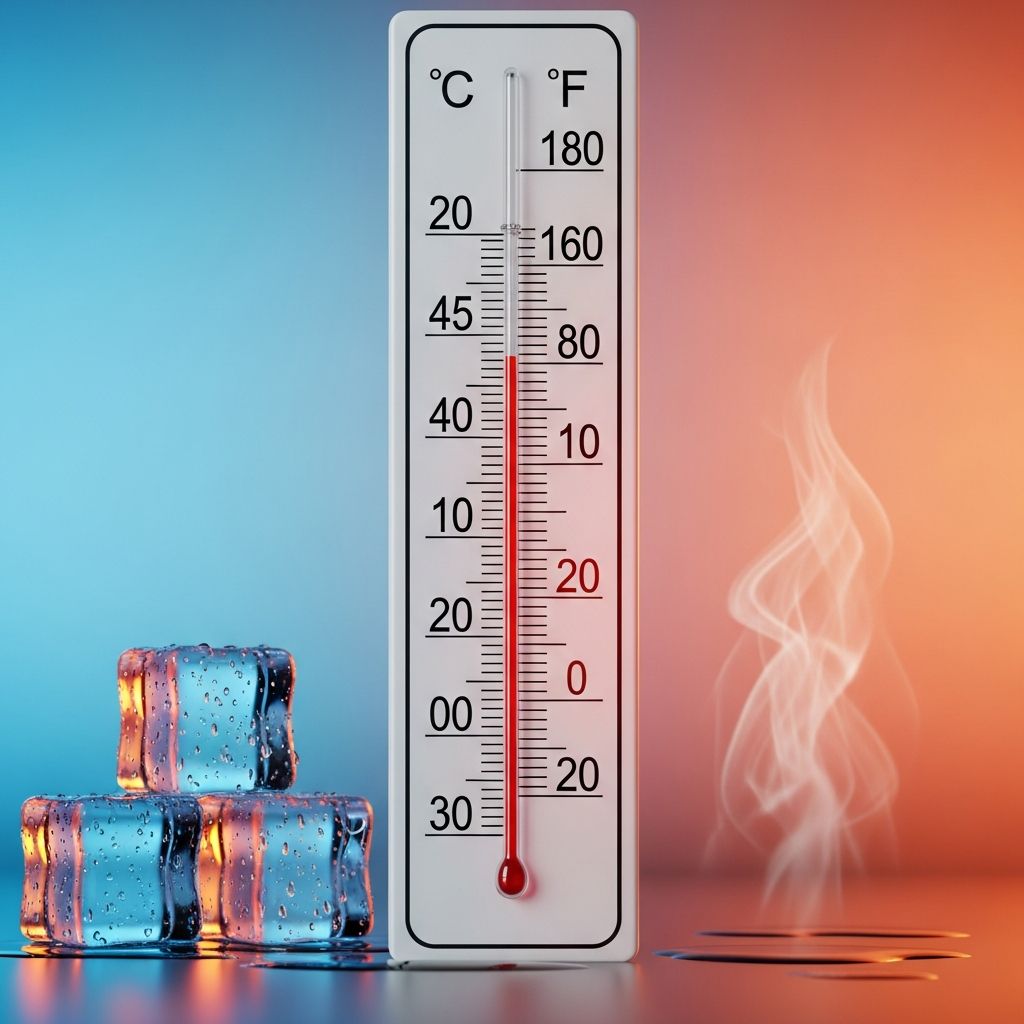
Understanding the Two Temperature Scales
Temperature measurement is fundamental to science, cooking, medicine, and weather forecasting. The world primarily uses two temperature scales: Celsius (also known as Centigrade) and Fahrenheit. While Celsius dominates in scientific communities and most countries worldwide, Fahrenheit remains prevalent in the United States and a few other nations. Understanding how to convert between these scales is essential for anyone working across international borders or studying science.
The Celsius scale, developed by Swedish astronomer Anders Celsius in 1742, defines the freezing point of water as 0°C and the boiling point as 100°C at standard atmospheric pressure. The Fahrenheit scale, created by German physicist Daniel Gabriel Fahrenheit in 1724, sets the freezing point of water at 32°F and the boiling point at 212°F. This difference in reference points and scale intervals makes conversion between the two systems necessary.
The Mathematical Foundation Behind Temperature Conversion
Converting between temperature scales requires understanding the mathematical relationship between them. The conversion formulas are based on the difference in reference points and the ratio of degrees between the two scales. One degree Celsius equals 1.8 degrees Fahrenheit (or expressed as a fraction, 9/5). This ratio represents the proportional difference in how each scale divides the temperature range between water’s freezing and boiling points.
The fundamental relationship can be expressed as: the Celsius scale uses 100 degrees to represent the temperature change from freezing to boiling, while Fahrenheit uses 180 degrees for the same temperature change. This creates the 9/5 ratio that appears in all conversion calculations.
Converting Celsius to Fahrenheit: The Exact Formula
The precise method for converting Celsius to Fahrenheit involves a straightforward two-step mathematical process. To convert any Celsius temperature to Fahrenheit:
- Multiply the Celsius temperature by 1.8 (which is equivalent to 9/5)
- Add 32 to the result
This can be expressed as the formula: °F = (°C × 1.8) + 32. Alternatively, using fractions: °F = (°C × 9/5) + 32.
Let’s work through a practical example. Suppose you need to convert 25°C to Fahrenheit:
- Multiply 25 by 1.8: 25 × 1.8 = 45
- Add 32 to the result: 45 + 32 = 77
- Therefore, 25°C equals 77°F
Another example with a different value: converting 21.5°C to Fahrenheit:
- Multiply 21.5 by 1.8: 21.5 × 1.8 = 38.7
- Add 32: 38.7 + 32 = 70.7
- Therefore, 21.5°C equals 70.7°F
Converting Fahrenheit to Celsius: The Reverse Process
When working in the opposite direction, converting Fahrenheit temperatures to Celsius requires reversing the mathematical operations. The formula for this conversion is: °C = (°F – 32) / 1.8.
The two-step process involves:
- Subtract 32 from the Fahrenheit temperature
- Divide the result by 1.8 (or multiply by 5/9)
For example, converting 68°F to Celsius:
- Subtract 32 from 68: 68 – 32 = 36
- Divide by 1.8: 36 / 1.8 = 20
- Therefore, 68°F equals 20°C
Mental Math Shortcuts for Quick Conversions
While exact formulas provide precision, sometimes you need a quick estimation without a calculator. Several mental math tricks can help you convert temperatures rapidly, though with slightly less accuracy.
The most popular quick trick for Celsius to Fahrenheit conversion is to double the Celsius temperature and add 30. This method is straightforward:
- Multiply the Celsius temperature by 2
- Add 30
Using 20°C as an example: 20 × 2 = 40, then 40 + 30 = 70°F. This gives a reasonably close approximation, though results may be a few degrees higher than the exact conversion.
A more refined approach involves an additional step for better accuracy. This method requires:
- Double the Celsius temperature
- Remove 10% from that result (subtract one-tenth)
- Add 32
Using the same 20°C example:
- Double 20: 20 × 2 = 40
- Remove 10% from 40: 40 – 4 = 36
- Add 32: 36 + 32 = 68°F
This produces a much more accurate result (actual conversion: 68°F) compared to the simpler double-and-add-30 method.
For reverse conversions from Fahrenheit to Celsius using mental math, the complementary quick trick is to subtract 30 and divide by 2. This works reasonably well for weather-related temperatures.
Comparison Table of Common Temperatures
Here is a reference table showing common temperature conversions:
| Celsius (°C) | Fahrenheit (°F) |
|---|---|
| 0 | 32.0 |
| 5 | 41.0 |
| 10 | 50.0 |
| 15 | 59.0 |
| 20 | 68.0 |
| 25 | 77.0 |
| 30 | 86.0 |
| 35 | 95.0 |
| 40 | 104.0 |
| 100 | 212.0 |
Critical Reference Points to Remember
Certain key temperature conversions serve as anchors for understanding the relationship between scales:
- Water freezes at 0°C (32°F)
- Room temperature is approximately 20°C (68°F)
- Normal human body temperature is about 37°C (98.6°F)
- Water boils at 100°C (212°F)
Memorizing these reference points helps you verify whether a conversion is reasonable and provides starting points for quick mental calculations.
Why These Scales Have Different Ranges
The historical development of these temperature scales explains their different intervals. When Fahrenheit created his scale in the early 18th century, he used a more granular approach, dividing the temperature range into more segments. Later, Celsius designed a simpler scale aligned with water’s phase changes. This historical difference persists today, requiring the conversion factor of 1.8 or 9/5.
The offset of 32 degrees in Fahrenheit represents a deliberate choice by Fahrenheit to avoid negative temperatures in everyday weather measurements common in his northern European location. This design choice, while practical historically, now requires the addition of 32 in all conversions.
Practical Applications in Daily Life
Temperature conversion skills apply to numerous real-world situations:
- International Travel: When visiting countries using different temperature scales, quick conversions help you understand weather forecasts and adjust clothing appropriately.
- Scientific Research: Scientists and engineers frequently work with data from international collaborators, necessitating accurate temperature conversions.
- Cooking: International recipes often specify temperatures in one scale, requiring conversion to match your oven’s measurement system.
- Medical Contexts: Healthcare professionals must accurately convert patient temperatures, particularly when consulting international medical literature.
- Industrial Processes: Manufacturing and industrial operations worldwide require precise temperature control and accurate inter-scale conversions.
Using Conversion Charts and Digital Tools
While formulas and mental math tricks are valuable, conversion charts and digital calculators provide quick, reliable references. Printed charts are particularly useful in settings where devices aren’t available, such as laboratories, kitchens, or outdoor scientific fieldwork. Many organizations maintain standard conversion charts for workplace reference.
Digital tools offer advantages including immediate results, handling of unusual values, and accessibility on multiple platforms. However, understanding the underlying mathematics ensures you can verify results and perform conversions independently when technology is unavailable.
Frequently Asked Questions
Q: What is the absolute zero temperature in both scales?
A: Absolute zero, the lowest possible temperature in the universe, is -273.15°C or -459.67°F. This represents the complete absence of thermal energy.
Q: Is there a temperature where Celsius and Fahrenheit are equal?
A: Yes, at -40 degrees, both scales show the same numerical value: -40°C = -40°F. This point occurs because the scales intersect at this specific temperature.
Q: How accurate are the quick mental math tricks?
A: The double-and-add-30 method typically yields results within 1-2 degrees of the exact conversion for common temperature ranges. The refined method (double, subtract 10%, add 32) is significantly more accurate.
Q: Which scale is more precise for scientific work?
A: Both scales have equal precision capability. The choice depends on the scientific field and international standards. Celsius is standard in most scientific disciplines globally.
Q: Can I convert negative temperatures using the same formulas?
A: Yes, the formulas work identically for negative temperatures. For example, -20°C = (-20 × 1.8) + 32 = -36 + 32 = -4°F.
Q: Why do I need to add 32 in the conversion formula?
A: The 32 represents the offset between the scales’ freezing points. Fahrenheit sets water’s freezing point at 32°F, while Celsius uses 0°C, creating this constant adjustment.
References
- Celsius to Fahrenheit Formula and Conversion — Calculator Soup. Accessed April 2026. https://www.calculatorsoup.com/calculators/conversions/celsius-to-fahrenheit.php
- The Easy Trick to Convert Celsius to Fahrenheit — Prep Scholar. Accessed April 2026. https://blog.prepscholar.com/convert-celsius-to-fahrenheit
- Easily Convert Celsius to Fahrenheit: HVAC Temperatures — AC Direct. Accessed April 2026. https://www.acdirect.com/blog/convert-celsius-fahrenheit
- Temperature Unit Converter: Celsius to Fahrenheit — Beamex. Accessed April 2026. https://www.beamex.com/us/resources/temperature-unit-converter/
- Temperature Conversion – Celsius to Fahrenheit — Newark Electronics. Accessed April 2026. https://canada.newark.com/temperature-converter

Medha Deb is an editor with a master's degree in Applied Linguistics from the University of Hyderabad. She believes that her qualification has helped her develop a deep understanding of language and its application in various contexts. Medha specializes in the areas of beauty, health, sports, and wellness and is committed to ensuring that the content on the website is…