
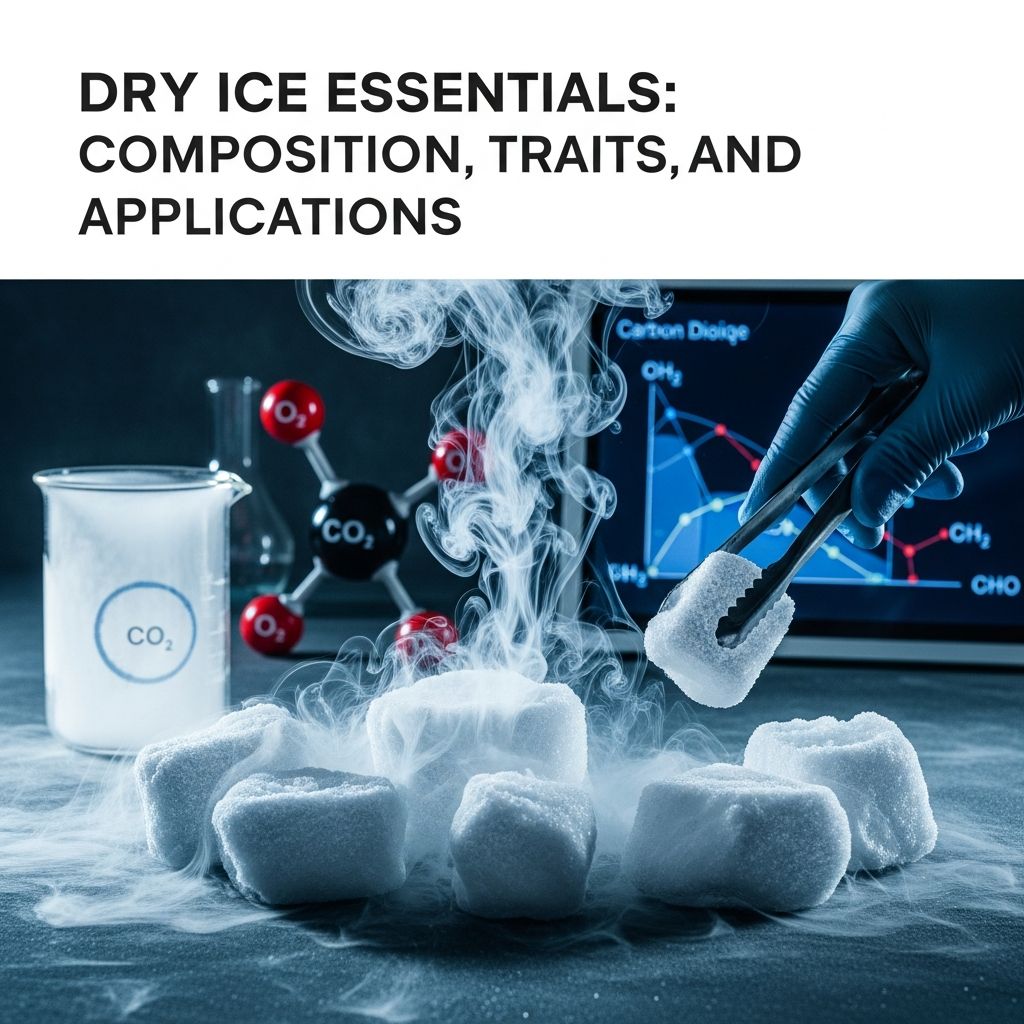
Dry ice represents solid carbon dioxide, a material that transitions directly from solid to gas at -78.5°C without melting into liquid, enabling unique cooling without residue.
Understanding the Molecular Makeup of Dry Ice
At its core, dry ice consists entirely of carbon dioxide (CO2), where one carbon atom bonds with two oxygen atoms in a linear molecule. This simple composition arises from capturing CO2 generated as a byproduct in industrial processes like fermentation or fossil fuel combustion. Unlike water ice (H2O), dry ice lacks hydrogen, granting it distinct physical behaviors under pressure and temperature changes.
Production begins with compressing gaseous CO2 until it liquefies, followed by controlled expansion that forms snowy crystals, which are then pressed into pellets, blocks, or slices for practical handling. High-purity dry ice exceeds 99.9% CO2, though trace impurities from manufacturing may occur, necessitating purity checks for sensitive uses like pharmaceuticals.
Fundamental Physical and Chemical Traits
Dry ice maintains a constant temperature of -78.5°C (-109.3°F) at standard pressure, far colder than water ice’s 0°C. Its defining feature is sublimation, bypassing the liquid phase to release CO2 gas, which condenses atmospheric moisture into visible fog.
- Extreme Cold: Ideal for rapid freezing, absorbing significant heat during phase change.
- Density: About 1.4-1.6 g/cm³, denser than water ice, allowing compact storage.
- Non-Flammable: Chemically inert, stable, and colorless, appearing white due to frost.
- Sublimation Rate: Loses 5-10 pounds per 24 hours in air, accelerated by warmth, airflow, or fragmentation.
These traits position dry ice as superior for residue-free cooling compared to traditional methods.
Production Techniques and Quality Control
Manufacturers start with liquid CO2 in insulated tanks, forcing it through nozzles to drop pressure and temperature, yielding CO2 snow. Hydraulic presses shape this snow into forms: pellets (3-16mm) for blasting, blocks (up to 10kg) for shipping. Facilities monitor food-grade standards via NSF or FDA certifications for purity.
| Form | Size Range | Primary Uses |
|---|---|---|
| Pellets | 3-16 mm | Blasting, medical transport |
| Blocks | 5-10 kg | Bulk refrigeration |
| Slices/Nuggets | Variable | Lab, events |
Storage demands thick insulation to curb sublimation; exposure halves lifespan.
Contrasting Dry Ice with Traditional Water Ice
Water ice melts above 0°C, creating wet mess unsuitable for certain transports, while dry ice sublimates cleanly. Dry ice’s lower temperature enables faster chilling, vital for perishables.
| Property | Dry Ice | Water Ice |
|---|---|---|
| Sublimation/Melting Point | -78.5°C | 0°C |
| Phase Change | Solid to Gas | Solid to Liquid |
| Residue | None | Water |
| Duration (uninsulated) | 24 hours (5-10 lb loss) | Days |
| Fragility | Brittle | Tougher |
Dry ice suits dynamic cooling needs despite shorter lifespan.
Key Applications Across Industries
Preserving Food and Pharmaceuticals
Dry ice excels in cold chain logistics, maintaining -18°C to -78°C for meats, ice cream, and vaccines without electricity. It prevents bacterial growth, extending shelf life during global shipping. In medicine, it transports organs, blood, and biologics, complying with WHO standards.
Industrial Cleaning Innovations
Dry ice blasting propels pellets at 150 m/s to dislodge contaminants via thermal shock and gas expansion, residue-free for food plants, electronics, and aviation. It cuts water use by 100% versus traditional methods.
Entertainment and Scientific Roles
Theatrical fog from sublimation enhances stage effects safely. Labs use it for -78.5°C storage of samples, DNA, and reactions; cryotherapy employs it for wart removal.
Emerging and Niche Uses
Pest control leverages CO2 to suffocate infestations; firefighting supplements suppressors for electrical blazes. Water treatment employs it to float debris.
Critical Safety Measures and Best Practices
Dry ice’s cold risks frostbite within seconds; always use insulated gloves. Sublimation elevates CO2 levels, demanding ventilation to avert asphyxiation (OSHA limit: 5000 ppm). Never seal in airtight containers to prevent explosions.
- Handle with cryogenic gloves, tongs.
- Store in ventilated, insulated chests.
- Avoid skin contact; rinse frostbite under cool water.
- Keep from pets, children; supervise use.
- Transport upright, open vents.
OSHA mandates training for industrial handling.
Environmental Impact and Sustainability
Dry ice’s CO2 returns to atmosphere, neutral if from captured sources, reducing fossil reliance. Reusable blasting cuts waste; industries adopt it for green cleaning certifications.
Future Prospects and Innovations
Advancements include longer-lasting additives, precise pellet tech for 3D printing molds, and space applications (NASA Mars simulations). Carbon capture integration enhances sustainability.
Frequently Asked Questions (FAQs)
What temperature does dry ice reach?
Dry ice stays at -78.5°C (-109.3°F) until fully sublimed.
Is dry ice safe for food contact?
Yes, food-grade variants are FDA-approved; ensure ventilation.
How to dispose of dry ice?
Let sublimate in ventilated area; never down drains.
Can dry ice damage skin?
Yes, causes frostbite; use protection.
Does dry ice produce liquid water?
No, it sublimates directly to gas.
How long does dry ice last?
Typically 24 hours uninsulated, longer insulated.
References
- Dry ice: uses and characteristics — Cryospain. 2023. https://cryospain.com/dry-ice-uses-characteristics
- Master Dry Ice Composition and Properties: Safety Guide — Dry Ice Composition and Properties. 2025-06-07. https://dry-ice-composition-and-properties20250607.pages.dev/posts/dry-ice-composition-and-properties/
- Dry ice | Uses, Description, Sublimation, Formation — Britannica. 2026. https://www.britannica.com/technology/dry-ice
- Dry ice components — White Lion. 2023. https://white-lion.eu/en/dry-ice-blasting-machines/dry-ice-guide/dry-ice-production/ingredients/
- Unique Properties of Dry Ice and Its Applications — nexAir. 2023. https://www.nexair.com/learning-center/unique-properties-of-dry-ice-and-its-applications/

- Integrated M.A. in Applied Linguistics, University of Hyderabad
- 5+ years in editorial, instructional, SEO, and research-based writing
Sneha is a relationships and lifestyle writer with a strong foundation in applied linguistics and certified training in relationship coaching. She brings over five years of writing experience to theskillvault, crafting thoughtful, research-driven content that empowers readers to build healthier relationships, boost emotional well-being, and embrace holistic living. Her writing and insights reflect the belief that beauty, happiness, and wellness…