
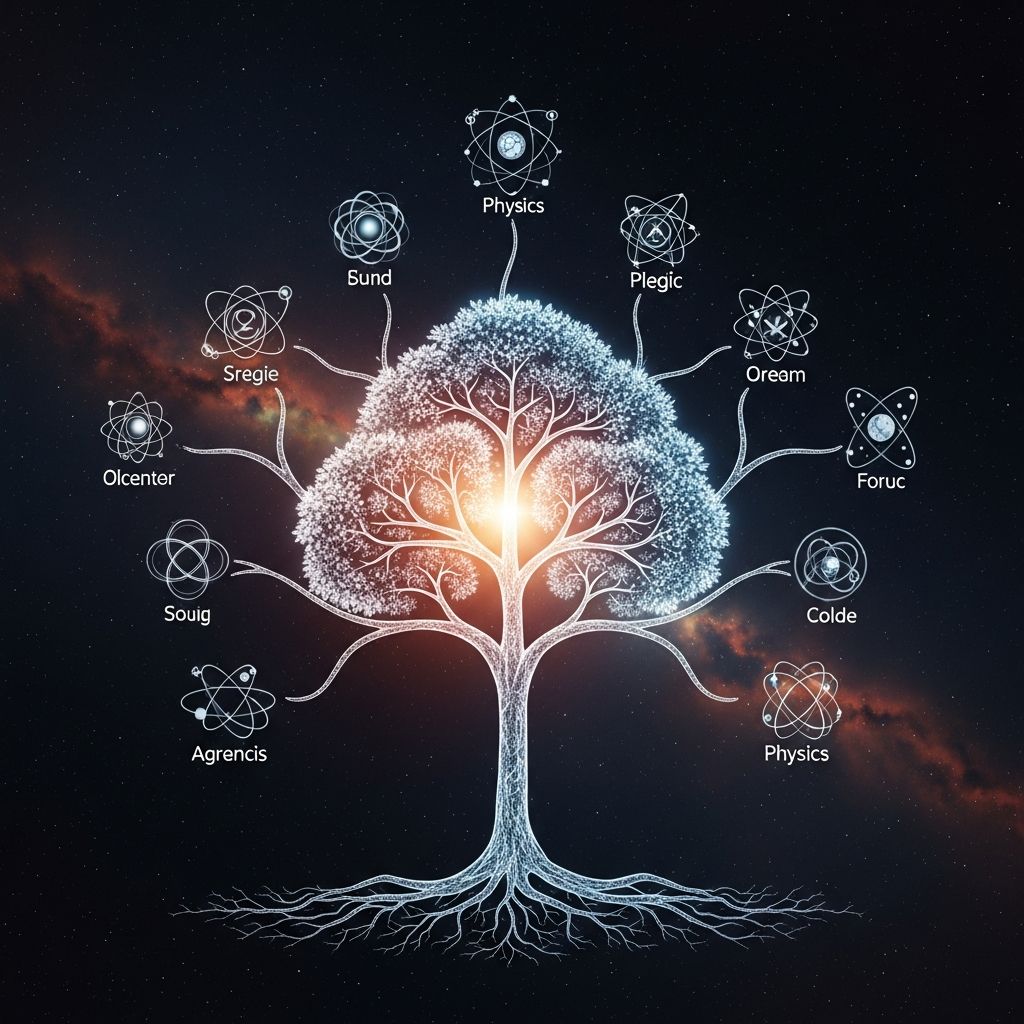
Physics stands as the cornerstone of natural sciences, seeking to unravel the fundamental laws governing the universe. From the motion of everyday objects to the behavior of subatomic particles, its branches provide frameworks for understanding reality. This article delves into the primary divisions of physics, highlighting their core concepts, historical development, and practical implications.
Foundational Pillars: Classical Physics
Classical physics forms the bedrock of the discipline, describing phenomena observable at macroscopic scales using deterministic laws. It encompasses several interconnected areas that dominated scientific thought until the early 20th century.
The Science of Motion and Forces: Mechanics
Mechanics investigates how objects respond to forces, whether at rest or in motion. Newton’s three laws of motion— inertia, F=ma, and action-reaction—provide the mathematical backbone for predicting trajectories and interactions. This branch splits into statics (equilibrium) and dynamics (motion), with applications in engineering, from bridge design to rocket propulsion.
- Key Concepts: Velocity, acceleration, momentum, energy conservation.
- Applications: Automotive safety systems, sports ballistics, planetary orbits.
Heat, Work, and Energy Transfer: Thermodynamics
Thermodynamics explores the relationships between heat, work, temperature, and energy. The four laws govern processes like engine efficiency and refrigeration, emphasizing entropy’s role in irreversible changes. Statistical mechanics links microscopic particle behavior to macroscopic properties.
| Law | Description | Example |
|---|---|---|
| Zeroth Law | Defines thermal equilibrium | Thermometer calibration |
| First Law | Energy conservation (ΔU = Q – W) | Heat engines |
| Second Law | Entropy increases in isolated systems | Ice melting |
| Third Law | Entropy approaches zero at absolute zero | Superconductivity studies |
Forces of Nature: Electromagnetism and Waves
Electric and Magnetic Interactions
Electromagnetism unifies electricity and magnetism, described by Maxwell’s equations. It explains phenomena from lightning to radio waves, powering modern electronics. Key ideas include fields, charges, currents, and electromagnetic induction.
- Discoveries: Faraday’s induction, Oersted’s magnetic fields from currents.
- Technologies: Generators, transformers, wireless communication.
Light, Sound, and Wave Phenomena
Optics studies light’s properties—reflection, refraction, diffraction—essential for lenses and lasers. Acoustics examines sound wave propagation, vibration, and resonance, applied in ultrasound imaging and concert hall design. Both reveal wave-particle duality hints.
Revolutionary Frameworks: Modern Physics
The 20th century introduced paradigms challenging classical views, addressing high speeds, tiny scales, and extreme conditions.
Spacetime and Gravity: Relativity
Einstein’s relativity comprises special (constant velocity, no gravity) and general (gravity as spacetime curvature) theories. Special relativity yields E=mc² and time dilation; general explains black holes and GPS corrections.
- Predictions: Light bending during eclipses, gravitational waves detected in 2015.
- Implications: Nuclear energy, cosmology.
Atomic and Subatomic Realms: Quantum Physics
Quantum mechanics governs particles at atomic scales, featuring wave functions, superposition, and uncertainty. The Schrödinger equation predicts probabilities, underpinning semiconductors and quantum computing.
Subfields include quantum electrodynamics (light-matter interactions) and field theory.
Specialized and Interdisciplinary Domains
Nuclear and Particle Frontiers
Nuclear physics probes atomic nuclei, fission, fusion, and radioactivity, fueling reactors and medicine. Particle physics seeks fundamental constituents via accelerators like the LHC, discovering Higgs boson and quarks.
Matter in Extremes: Condensed Matter and Cryogenics
Condensed matter (solid-state) analyzes solids’ electrical, magnetic properties, birthing transistors and superconductors. Cryogenics studies low-temperature behaviors like superfluidity.
Cosmic Scales: Astrophysics and Cosmology
Astrophysics applies physics to stars, galaxies, and phenomena like supernovae. Cosmology models universe evolution, Big Bang, dark matter/energy.
Earth and Environment: Geophysics and Beyond
Geophysics uses seismic waves, magnetism for Earth’s interior, resource exploration. Biophysics, medical physics apply principles to life processes, imaging.
Emerging and Applied Fields
Interdisciplinary branches like computational physics (simulations), nanophysics, and plasma physics drive innovation in AI, materials, fusion energy.
| Field | Focus | Applications |
|---|---|---|
| Medical Physics | Radiation therapy, MRI | Cancer treatment |
| Environmental Physics | Climate modeling | Sustainability |
| Engineering Physics | Materials design | Aerospace |
Frequently Asked Questions (FAQs)
What are the main branches of physics?
The core branches include classical mechanics, thermodynamics, electromagnetism, optics, relativity, quantum mechanics, and nuclear physics, with many subfields.
How does quantum physics differ from classical physics?
Quantum physics deals with probabilistic behaviors at subatomic levels, unlike classical physics’ deterministic macroscopic predictions.
What is the role of physics in everyday technology?
From smartphones (quantum semiconductors) to GPS (relativity), physics underpins modern devices.
Is astrophysics a branch of physics?
Yes, it applies physical laws to celestial bodies and cosmic phenomena.
What career opportunities exist in physics branches?
Fields like medical physics offer roles in healthcare; particle physics in research; geophysics in energy.
Conclusion: The Evolving Landscape of Physics
Physics branches interconnect, fueling discoveries from quantum computers to gravitational wave detectors. As research advances, these fields continue reshaping our world.
References
- Branches of physics — Wikipedia. 2023-10-15. https://en.wikipedia.org/wiki/Branches_of_physics
- What is Physics? | Definition & Branches — Study.com. 2024-01-20. https://study.com/learn/lesson/what-is-physics-branches.html
- Branches of physics: What specialties are there? — Universidad Europea. 2023-05-10. https://universidadeuropea.com/en/blog/branches-of-physics/
- Branches of Physics | Lets Make Physics Simple — YouTube (Lets Make Physics Simple). 2022-08-12. https://www.youtube.com/watch?v=1JlNa7v9QNs
- Subfields of Physics — George Mason University Physics. 2023-01-03. http://physics.gmu.edu/~dmaria/depweb0103md/program/subfields_of_physics.htm

- Integrated M.A. in Applied Linguistics, University of Hyderabad
- 5+ years in editorial, instructional, SEO, and research-based writing
Sneha is a relationships and lifestyle writer with a strong foundation in applied linguistics and certified training in relationship coaching. She brings over five years of writing experience to theskillvault, crafting thoughtful, research-driven content that empowers readers to build healthier relationships, boost emotional well-being, and embrace holistic living. Her writing and insights reflect the belief that beauty, happiness, and wellness…