
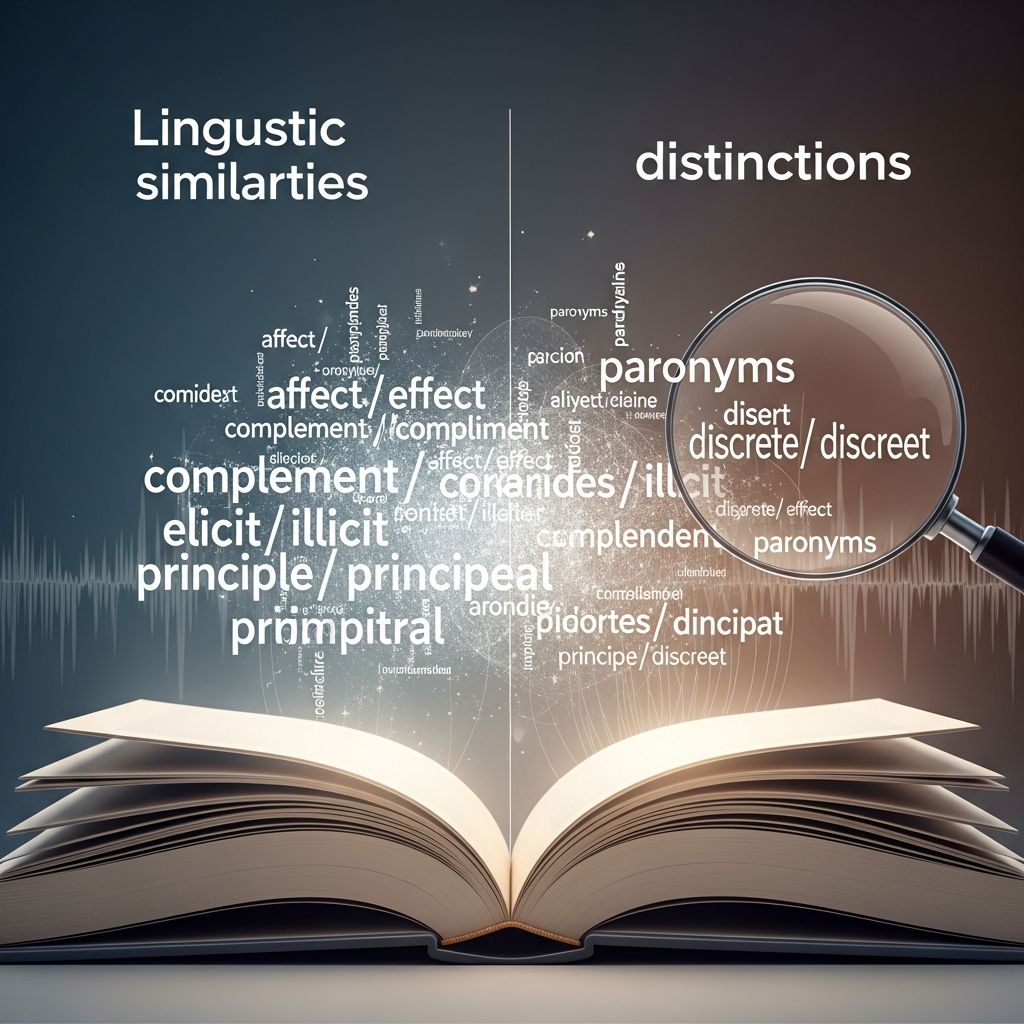
Defining Linguistic Lookalikes and Soundalikes
The English language presents numerous challenges to both native speakers and learners, particularly when navigating words that appear remarkably similar yet carry distinct meanings or functions. One category of words that frequently creates confusion is known as paronyms. These linguistic elements deserve careful examination because their misuse can alter intended meaning, create ambiguity, and undermine written and spoken communication.
A paronym is fundamentally a word that shares characteristics with another word—whether in spelling, pronunciation, or meaning—but remains distinct in critical ways. The term itself derives from Greek components: par-, meaning “altered” or “alongside,” combined with -onym, which translates to “name” or “word”. This etymological foundation reflects the core concept: paronyms are words that stand beside or alongside other words in similarity while maintaining their own identity.
Multiple Interpretations and Definitions
The concept of paronymy encompasses several distinct meanings, which accounts for some of the confusion surrounding this linguistic term. Understanding these various interpretations provides essential context for recognizing paronyms in everyday usage.
Root-Based Word Relationships
The most frequently cited definition describes paronyms as words derived from a common root or stem. Under this interpretation, paronyms share etymological origins and typically maintain related or similar meanings. For instance, the words “childhood” and “childish” both stem from the root “child,” yet they express different concepts—one referring to a life stage, the other describing behavior patterns.
Cross-Language Adaptation
Another established definition involves words that transfer between languages with minimal formal changes. These paronyms often appear virtually identical across linguistic borders, such as “salad” in English and “salade” in French. This category reflects how languages share vocabulary through historical contact, trade, and cultural exchange. Recognizing these similarities can aid language learners in expanding their vocabulary across multiple languages.
Phonetic and Orthographic Similarity
Perhaps the most practically relevant definition identifies paronyms as words resembling one another in sound or appearance while conveying different meanings—essentially near-homonyms. This category directly impacts everyday communication. Words like “accept” and “except” exemplify this distinction: “accept” means to receive or agree to something, while “except” means to exclude or to set apart. A common error occurs when writers interchange these words in sentences such as, “John will accept all of the chores he was given, except for cleaning out the garage.”
Classification Systems for Paronymic Words
Linguists organize paronyms into useful categories that help illuminate their relationships and distinguish them from one another.
Pronunciation-Based Groupings
One classification method considers whether paronyms sound identical, similar, or distinctly different. Some paronyms remain nearly indistinguishable aurally, requiring careful pronunciation to differentiate. Others may share similar phonetic qualities but diverge noticeably when spoken deliberately. The addition of prefixes, suffixes, or syllables can modify pronunciation, creating stress patterns and tonal variations that distinguish otherwise comparable words.
Morphological Categories
Paronyms can be organized by their structural components. Words related through common prefixes or suffixes form coherent groups. For example, words ending in “-ful” versus “-ous,” or those built upon shared roots with differing affixes, demonstrate how morphological variation generates related yet distinct vocabulary items.
Practical Examples Across Common Word Pairs
Examining concrete examples illuminates how paronymic confusion arises and the importance of precision in their usage.
The Artistic Spectrum
Consider the related terms “artist,” “artisan,” and “artistic.” An “artist” refers to a person skilled in fine arts such as painting, sculpture, or music. An “artisan” denotes a craftsperson or skilled tradesperson who works with hands, such as a bricklayer or woodworker. “Artistic,” as an adjective, describes something possessing creative qualities or relating to art, as in “an artistic flair”. While these words share the common root “art,” they serve distinct grammatical and semantic functions.
The Childhood Terminology
The words “child,” “childish,” and “childlike” demonstrate how subtle distinctions in morphology create significant meaning differences. “Child” identifies a young person in a neutral, factual manner. “Childish” carries a negative connotation, suggesting immature, foolish, or inappropriate behavior, typically used as criticism. “Childlike,” conversely, describes innocent, naive, or endearing qualities reminiscent of childhood but not necessarily disparaging, as in “her childlike wonder”.
Grace-Based Word Family
“Graceful” and “gracious” exemplify paronyms that sound similar but convey entirely different meanings. “Graceful” describes elegant physical movement or beautiful appearance. “Gracious” denotes kindness, hospitality, or welcoming behavior in social contexts. Confusing these terms creates awkward or nonsensical expressions.
The Honor Distinction
Similarly, “honorary” and “honorable” present a paronymic pair with distinct applications. “Honorary” refers to a position or title given without the usual requirements, typically as recognition rather than earned through standard procedures. “Honorable” functions as an adjective describing someone governed by principles, integrity, or ethical conduct.
Human Versus Humane
These paronyms highlight how similar-sounding words serve different purposes. “Human” refers to membership in the species or relates to human characteristics. “Humane” describes compassionate, kind, or merciful treatment, particularly toward animals or people experiencing suffering.
Industrial Dimensions
“Industrious” and “industrial” demonstrate morphological variation creating paronymic relationships. “Industrious” describes a person or effort characterized by diligent hard work and productivity. “Industrial” refers to manufacturing, factories, or the broader economic sector involving production.
Temporal Distinctions
“Momentous” and “momentary” present paronyms distinguished by prefix and suffix combinations. “Momentous” describes occasions or events of great significance and lasting importance. “Momentary” indicates something brief, lasting only a moment or short duration. These words occupy opposite ends of a temporal spectrum despite their similar construction.
Affection and Aesthetics
“Lovable” (or “loveable”) and “lovely” represent paronyms with related but distinct meanings. “Lovable” describes qualities that inspire affection or endearment. “Lovely” functions as a broader term indicating beauty, attractiveness, or general pleasantness.
Why Paronyms Challenge Language Users
Paronymic confusion arises from several interconnected factors. The superficial similarity in form creates a false sense of equivalence, leading users to assume interchangeability. Additionally, related etymologies can obscure functional differences. Language learners, in particular, struggle with paronyms because extensive exposure and contextual understanding are required to distinguish them reliably.
English contains paronyms in quantities that exceed those found in many other languages, creating a uniquely complex landscape for learners and native speakers alike. Historical borrowing, morphological flexibility, and the gradual evolution of English vocabulary have generated numerous near-duplicates that require careful disambiguation.
Cross-Linguistic Paronymic Phenomena
Paronyms extend beyond English into multilingual contexts. False cognates—words appearing similar across languages but possessing different meanings—represent a specific type of cross-linguistic paronymy. Language learners frequently encounter these deceptive similarities, particularly when studying Romance languages, Germanic languages, or languages with historical contact relationships.
Strategic Approaches to Mastering Paronyms
Developing proficiency with paronyms requires deliberate strategies:
- Create mental associations linking each paronym to its specific meaning and usage context
- Practice using paronyms within complete sentences to internalize functional distinctions
- Maintain reference lists of commonly confused paronym pairs for consultation
- Study morphological patterns to predict meaning variations based on prefixes and suffixes
- Engage with authentic written and spoken examples to build intuitive recognition
- Distinguish between grammatical categories, as paronyms often function as different parts of speech
Paronyms in Professional and Academic Writing
Precision in paronym usage becomes increasingly critical in professional contexts. Academic writing, legal documents, technical specifications, and business communications demand accuracy. Misusing “accept” for “except,” or “graceful” for “gracious,” undermines credibility and creates potential misinterpretation. Professional writers benefit significantly from systematic review processes that specifically target paronymic errors.
Common Questions About Paronyms
Q: How do paronyms differ from homonyms?
A: Paronyms resemble other words in spelling, pronunciation, or meaning but remain fundamentally distinct. Homonyms, by contrast, are words that share identical spelling and pronunciation while possessing completely different meanings, such as “bank” (financial institution) and “bank” (riverside).
Q: Are cognate words always paronyms?
A: Cognate words—those sharing common etymological roots and expressing related meanings—often qualify as paronyms under the root-based definition. However, not all cognates function as paronyms in practical usage, particularly when they differ significantly in form.
Q: Why should I care about paronym distinctions in casual conversation?
A: While casual speech permits greater flexibility, maintaining paronymic precision prevents misunderstanding, enhances credibility, and demonstrates linguistic competence. Regular attention to these distinctions in conversation strengthens writing abilities and communication effectiveness.
Q: How can non-native English speakers efficiently learn paronym distinctions?
A: Systematic study of paronym pairs, coupled with contextual practice and exposure to authentic materials, proves most effective. Organizing paronyms by semantic fields and morphological patterns accelerates learning compared to isolated memorization.
Q: Do all languages contain paronyms?
A: All languages contain some paronymic elements, but English contains them in notably higher concentrations than many other languages. This abundance reflects English’s complex history and vocabulary borrowing from multiple sources.
References
- Paronym — Wikipedia. Accessed 2026-04-05. https://en.wikipedia.org/wiki/Paronym
- Paronyms and Paranyms — Daily Writing Tips. https://www.dailywritingtips.com/paronyms-and-paranyms/
- Paronyms — Education Bug. https://www.educationbug.org/a/paronyms.html
- Paronym Definition & Meaning — Merriam-Webster Dictionary. 2026-02-27. https://www.merriam-webster.com/dictionary/paronym
- Paronyms: A Guide To Understanding Them And Their Use — iTalki. https://www.italki.com/en/article/773/paronyms-a-guide-to-understanding-them-and-their-use
- Paronym – Definition, Meaning & Synonyms — Vocabulary.com. https://www.vocabulary.com/dictionary/paronym

- Integrated M.A. in Applied Linguistics, University of Hyderabad
- 5+ years in editorial, instructional, SEO, and research-based writing
Sneha is a relationships and lifestyle writer with a strong foundation in applied linguistics and certified training in relationship coaching. She brings over five years of writing experience to theskillvault, crafting thoughtful, research-driven content that empowers readers to build healthier relationships, boost emotional well-being, and embrace holistic living. Her writing and insights reflect the belief that beauty, happiness, and wellness…