
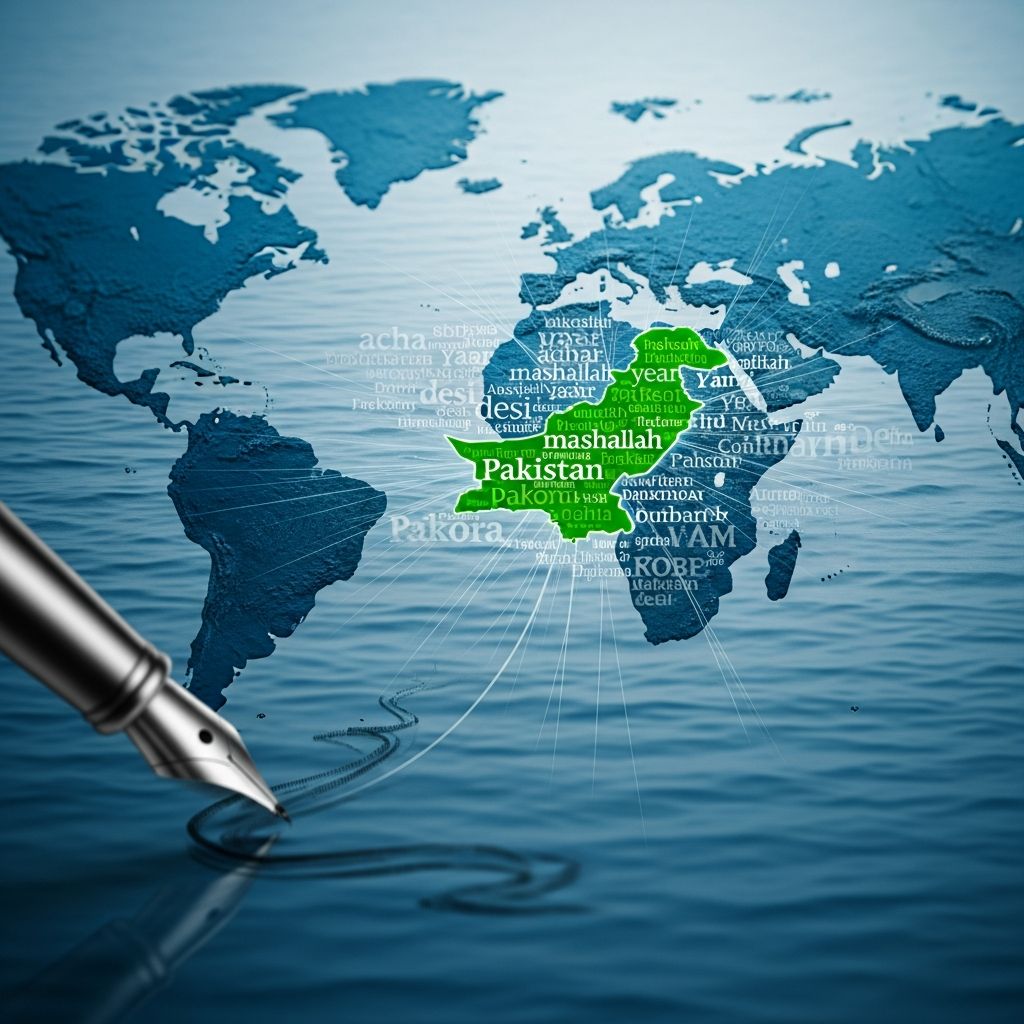
Pakistani English represents a vibrant and evolving form of the language, shaped by Pakistan’s multilingual landscape and colonial history. As one of the recognized varieties in World Englishes, it blends English with influences from Urdu, Punjabi, Sindhi, Pashto, and other local tongues, creating a hybrid that serves official, educational, and social functions nationwide.
Historical Foundations and Official Status
The roots of Pakistani English trace back to British colonial rule, when English was introduced as the language of administration and education. Post-independence in 1947, it retained its prominence alongside Urdu, functioning as a co-official language in government, courts, higher education, and commerce. Today, while only a small elite speaks it natively, it dominates formal domains, reflecting Pakistan’s bilingual policy.
This dual-language framework fosters a dynamic where English adapts to local needs, evolving into a distinct variety. Urban professionals, academics, and media outlets primarily employ the acrolectal form—closer to standard English—while mesolectal and basilectal versions incorporate heavier local influences, varying by region and social class.
Phonological Characteristics: Sounds and Rhythm
Pakistani English pronunciation diverges notably from British or American standards due to substrate languages. Speakers often merge short and long vowels, pronouncing ‘ship’ and ‘sheep’ nearly identically, as vowel length distinctions from Urdu and Punjabi carry over weakly.
Consonants show adaptations too: dental fricatives like /θ/ in ‘think’ and /ð/ in ‘this’ become stops [t̪ʰ] and [d̪], aligning with retroflex sounds in local languages. The velar nasal [ŋ] appears without following [ɡ], so ‘English’ sounds as [ˈiŋliʃ].
Diphthongs simplify into monophthongs—’face’ /eɪ/ becomes /eː/—and unique triphthongs like [uai] emerge in words borrowed from Urdu. Stress patterns shift at word and sentence levels; functional words may receive unexpected emphasis, altering rhythm. Intonation rises at declarative ends, mimicking Urdu prosody, while questions feature high rises or level tones.
- Vowel Mergers: Minimal pairs like /ɪ/ and /iː/ neutralized.
- Consonant Substitutions: /θ/ → [t̪ʰ], /ð/ → [d̪].
- Prosody: Rising intonation in statements, influenced by regional languages like Pashto’s elongated vowels.
Regional variations abound: Punjabi speakers emphasize aspirated stops, Sindhis add retroflexion, and Pashto influences prolong vowels, creating a phonological mosaic.
Lexical Innovations: Borrowing and Hybridization
Pakistani English enriches its lexicon through borrowing from Urdu and regional languages, often with shifted meanings. Words like ‘lungi’ (a garment) or ‘shalwar kameez’ enter everyday use, while code-mixing inserts Urdu terms mid-sentence, as in ‘Please copy kar do the assignment.’ This Hinglish-like fusion, termed Pinglish, thrives in informal speech and advertising.
Semantic shifts occur: ‘timepass’ means idle chatting, ‘eve-teasing’ denotes harassment. Newspapers and magazines corpus analyses reveal frequent Urdu loans in domains like food (‘biryani’), clothing, and bureaucracy (‘gazetted holiday’).
| English Word | Pakistani Usage/Loan | Meaning/Origin |
|---|---|---|
| Adjust | Adjust karna | To settle or fix something informally (Urdu influence). |
| Brainwash | Brainwash | Shifted to mean indoctrination in politics. |
| Lungi | Lungi | Traditional wraparound cloth for men. |
| Godown | Godown | Warehouse (Portuguese via Indian English). |
These innovations reflect cultural embedding, making Pakistani English functional for local contexts.
Grammatical and Syntactic Adaptations
Syntax in Pakistani English incorporates structures from substrate languages, diverging from standard norms. Adverbs often precede verbs rigidly, and the definite article ‘the’ appears with unique nouns or generics, as in ‘the furniture is broken.’ Uncountable nouns pluralize: ‘furnitures,’ ‘informations.’
Progressive aspect overuses for stative verbs: ‘I am knowing’ instead of ‘I know.’ Prepositions simplify or omit, and relative clauses use ‘which’ invariantly. Code-switching extends syntactically, blending clauses seamlessly.
- Article Usage: ‘The’ with abstracts: ‘the nature is beautiful.’
- Verb Forms: ‘Enjoyed’ for ongoing states.
- Question Structures: No inversion in yes/no questions sometimes.
These features validate Pakistani English as a stable variety, not mere error, per World Englishes theory.
Societal Roles and Usage Domains
In Pakistan, English bridges elite and mass communication. Elite schools teach British norms, but public discourse mixes varieties. Media—Dawn, The News—employs a polished acrolect with local flavor. Politics features code-mixing for accessibility.
Education relies on it for STEM and law; universities produce research in Pakistani English. Diaspora communities maintain it, influencing global perceptions via cricket commentary or films.
Regional and Social Variations
Pakistani English isn’t uniform. Urban Karachi favors Urdu-English mixes; Lahore leans Punjabi-inflected; Peshawar shows Pashto tones. Socially, upper classes approximate RP, while lower strata use basilect with heavy substrate.
Gender plays a role: women in conservative areas may code-switch more. Migration adds layers, as overseas Pakistanis blend with host Englishes.
Global Recognition and Future Prospects
Scholars recognize Pakistani English since the 1970s, akin to Indian English but distinct in accent and lexicon. Corpora studies affirm its legitimacy, urging inclusive ELT pedagogies.
Digital media accelerates spread via social platforms, memes, and YouTube. As globalization grows, Pakistani English solidifies as a contributor to pluricentric English.
Frequently Asked Questions (FAQs)
What makes Pakistani English different from Indian English?
Pakistani English features stronger Urdu phonological influences, unique lexical items like ‘lungi,’ and distinct intonation, differing from Hindi-Sanskrit impacts in Indian English.
Is code-mixing in Pakistani English a sign of poor proficiency?
No, it’s a strategic bilingual practice enhancing expressiveness, common in multilingual societies and accepted in formal media.
How does Pakistani English affect education?
It serves as the medium for higher education, though phonological variations challenge listening comprehension for native speakers.
Will Pakistani English standardize over time?
Likely yes, through media and education, forming a stable norm while retaining local flavors.
Examples of Pakistani English in media?
Headlines like ‘Govt takes notice’ or ads mixing ‘Double mazaa’ showcase its hybrid vitality.
References
- A Survey Of Phonological Characteristics Of Pakistani English — Bilal. 2023. https://migrationletters.com/index.php/ml/article/download/10689/7143/26278
- Pakistani English: An Analysis of Grammatical-Syntactical Structures — Journal of Development and Social Sciences. 2023. https://ojs.jdss.org.pk/journal/article/download/1061/1000/1581
- Pakistani English — Wikipedia (informed by primary sources). 2026. https://en.wikipedia.org/wiki/Pakistani_English
- A Corpus Analysis of Pakistani English Newspapers and Magazines — Zenodo. 2024. https://zenodo.org/records/14757109
- Analyzing the Linguistic Components of Pakistani English — CORE. 2023. https://files01.core.ac.uk/download/492915556.pdf
- Unveiling Pakistani English: A Linguistic and Cultural Odyssey — QJSSH. 2023. https://qjssh.com.pk/index.php/qjssh/article/download/122/106

- Integrated M.A. in Applied Linguistics, University of Hyderabad
- 5+ years in editorial, instructional, SEO, and research-based writing
Sneha is a relationships and lifestyle writer with a strong foundation in applied linguistics and certified training in relationship coaching. She brings over five years of writing experience to theskillvault, crafting thoughtful, research-driven content that empowers readers to build healthier relationships, boost emotional well-being, and embrace holistic living. Her writing and insights reflect the belief that beauty, happiness, and wellness…