
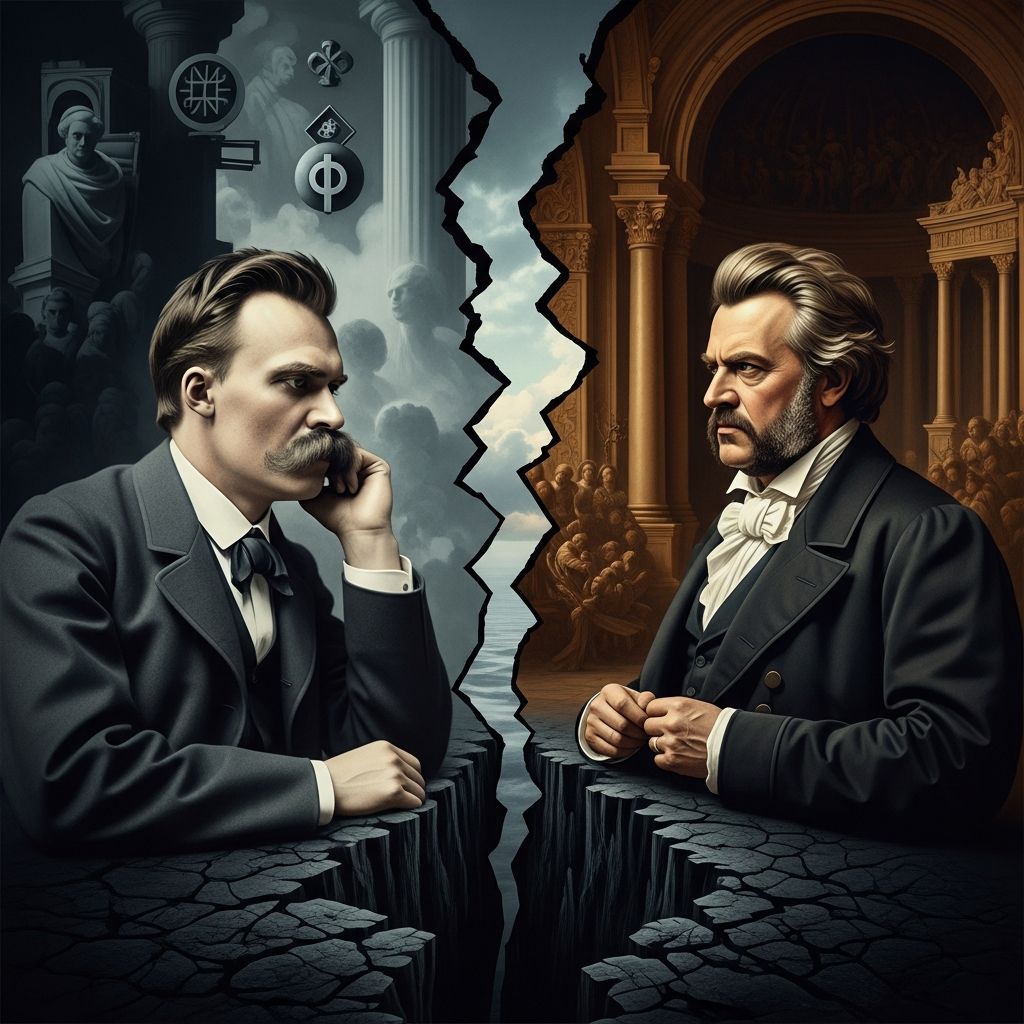
The relationship between Friedrich Nietzsche and Richard Wagner stands as one of the most captivating chapters in intellectual history. What began as profound mutual admiration evolved into a fierce antagonism, marked by public denunciations and deeply personal grievances. This article explores the multifaceted reasons for their estrangement, drawing on philosophical divergences, artistic disagreements, and emotional undercurrents that transformed allies into adversaries.
The Early Bond: Admiration and Shared Vision
In the 1860s and 1870s, Nietzsche, then a young professor of classical philology at the University of Basel, encountered Wagner’s revolutionary operas and was captivated. Wagner, the exiled composer revolutionizing music with works like Tristan und Isolde and The Ring Cycle, embodied for Nietzsche the rebirth of Greek tragedy in modern form. Nietzsche’s first major book, The Birth of Tragedy (1872), hailed Wagner as the savior of German culture, arguing that his music-drama fused Apollonian form with Dionysian ecstasy to redeem a decadent society.
This alliance was more than intellectual; it was personal. Nietzsche visited Wagner at his home in Tribschen, forging a close friendship. Wagner reciprocated by appreciating Nietzsche’s youthful genius, and they shared dreams of cultural renewal amid Germany’s unification. Yet, cracks appeared as Nietzsche observed Wagner’s growing obsession with fame, power, and institutional support, foreshadowing deeper conflicts.
Ideological Clashes: From Pagan Vitality to Christian Resignation
Central to their rift were irreconcilable worldviews. Nietzsche championed life-affirmation, eternal recurrence, and the Übermensch—ideas celebrating instinctual vitality and rejecting otherworldly consolations. Wagner, initially a radical influenced by Feuerbachian atheism and revolutionary socialism, shifted toward mysticism and nationalism.
By the mid-1870s, Wagner embraced Schopenhauerian pessimism more fully, viewing art as a temporary escape from the will’s torment. Nietzsche, who had introduced Wagner to Schopenhauer, now saw this as defeatist. Worse, Wagner’s late opera Parsifal (1882) glorified chastity, redemption through suffering, and Christian symbolism—elements Nietzsche decried as life-denying. In The Case of Wagner (1888), he lambasted it as Wagner’s capitulation to Catholicism, calling it “Rome’s faith without the text.” This perceived betrayal of their shared anti-Christian stance fueled Nietzsche’s outrage.
- Pagan vs. Christian Elements: Early Wagner operas pulsed with mythic eroticism; Parsifal inverted this into ascetic purity.
- Pessimism Divergence: Wagner sought transcendence through art; Nietzsche demanded affirmation of earthly chaos.
- Nationalism: Wagner’s German chauvinism and anti-Semitism clashed with Nietzsche’s cosmopolitanism.
Musical Critiques: Decadence in Melody and Rhythm
Nietzsche, an accomplished composer and pianist, turned his scrutiny to Wagner’s music itself. Once praising its Dionysian power, he later diagnosed it as decadent—overly chromatic, rhythmically amorphous, and manipulative. In Nietzsche contra Wagner (1888), he argued Wagner’s “endless melody” dissolved structure, preventing dance-like vitality. “One does not breathe easily,” he wrote; feet rebelled against the music’s hypnotic sway.
Wagner’s harmonies, reliant on enharmonic shifts, created a “rope of enharmonics” where ugly motifs gymnastics without progression—like a sloshing sea, not a flowing river. Nietzsche contrasted this with classical clarity, accusing Wagner of prioritizing emotional inflation over authentic expression. Characters became histrionic poses, dramas mere theatrical effects from a showman.
| Aspect | Nietzsche’s View | Wagner’s Innovation |
|---|---|---|
| Melody | Endless, formless posing | Continuous leitmotif flow |
| Rhythm | Non-danceable, stagnant | Flexible, expressive undulation |
| Harmony | Enharmonic gymnastics, counterfeit | Chromatic depth for emotion |
| Overall | Decadent art for weak souls | Gesamtkunstwerk renewal |
These critiques reflected Nietzsche’s broader attack on modernity’s sickness, with Wagner as symptom.
Personal Betrayals: Ego, Anti-Semitism, and the Breaking Point
Beneath philosophy lay raw emotion. Nietzsche idealized Wagner as a father figure, enduring his ego and demands. Prolonged proximity revealed Wagner’s hunger for success over artistic purity—courting kings, building Bayreuth as a cult shrine, and embracing anti-Semitism for patronage. Nietzsche, whose sister later promoted Nazi distortions, abhorred this; he broke ties partly over Wagner’s reactionary turn post-1876 Bayreuth Festival.
The “mortal insult” was mutual suspicion: Wagner mocked Nietzsche’s music as dilettantish; Nietzsche felt used then discarded. Their split was a “divorce,” Nietzsche expelling idolized poison turned toxic in his system. Pain morphed into vitriolic prose, as in The Wagner Case, blending critique with wounded affection.
Legacy of the Split: Shaping 20th-Century Thought
Their feud influenced Adorno’s Wagner critiques, highlighting anti-Semitism and mythic nationalism. Nietzsche’s ideas freed philosophy from Wagnerian shadow, emphasizing individual will over collective myth. Wagner’s music endured triumphantly, but Nietzsche’s words ensured scrutiny of its ideological baggage.
Today, their rift illuminates tensions between art’s seductive power and philosophy’s demand for truth— a cautionary tale of genius colliding.
Frequently Asked Questions (FAQs)
What triggered Nietzsche’s initial admiration for Wagner?
Nietzsche saw Wagner’s operas as reviving ancient Greek tragedy’s spirit, blending rational form with primal energy in The Birth of Tragedy.
Why did Nietzsche call Wagner’s music decadent?
He criticized its lack of rhythmic vitality, formless melodies, and manipulative harmonies that feigned depth without true progression.
Did personal factors play a role in the breakup?
Yes, Nietzsche felt betrayed by Wagner’s ego, pursuit of fame, nationalism, and shift to Christian themes, shattering his paternal ideal.
How did Wagner respond to Nietzsche’s attacks?
Wagner dismissed Nietzsche as ungrateful, focusing on his own Bayreuth empire rather than engaging philosophically.
What is the significance of Parsifal in their dispute?
Nietzsche viewed it as Wagner’s ultimate betrayal—embracing chastity and Catholicism against their shared life-affirming paganism.
References
- Nietzsche contra Wagner — Friedrich Nietzsche. 1889. https://en.wikipedia.org/wiki/Nietzsche_contra_Wagner
- Nietzsche on Wagner — Sir Roger Scruton, Roger-Scruton.com. 2010. https://www.roger-scruton.com/articles/31-understanding-music/181-nietzsche-on-wagner
- The Curious Case of Nietzsche and Wagner — Prestonstories.com. 2020. https://prestonstories.com/?p=145
- Understanding Wagner’s Parsifal through Nietzsche’s Critique — Georges Liébert (referenced in Scruton). 1995. https://www.roger-scruton.com/articles/31-understanding-music/181-nietzsche-on-wagner
- The Birth of Tragedy and The Case of Wagner — Friedrich Nietzsche (primary texts). 1872/1888. https://en.wikipedia.org/wiki/Nietzsche_contra_Wagner

Medha Deb is an editor with a master's degree in Applied Linguistics from the University of Hyderabad. She believes that her qualification has helped her develop a deep understanding of language and its application in various contexts. Medha specializes in the areas of beauty, health, sports, and wellness and is committed to ensuring that the content on the website is…