
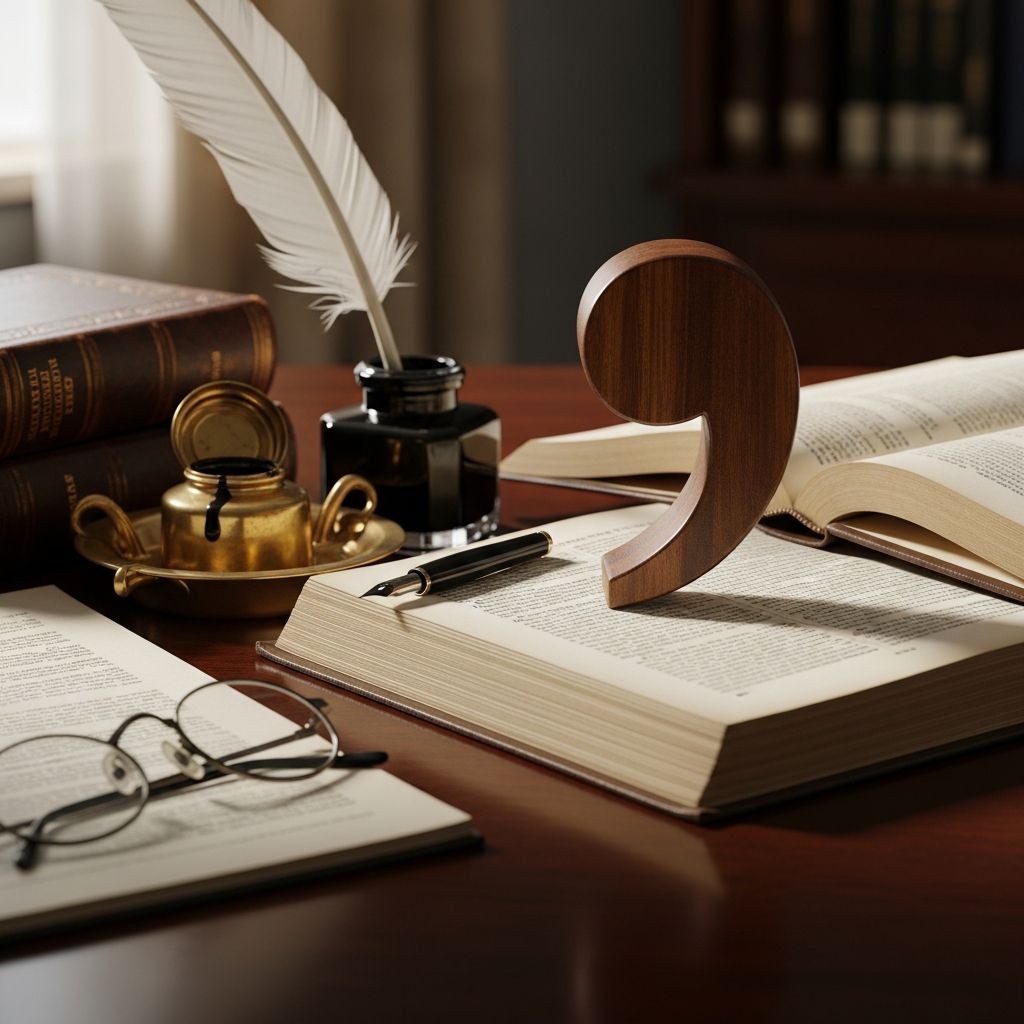
The comma is a fundamental punctuation mark in English that signals pauses, separates ideas, and clarifies meaning within sentences. Unlike a period, which ends a thought, the comma creates a gentle break, allowing complex ideas to flow smoothly.
Understanding the Role of Commas in Sentences
Commas function as traffic directors in writing, guiding readers through lists, clauses, and additional information. They prevent confusion by distinguishing between essential and extra details, ensuring sentences are easy to follow. Originating from ancient Greek systems for marking breath pauses in text, modern commas evolved to handle diverse grammatical needs.
Key benefits include improved readability and precision. Without proper commas, sentences like “Let’s eat Grandma” become ambiguous compared to “Let’s eat, Grandma.” This guide explores core rules with examples to build your skills.
Separating Items in Lists: The Serial Comma Debate
One primary use is dividing three or more items in a series, known as the serial or Oxford comma before the final “and.” For instance: “She packed apples, oranges, bananas, and grapes.”
- Use commas consistently: “The recipe calls for flour, sugar, eggs, butter, and vanilla.”
- Serial comma optional but recommended for clarity: “I invited my parents, Elvis, and Beyoncé” avoids misreading.
Style guides differ—AP omits it, Chicago includes it—but consistency matters in documents.
Joining Independent Clauses with Coordinating Conjunctions
When linking two complete sentences (independent clauses) with words like and, but, or, nor, for, so, yet, place a comma before the conjunction. Example: “I wanted to attend the concert, but traffic was terrible.”
| Conjunction | Example |
|---|---|
| and | The team practiced daily, and they won the championship. |
| but | It rained heavily, but we finished the hike. |
| or | Study hard, or you might fail the exam. |
| yet | She was exhausted, yet she kept working. |
Avoid commas if clauses are short and closely related: “I came I saw I conquered.”
Handling Introductory Elements and Phrases
Follow introductory words, phrases, or clauses with a comma to signal the main clause begins. This includes adverbs like however, participial phrases, and prepositional phrases over four words.
- Adverb: “However, the plan changed suddenly.”
- Participial: “Running late, he skipped breakfast.”
- Prepositional: “After the meeting, we grabbed coffee.”
Shorter phrases may omit commas for rhythm, but longer ones need them: “In the quiet library on campus, students focused intently.”
Setting Off Nonessential Information
Nonessential clauses, phrases, or appositives—extra info not vital to meaning—require paired commas. Remove them, and the sentence stands.
Examples:”My brother, who lives in Boston, visited last week.” (Nonessential—implies one brother.)
“The book that I borrowed was fascinating.” (Essential—no commas.)
Appositives rename nouns: “Dr. Smith, our family physician, retired.”
Commas with Direct Quotes and Dialogue
Separate quotes from speaker tags like “he said.” The comma goes inside closing quotes.
- “Study every day,” the teacher advised, “and success will follow.”
- She replied, “I’m ready to learn.”
For quotes within quotes or interruptions, adjust placement carefully.
Dates, Addresses, and Titles
Commas clarify everyday details:
- Dates: “The event is on July 4, 2026, at the park.” (No comma if only month/year.)
- Addresses: “Send to 123 Main St., Anytown, NY 12345.”
- Titles: “Jane Doe, PhD, spoke at the conference.”
Question Tags and Direct Address
Tag questions seek agreement: “This is fun, isn’t it?”Direct address personalizes: “Pass the salt, please, waiter.” Commas enclose names or titles for emphasis.
Common Comma Mistakes to Avoid
Misuse leads to errors like comma splices (joining clauses without conjunctions) or fragments.
| Error Type | Incorrect | Correct |
|---|---|---|
| Comma Splice | I woke early, I went running. | I woke early, and I went running. |
| Restrictive Clause | My car, which is red, is fast. | My car which is red is fast. (If essential.) |
| Fused Sentence | She sang he danced. | She sang, and he danced. |
Proofread aloud to catch unnatural pauses.
Advanced Tips for Professional Writing
In academic or business writing, adhere to style guides like MLA or APA, which favor the Oxford comma. Use tools sparingly—understand rules first. Practice transforms commas from obstacles to assets, elevating clarity and professionalism.
Frequently Asked Questions (FAQs)
Should I always use the Oxford comma?
It’s optional but prevents ambiguity in complex lists. Chicago Manual recommends it; AP Style does not.
When do I skip commas after introductory phrases?
For short phrases under four words without confusion, like “Yesterday I ran.” Longer ones need commas.
How do commas work with contrasting phrases?
Use for emphasis: “Tall, not short, he stood out.”
Are commas needed in compound sentences with short clauses?
No, if closely related: “She tried but failed.”
What’s the rule for commas in addresses?
Separate city/state and state/ZIP: “Boston, MA 02101.”
References
- Rules for Using Commas, With Examples — Grammarly. 2023. https://www.grammarly.com/blog/punctuation-capitalization/comma/
- WHAT IS A COMMA? — Monmouth University. 2022-01-15. https://www.monmouth.edu/resources-for-writers/documents/commas.pdf/
- Comma — Wikipedia. 2026-04-01. https://en.wikipedia.org/wiki/Comma
- Extended Rules for Using Commas — Purdue OWL, Purdue University. 2024. https://owl.purdue.edu/owl/general_writing/punctuation/commas/extended_rules_for_commas.html
- Comma Rules — Brandeis University Writing Program. 2023. https://www.brandeis.edu/writing-program/resources/students/academic/style-grammar/comma-rules.html
- Commas (Eight Basic Uses) — Indiana University East. 2025. https://east.iu.edu/student-success/coursework/commas.html

Medha Deb is an editor with a master's degree in Applied Linguistics from the University of Hyderabad. She believes that her qualification has helped her develop a deep understanding of language and its application in various contexts. Medha specializes in the areas of beauty, health, sports, and wellness and is committed to ensuring that the content on the website is…