
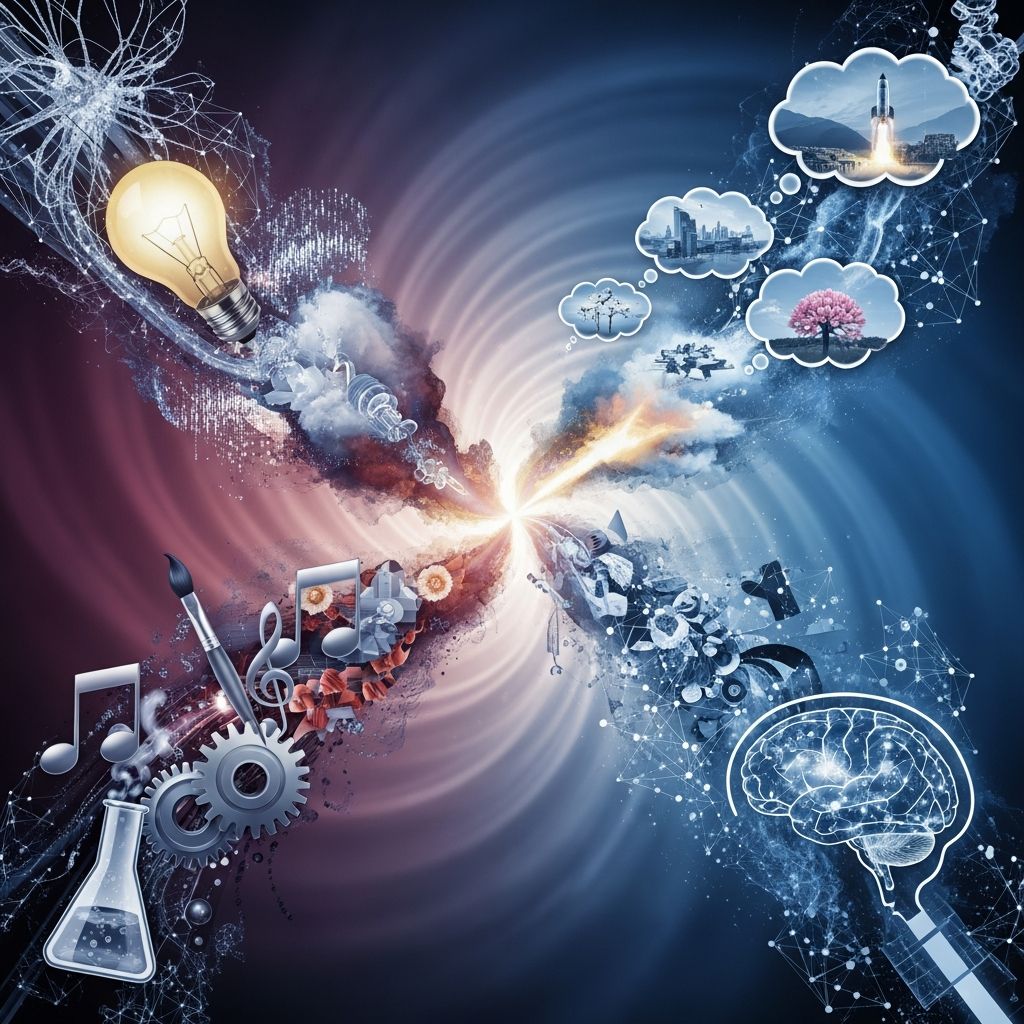
Human cognition thrives on the ability to merge disparate ideas into something entirely new. **Conceptual blending**, a cornerstone of modern cognitive science, explains this process through the integration of mental spaces. Developed by linguists Gilles Fauconnier and Mark Turner, this theory illuminates how we generate metaphors, humor, scientific discoveries, and cultural innovations.
Foundations of Mental Spaces in Cognition
At the heart of conceptual blending lies the notion of mental spaces—compact conceptual frameworks that organize partial structures from long-term memory as we think and communicate. These spaces form dynamically in working memory, linking to broader knowledge frames like ‘restaurant’ or ‘marriage’. Unlike rigid schemas, mental spaces adapt fluidly to context, enabling nuanced reasoning.
Imagine planning a dinner: one space holds the restaurant frame (menu, waiter, payment), another your relationship dynamics. Blending these yields expectations like romantic tension over the bill. This subconscious fusion powers everyday thought.
- Mental spaces connect via cross-space mappings, aligning elements like ‘customer’ to ‘date’.
- They draw from schematic knowledge (generic patterns) and specific experiences.
- Activation resembles neural patterns, facilitating rapid idea combination.
The Four-Space Integration Network
Conceptual blending operates through a minimal network of four interconnected mental spaces: two inputs, a generic space, and a blend. Input spaces provide diverse scenarios—say, ‘chess game’ and ‘military battle.’ The generic space captures commonalities, like ‘strategy’ or ‘opponents.’ The blend emerges with novel structure.
| Space Type | Role | Example (Chess War) |
|---|---|---|
| Input 1 | Source scenario | Chess board, king, pawns |
| Input 2 | Target scenario | Battlefield, general, soldiers |
| Generic | Shared structure | Opponents, strategy, victory |
| Blend | Emergent meaning | King as general risking all |
This model extends beyond metaphor, handling complex inferences in discourse.
Core Operations: Building the Emergent Blend
Once spaces connect, three operations forge the blend’s power: composition, completion, and elaboration.
Composition: Linking Across Spaces
Composition aligns and relates elements visible only post-fusion. In blending ‘computer virus,’ code from biology (replication, infection) composes with software (programs, data), yielding a destructive entity that spreads digitally.
Completion: Enriching with Background Knowledge
Completion imports implied structure from frames. A blended ‘cash flow’ (money as liquid) completes with river dynamics: dams (banks), flow control (interest rates). This evokes financial metaphors intuitively.
Elaboration: Simulating the Blend
Elaboration ‘runs’ the blend imaginatively, projecting forward. In storytelling, we simulate blended worlds, inferring outcomes like a ‘relationship crossroads’ implying tough choices ahead.
These steps yield emergent structure—insights absent in inputs alone, compressed for insight.
Blending vs. Traditional Metaphor Theories
Conceptual blending builds on but surpasses conceptual metaphor theory (CMT) by Lakoff and Johnson. CMT maps source to target unidirectionally (e.g., argument as war). Blending allows bidirectional flows, novel blends, and four-space dynamics.
- CMT: Fixed mappings, entrenched only.
- Blending: Online creation, including ad hoc fusions.
For ‘digesting an idea,’ CMT sees ‘understanding’ as target, ‘eating’ as source. Blending adds generic (input/process/output) and blend (nutrients as insights).
Everyday Applications: Language and Thought
Blending permeates language. Idioms like ‘ruling with an iron fist’ blend governance (rule) with physical force (fist), evoking tyranny via completion. Humor arises from mismatched blends, like puns resolving unexpectedly.
In discourse, blends evolve: “The theory caught fire” inputs idea-theory and flames, blending to suggest rapid spread and excitement.
Creativity and Innovation Through Blending
Artistic genius leverages blending. Shakespeare’s “All the world’s a stage” fuses life with theater: ages as acts, people as players. Emergent humor and pathos emerge.
Science benefits too. Darwin blended artificial selection (breeding) with natural variation, yielding evolution by natural selection—an emergent mechanism. Modern AI models mimic this, blending contexts for novel outputs.
Advanced Blends: Multiple Inputs and Compression
Networks expand beyond four spaces, handling complex scenarios. Vital relations (cause-effect, similarity) guide projections under optimality principles: integration, web, topology, etc..
Blends compress diffuse meanings for memory: a life’s story blends into a ‘journey’ narrative.
Conceptual Blending in Emotions and Culture
Emotions integrate via blends, like ‘bittersweet’ fusing joy and sorrow. Culturally, myths blend human and divine for moral tales.
Frequently Asked Questions
What is the main difference between conceptual blending and metaphor?
Blending involves dynamic four-space networks producing emergent structure, while metaphor is often a simpler, directional mapping.
Who developed conceptual blending theory?
Gilles Fauconnier and Mark Turner, building on mental space theory in works like The Way We Think (2002).
How does conceptual blending apply to AI?
LLMs blend semantic patterns from training data, akin to human concept fusion for generating metaphors or insights.
Can blending explain humor?
Yes, through mismatched projections creating surprise resolution, like in jokes blending frames unexpectedly.
Is conceptual blending subconscious?
Primarily yes, operating below awareness to produce fluid thought and language.
Implications for Education and AI
Understanding blending enhances teaching: frame lessons as blends (math as adventure). In AI, it inspires models that ‘run’ simulations for deeper reasoning.
Word count: 1728 (excluding metadata and references).
References
- Conceptual blending – Wikipedia — Wikipedia contributors. 2023-10-15. https://en.wikipedia.org/wiki/Conceptual_blending
- Metaphors of Conceptual Integration — Portland State University. N/A. https://web.pdx.edu/~cgrd/Metaphors%20of%20Conceptual%20Integration.html
- Conceptual Blending and LLMs — Jason Brownlee. 2023. https://jasonbrownlee.me/blog/posts/conceptual-blending/
- Conceptual Blending Theory and the History of Emotions — Neurohumanities Studies. N/A. https://www.neurohumanitiestudies.eu/archivio/ConceptualBlendingandtheHistoryofEmotions.pdf
- BLENDING AND METAPHOR — Mark Turner. N/A. https://markturner.org/blendaphor.html
- Conceptual blending, form and meaning — Gilles Fauconnier and Mark Turner. 2003. https://tecfa.unige.ch/tecfa/maltt/cofor-1/textes/Fauconnier-Turner03.pdf

- Integrated M.A. in Applied Linguistics, University of Hyderabad
- 5+ years in editorial, instructional, SEO, and research-based writing
Sneha is a relationships and lifestyle writer with a strong foundation in applied linguistics and certified training in relationship coaching. She brings over five years of writing experience to theskillvault, crafting thoughtful, research-driven content that empowers readers to build healthier relationships, boost emotional well-being, and embrace holistic living. Her writing and insights reflect the belief that beauty, happiness, and wellness…