
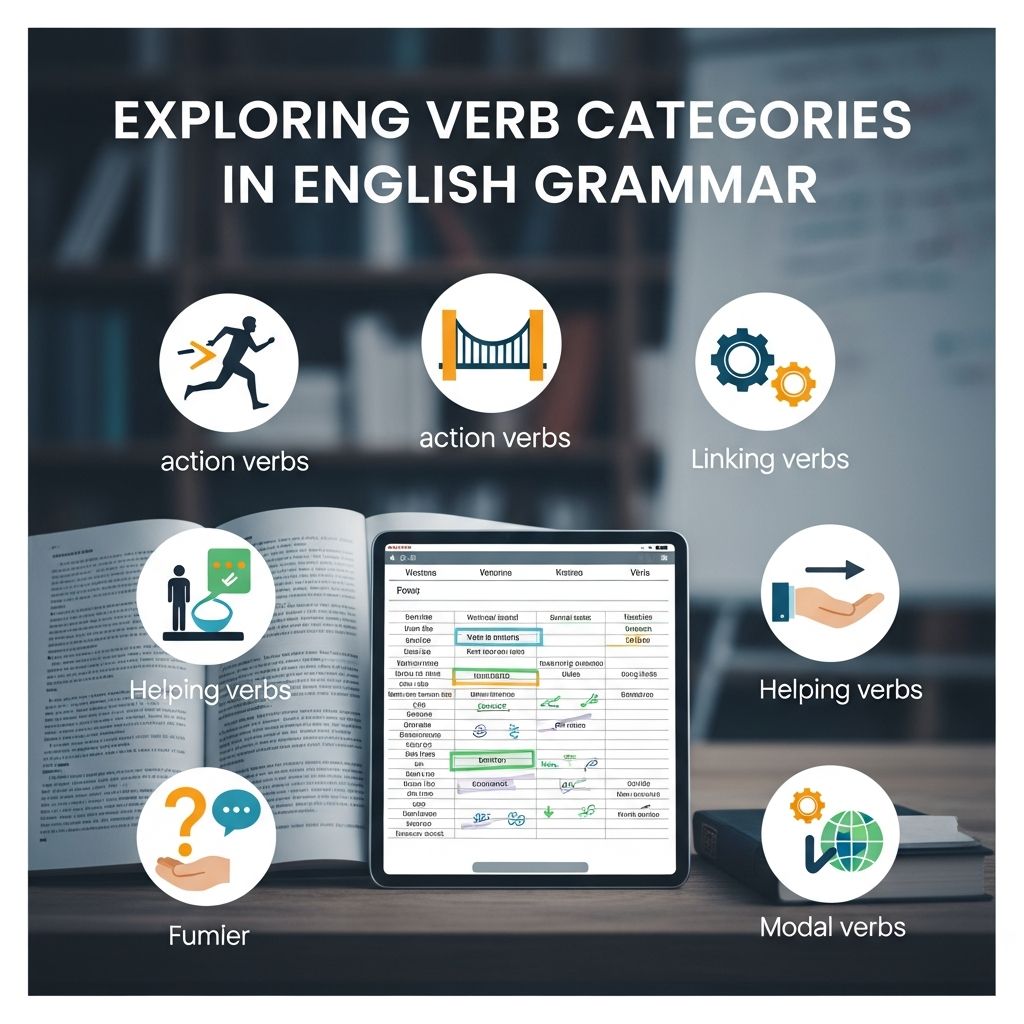
Verbs form the backbone of every sentence, conveying actions, states, and relationships. Understanding their categories helps writers and speakers craft clear, dynamic communication. This guide examines key verb types, their functions, and practical applications.
Dynamic Action Verbs: Bringing Energy to Sentences
Dynamic verbs, often called action verbs, depict physical or mental activities that subjects perform. These verbs add vitality to writing by showing observable events. For instance, words like run, jump, think, and decide illustrate movement or cognition.
Unlike static descriptions, action verbs propel narratives forward. Consider: “The athlete sprinted across the finish line.” Here, sprinted vividly captures motion. Writers should favor specific action verbs over vague ones like “do” to enhance precision.
- Physical examples: swim, dance, eat, build
- Mental examples: analyze, create, solve, imagine
These verbs typically work in continuous tenses, such as “She is running daily,” emphasizing ongoing activity.
Stative Verbs: Describing Conditions and States
Stative verbs express situations or conditions rather than actions, focusing on states of being, emotions, or senses. Common examples include know, love, seem, own, and believe.
These verbs rarely appear in progressive forms because they represent enduring qualities. Saying “I am knowing the answer” feels unnatural; instead, use “I know the answer.” Stative verbs enrich descriptive language, painting pictures of internal worlds.
| Category | Examples | Usage Note |
|---|---|---|
| Emotions | love, hate, prefer | Express feelings |
| Possession | have, own, belong | Indicate ownership |
| Senses | see, hear, feel | Describe perceptions |
Mastering stative verbs prevents tense errors and adds depth to prose.
Transitive and Intransitive Verbs: Objects and Independence
Verbs classify by object needs. Transitive verbs require a direct object to complete meaning, answering “what?” or “whom?” Examples: “She kicked the ball” (ball is the object).
Intransitive verbs stand alone without objects, like “She sleeps peacefully.” No further detail is needed. Some verbs, termed ambatransitive, switch roles: “He reads” (intransitive) vs. “He reads books” (transitive).
Ditransitive verbs take both direct and indirect objects: “She gave him a gift.” This distinction ensures grammatical completeness.
- Transitive: eat (food), write (letter), build (house)
- Intransitive: arrive, laugh, exist
Linking Verbs: Connecting Subjects to Descriptions
Linking verbs, or copular verbs, connect subjects to complements, describing or identifying them. Primary examples are forms of be (is, was, seem, appear, become).
In “The soup tastes delicious,” tastes links soup to delicious. These verbs don’t show action but equate or describe: “He seems tired.” Avoid overusing be; opt for vivid alternatives like appears or feels.
Key linking verbs include: be, seem, look, sound, feel, taste, smell, become, remain.
Auxiliary and Modal Verbs: Supporting and Modifying Actions
Auxiliary verbs (helping verbs) assist main verbs in forming tenses, voices, or moods. Core auxiliaries are be, have, do: “She is running,” “They have finished,” “I do care”.
Modal verbs (can, could, may, might, must, shall, should, will, would) express possibility, obligation, or ability: “You should study.” They precede main verbs without ‘to’: “She can swim”.
| Auxiliary | Forms | Example |
|---|---|---|
| Be | is, am, are, was, were, been, being | She is dancing. |
| Have | has, have, had | We have eaten. |
| Do | do, does, did | They do understand. |
Modals add nuance: permission (may), necessity (must), advice (should).
Regular and Irregular Verbs: Patterns in Past Forms
Regular verbs follow predictable patterns, adding -ed or -d for past and participle: walk/walked, play/played, cry/cried. Spelling tweaks occur, like drop-e (love/loved) or double consonants (stop/stopped).
Irregular verbs defy patterns, demanding memorization. Common ones: be/was/been, go/went/gone, eat/ate/eaten. Lists aid learning; focus on high-frequency verbs like come/came/come.
- Regular: talk/talked, jump/jumped
- Irregular: see/saw/seen, run/ran/run
Subject-verb agreement is crucial: singular subjects take singular forms (he runs), plurals take plural (they run).
Phrasal Verbs: Multi-Word Powerhouses
Phrasal verbs combine verbs with particles (prepositions/adverbs), creating idiomatic meanings: “turn up” (arrive), “give up” (quit), “look after” (care for).
Separable phrasals allow object insertion: “pick it up” or “pick up it.” Inseparable ones don’t: “look after him.” Context determines meaning; “get” yields get over, get by, get through.
Practice enhances fluency: “She ran into an old friend” (met unexpectedly).
Infinitives: Base Forms with Potential
Infinitives use “to” + base verb (to run, to eat), functioning as nouns, adjectives, or adverbs: “To err is human” (noun), “a chance to win” (adjective).
Bare infinitives follow modals: “I can go.” They express purpose: “She studied to pass.” Avoid confusion with prepositions; infinitives denote potential action.
Practical Tips for Using Verbs Effectively
Strong verbs elevate writing. Replace weak verbs + adverbs (walked slowly → sauntered). Favor active voice: “The dog chased the cat” over passive. Vary verb types for rhythm—mix action with stative for balance.
Check subject-verb agreement and tense consistency. Tools like grammar checkers help, but understanding categories builds intuition.
Frequently Asked Questions
What is the difference between transitive and intransitive verbs?
Transitive verbs need a direct object (e.g., “eat apple”), while intransitive do not (e.g., “sleep”).
Can a verb be both stative and dynamic?
Yes, depending on context: “think” (opinion, stative) vs. “think” (process, dynamic).
How many irregular verbs are there?
About 200 common ones; memorize top 50 for everyday use.
What are common errors with modal verbs?
Adding ‘to’ (wrong: “can to go”; correct: “can go”) or double modals.
Why avoid passive voice often?
It weakens impact; active voice is direct and engaging.
References
- 11 Common Types Of Verbs Used In The English Language — Thesaurus.com. 2023. https://www.thesaurus.com/articles/what-are-the-types-of-verbs
- 9 Types Of Verbs/ Verb And Its Types — YouTube (Homeschooling with Hira). 2023-10-15. https://www.youtube.com/watch?v=7Bv5mDZlnRQ
- What Is a Verb? | Definition, Types & Examples — Scribbr. 2024-01-12. https://www.scribbr.com/category/verbs/
- Types of Verbs, Definition and Examples — ProWritingAid. 2023. https://prowritingaid.com/Verbs
- Verbs: What Are They and How Do You Use Them? — Grammarly Blog. 2024-02-20. https://www.grammarly.com/blog/parts-of-speech/verbs/
- Verb Types — Lumen Learning (English Composition 1). 2023. https://courses.lumenlearning.com/englishcomp1/chapter/text-verb-types/

- Integrated M.A. in Applied Linguistics, University of Hyderabad
- 5+ years in editorial, instructional, SEO, and research-based writing
Sneha is a relationships and lifestyle writer with a strong foundation in applied linguistics and certified training in relationship coaching. She brings over five years of writing experience to theskillvault, crafting thoughtful, research-driven content that empowers readers to build healthier relationships, boost emotional well-being, and embrace holistic living. Her writing and insights reflect the belief that beauty, happiness, and wellness…