
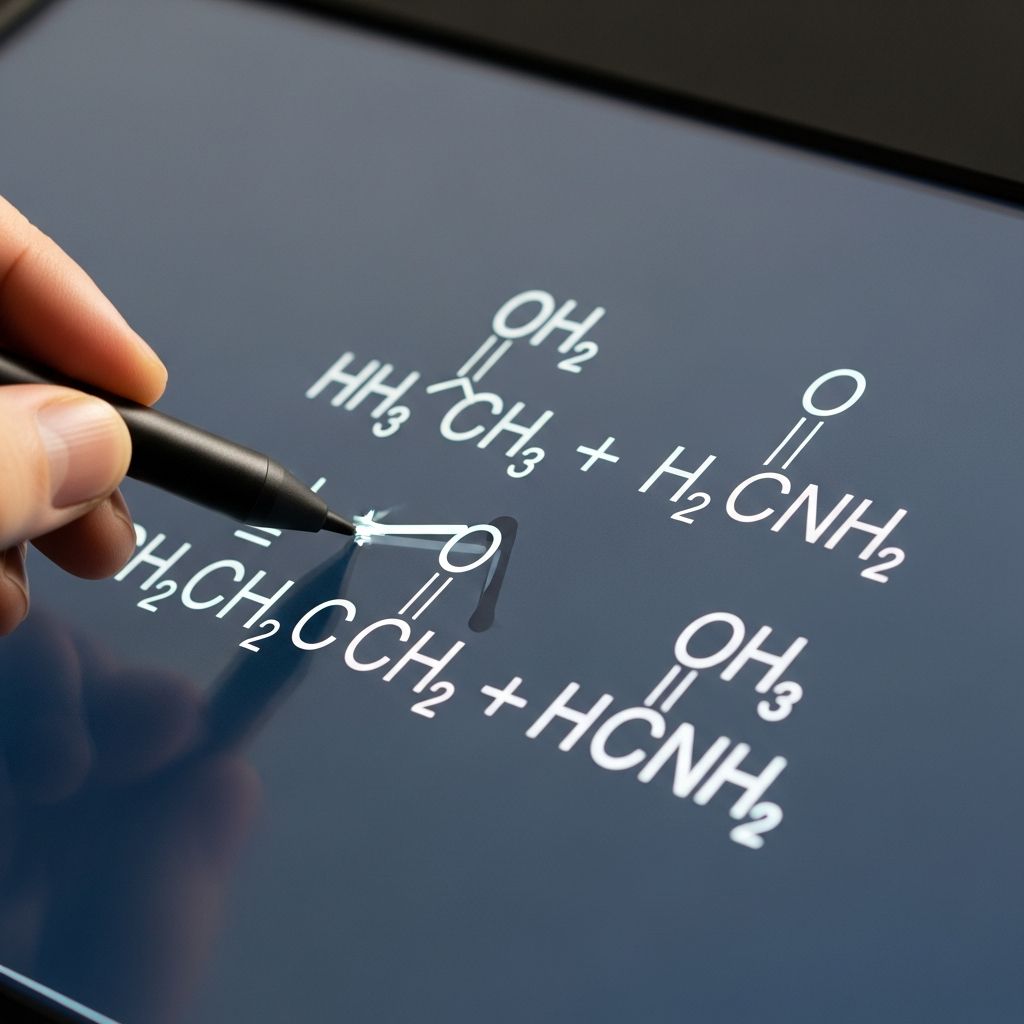
Balancing chemical equations is a foundational skill in chemistry that ensures reactions obey fundamental physical laws. This process involves adjusting coefficients to equalize atom counts on both sides of the equation, reflecting real-world conservation principles.
Why Balance Chemical Equations?
The core reason for balancing lies in the **law of conservation of mass**, which states atoms cannot be created or destroyed during reactions. Unbalanced equations imply impossible atom generation or loss, violating this law.
In practice, balanced equations enable precise predictions of reactant and product quantities, crucial for lab work, industrial processes, and stoichiometric calculations. Mastery here unlocks advanced topics like limiting reagents and reaction yields.
Core Principles Before Starting
- Atoms must match: Identical numbers of each element on reactant (left) and product (right) sides.
- Coefficients only: Modify numbers before formulas (e.g., 2H₂O); never alter subscripts (e.g., H₂O stays H₂O).
- Polyatomic ions as units: Treat groups like SO₄²⁻ or NO₃⁻ as single entities when possible.
- Fractions temporary: Use if needed, then scale to whole numbers.
These rules prevent formula changes, preserving compound identities.
Step-by-Step Balancing Method
Follow this systematic approach for consistent success:
- Write the unbalanced equation: Identify reactants → products.
- Count atoms: Tally each element on both sides; use a table for accuracy.
- Balance less common elements first: Start with metals, then non-metals, save oxygen/hydrogen for last.
- Adjust coefficients iteratively: Add smallest numbers to match counts.
- Verify and scale: Recount; multiply all by least common multiple if fractions appear.
This method, refined across educational resources, minimizes trial-and-error.
Worked Examples: From Simple to Complex
Basic Combustion: Hydrogen and Oxygen
Unbalanced: H₂ + O₂ → H₂O
| Element | Left | Right |
|---|---|---|
| H | 2 | 2 |
| O | 2 | 1 |
Balance O by placing 2 before H₂O: H₂ + O₂ → 2H₂O (now O:2, H:2 left vs. H:4, O:2 right). Balance H with 2H₂: 2H₂ + O₂ → 2H₂O.
Iron Oxidation
Unbalanced: Fe + O₂ → Fe₂O₃
Balance Fe: place 4 before Fe (matches 2×2 in 2Fe₂O₃). O requires 3O₂ for 6O (2×3). Final: 4Fe + 3O₂ → 2Fe₂O₃.
Hydrocarbon Combustion: Butane
Unbalanced: C₄H₁₀ + O₂ → CO₂ + H₂O
Balance C: 4CO₂. H: 5H₂O (10H). O: 8 from CO₂ + 5 from H₂O = 13; needs 13/2 O₂. Scale ×2: 2C₄H₁₀ + 13O₂ → 8CO₂ + 10H₂O.
Double Displacement: Sodium Sulfate
Unbalanced: Na₂SO₄ + CaCl₂ → CaSO₄ + NaCl
Balance by swapping: 1:1 for SO₄ and Ca, but 2Na and 2Cl require 2NaCl. Final: Na₂SO₄ + CaCl₂ → CaSO₄ + 2NaCl.
Handling Tricky Cases
Polyatomic Ions
Treat NO₃⁻ or SO₄²⁻ as units. Example: AgNO₃ + CuSO₄ → Ag₂SO₄ + Cu(NO₃)₂. Balance NO₃ and SO₄ first (2 each side), then Ag and Cu.
Fractional Coefficients
Allow temporarily (e.g., ½O₂), multiply through. From Khan Academy: Set ion charges oppositely (Al:2, O:3 for Al₂O₃), solve system.
Organic Reactions
Combustion prioritizes C, then H, then O. For C₅H₁₂: 5CO₂, 6H₂O, scale O accordingly.
Practice Problems with Solutions
Test skills here; solutions follow.
- P1: Al + HCl → AlCl₃ + H₂
- P2: P + O₂ → P₄O₁₀
- P3: KOH + H₃PO₄ → K₃PO₄ + H₂O
Solutions
P1: 2Al + 6HCl → 2AlCl₃ + 3H₂
P2: 4P + 5O₂ → P₄O₁₀
P3: 3KOH + H₃PO₄ → K₃PO₄ + 3H₂O
Common Mistakes and Fixes
| Mistake | Why Wrong | Fix |
|---|---|---|
| Changing subscripts | Alters compounds | Use coefficients only |
| Forgetting to recount | Miss imbalances | Always verify table |
| Balancing O/H first | Leads to fractions | Start with metals |
| Leaving fractions | Not standard | Scale to integers |
Avoid by using tables and checklists.
Advanced Tips for Efficiency
- Algebraic method: Assign variables (aA + bB → cC), solve systems.
- Check charges: For redox/ionic, balance atoms then charge.
- Software aid: Use calculators post-manual practice for verification.
- Memorize patterns: Combustion (CₓHᵧ + O₂ → xCO₂ + (y/2)H₂O).
Frequently Asked Questions (FAQs)
What if I get stuck on oxygen?
Balance it last; adjust O₂ coefficient after others match.
Are fractional coefficients acceptable?
In calculations yes, but multiply for standard form.
How do polyatomics change things?
Count as groups: 2NO₃⁻ means 2N and 6O.
Why use tables?
Prevents counting errors in complex equations.
Can I balance combustion easily?
C first, H second, O by inspection or calculation.
Applications Beyond Classroom
Balanced equations drive stoichiometry in labs (e.g., yield %), industry (fuel efficiency), and environmental science (pollutant reactions). Understanding fosters quantitative reasoning across sciences.
Practice consistently; start simple, build complexity. Tools like Khan Academy videos reinforce visually.
References
- Balance Chemical Equations in 5 Easy Steps — YouTube (Khan Academy style tutorial). 2020-01-15. https://www.youtube.com/watch?v=zmdxMlb88Fs
- How to Balance Chemical Equations? Practice Problems — YouTube (Brain Station Advanced). 2022-05-10. https://www.youtube.com/watch?v=6siOk-aWoPI
- Balance Chemical Equation Calculator — Pearson Channels. 2025-03-20. https://www.pearson.com/channels/calculators/balance-chemical-equation-calculator
- Introduction to Balancing Chemical Equations — The Organic Chemistry Tutor (YouTube). 2021-08-12. https://www.youtube.com/watch?v=e_C-V5vJv80
- Balancing Chemical Equations — Khan Academy (article). 2024-09-01. https://www.khanacademy.org/science/ms-chemistry/xc370bc422b7f75fc:chemical-changes/xc370bc422b7f75fc:chemical-reactions/a/balancing-chemical-equations
- Balancing Chemical Equations Walkthrough — Khan Academy (video). 2023-11-05. https://www.khanacademy.org/science/hs-chemistry/x2613d8165d88df5e:chemical-reactions/x2613d8165d88df5e:balancing-chemical-equations/v/balancing-chemical-equations-introduction
- Balancing Chemical Equations: Practice and Review — Albert.io. 2024-02-28. https://www.albert.io/blog/balancing-chemical-equations-practice-and-review/

- Integrated M.A. in Applied Linguistics, University of Hyderabad
- 5+ years in editorial, instructional, SEO, and research-based writing
Sneha is a relationships and lifestyle writer with a strong foundation in applied linguistics and certified training in relationship coaching. She brings over five years of writing experience to theskillvault, crafting thoughtful, research-driven content that empowers readers to build healthier relationships, boost emotional well-being, and embrace holistic living. Her writing and insights reflect the belief that beauty, happiness, and wellness…