
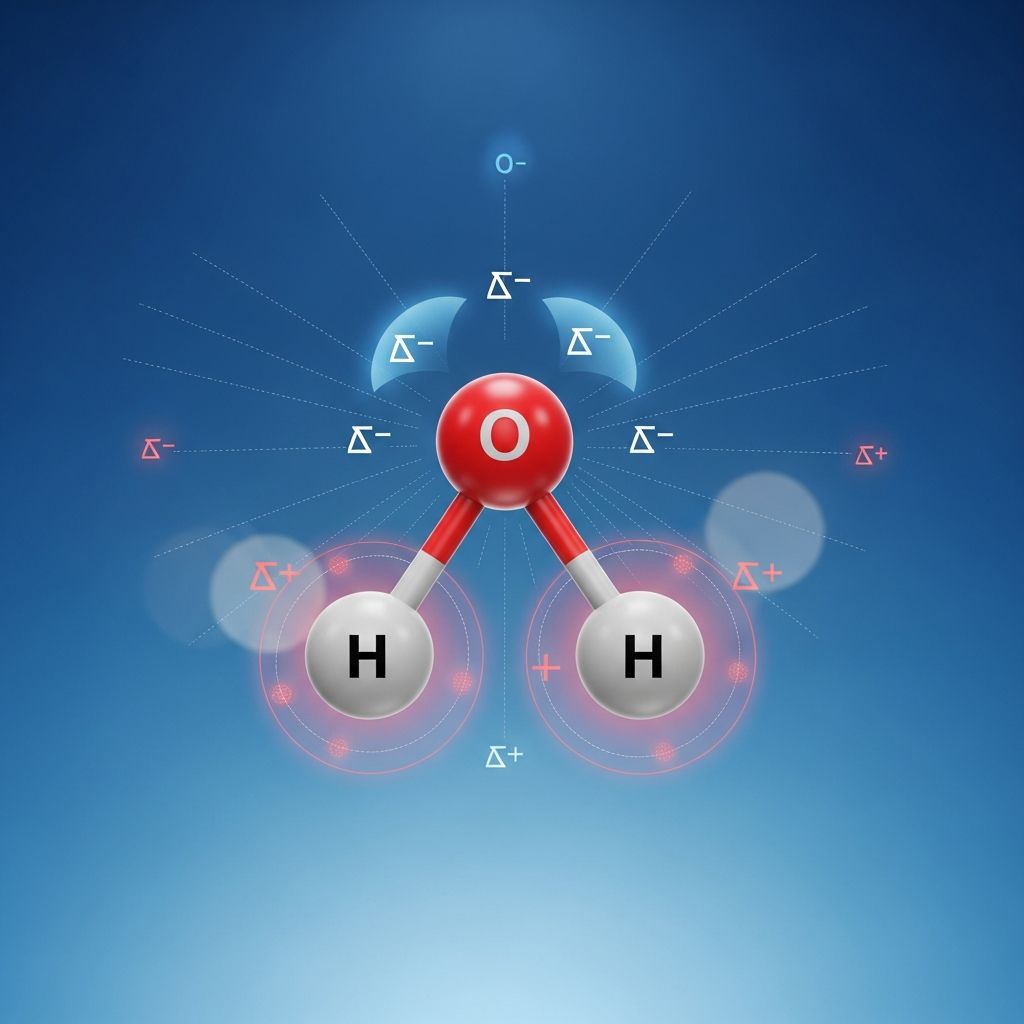
Water, with its simple chemical formula H2O, exhibits polarity due to the uneven distribution of electrons in its molecular structure, creating partial charges that lead to remarkable physical and chemical behaviors.
The Fundamental Building Blocks of Water’s Structure
At its core, a water molecule consists of one oxygen atom bonded to two hydrogen atoms. These bonds are covalent, meaning electrons are shared between the atoms. However, the sharing is not equal because oxygen is more electronegative than hydrogen. Electronegativity measures an atom’s ability to attract electrons in a bond; oxygen’s value is 3.44, while hydrogen’s is 2.20, resulting in a significant difference that pulls shared electrons closer to oxygen.
This electron shift imparts a partial negative charge (δ⁻) to the oxygen atom and partial positive charges (δ⁺) to the hydrogen atoms. The molecule adopts a bent geometry with a bond angle of approximately 104.5 degrees, influenced by the oxygen atom’s two lone pairs of electrons, which repel the bonds and distort the shape from ideal tetrahedral geometry.
- Bent shape: Prevents cancellation of dipole moments, unlike linear molecules.
- Lone pairs on oxygen: Contribute to VSEPR theory’s prediction of angular structure.
- Electronegativity difference: Greater than 0.4, confirming polar covalent bonds.
How Polarity Emerges in Water
Polarity in a molecule arises when there is a separation of charge, forming a dipole moment. In water, the oxygen end is electron-rich and negative, while the hydrogens are electron-poor and positive. This dipole is represented vectorially, with arrows pointing from positive to negative regions.
Visualize the electron cloud: denser around oxygen (darker in models), sparser around hydrogens, illustrating unequal sharing. Without this bent configuration, dipoles might cancel, as in CO2, but water’s asymmetry ensures net polarity.
| Molecule | Shape | Electronegativity Difference | Polar? |
|---|---|---|---|
| H2O | Bent (104.5°) | 1.24 (O-H) | Yes |
| CO2 | Linear | 0.89 (C-O) | No |
| NH3 | Trigonal pyramidal | 0.84 (N-H) | Yes |
This table compares water to similar molecules, highlighting how shape and electronegativity dictate polarity.
Hydrogen Bonding: The Key Intermolecular Force
Individual water molecules are polar dipoles, but their interactions amplify effects through hydrogen bonding. A hydrogen bond forms when a hydrogen atom, positively charged, attracts the lone pair on another molecule’s oxygen.
These bonds are weaker than covalent bonds (about 5% strength) but numerous, creating a network. In liquid water, each molecule forms up to four hydrogen bonds, explaining cohesion (molecules sticking together) and adhesion (to other surfaces).
- Cohesion: Leads to high surface tension, allowing insects to walk on water.
- Adhesion: Causes capillary action in plants, aiding water transport.
- Network strength: Requires more energy to break, raising boiling and melting points.
Unique Properties Stemming from Polarity
Water’s polarity underpins properties vital for life. Its high specific heat capacity (4.18 J/g°C) moderates temperatures, as hydrogen bonds absorb heat before molecules move faster.
The boiling point (100°C) is anomalously high compared to H2S (-60°C), despite similar masses, due to hydrogen bonding. Solvent power dissolves ionic and polar substances: NaCl dissociates as Na+ hydrates with oxygen, Cl– with hydrogens (“like dissolves like”).
In ice, hydrogen bonds form a rigid, open lattice, making it less dense than liquid water—ice floats, insulating oceans and enabling aquatic life.
Biological and Environmental Significance
Life depends on water’s polarity. In cells, it facilitates transport, reactions, and structure. Polarity enables protein folding via hydrogen bonds and DNA base pairing.
Environmentally, polarity drives the water cycle: high heat of vaporization cools Earth via evaporation; surface tension shapes droplets and waves.
Without polarity, oceans would freeze solid, rivers not flow, and blood not carry nutrients efficiently.
Experimental Evidence and Demonstrations
Lab tests confirm polarity. Paper chromatography shows water’s pull on polar inks. Electronegativity models use ball-and-stick kits to depict bent shape and dipoles.
Surface tension demos with pepper or needles floating illustrate cohesion. Capillary rise in tubes shows adhesion overpowering gravity.
Frequently Asked Questions
Why does water have a bent shape?
The two lone electron pairs on oxygen repel the O-H bonds, compressing the angle to 104.5° per VSEPR theory.
Is distilled water polar?
Yes, polarity is intrinsic to H2O molecules, unaffected by purity.
How does polarity make water a universal solvent?
Hydrogen bonds solvate ions and polar molecules, surrounding charges oppositely.
Why is ice less dense than water?
Frozen hydrogen bonds create a spacious crystal lattice, expanding volume.
Can nonpolar molecules dissolve in water?
Poorly; oil floats due to weak interactions, unlike polar solutes.
Advanced Insights: Dipole Moment and Quantum Views
Water’s dipole moment is 1.85 Debye, quantifiable via spectroscopy. Quantum mechanics explains electron density via molecular orbitals, concentrated on oxygen.

- Integrated M.A. in Applied Linguistics, University of Hyderabad
- 5+ years in editorial, instructional, SEO, and research-based writing
Sneha is a relationships and lifestyle writer with a strong foundation in applied linguistics and certified training in relationship coaching. She brings over five years of writing experience to theskillvault, crafting thoughtful, research-driven content that empowers readers to build healthier relationships, boost emotional well-being, and embrace holistic living. Her writing and insights reflect the belief that beauty, happiness, and wellness…