
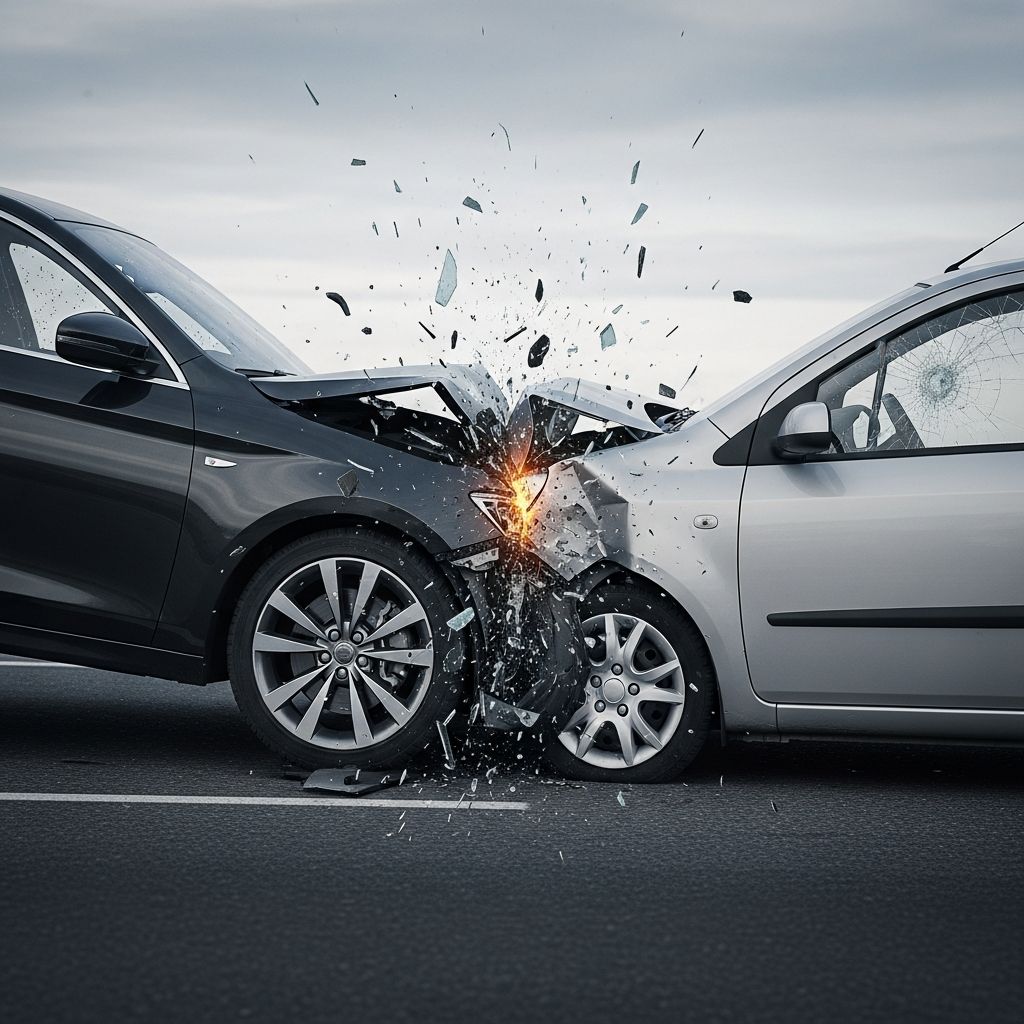
Car crashes represent sudden, violent events where fundamental physics principles dictate the outcomes for vehicles and occupants. These incidents involve rapid changes in motion, governed by laws of mechanics that explain everything from deformation to injury risks.
Foundational Principles of Motion in Collisions
Understanding crashes begins with Isaac Newton’s three laws of motion, which underpin every interaction during impact.
Newton’s **first law**, the law of inertia, states that objects in motion stay in motion unless acted upon by an external force. In a crash, a vehicle continues forward until barriers like another car or a wall intervene.
The **second law** quantifies how force equals mass times acceleration (F = ma). Greater vehicle mass or sudden deceleration amplifies forces, directly influencing damage extent.
Newton’s **third law** asserts that every action has an equal and opposite reaction. When a car hits a wall, the wall exerts an identical force back, propelling contents rearward.
Momentum Dynamics During Impacts
Momentum, defined as mass times velocity (p = mv), remains conserved in collisions absent external influences like friction.
In head-on crashes between equal-mass vehicles, each traveling at speed v, post-collision velocities depend on elasticity. Elastic collisions rebound objects with original speeds reversed; inelastic ones, common in real crashes, cause vehicles to merge motion, halving speed for equal masses.
| Collision Type | Momentum Conservation | Energy Outcome | Real-World Example |
|---|---|---|---|
| Elastic | Preserved | Preserved as kinetic | Bumper taps at low speed |
| Inelastic | Preserved | Converted to deformation/heat | Frontal vehicle smash |
| Perfectly Inelastic | Preserved | Objects stick together | Trucks embedding |
This table illustrates how momentum dictates post-crash trajectories, critical for accident reconstruction.
Kinetic Energy and Its Destructive Power
Kinetic energy (KE = ½mv²) escalates quadratically with velocity, explaining why speed critically heightens crash severity. Doubling speed quadruples energy, overwhelming structures.
- At 30 mph, KE is moderate, often survivable with safety gear.
- At 60 mph, KE quadruples, crumpling frames and risking fatalities.
During impact, this energy dissipates via vehicle deformation, sounds, heat, and occupant forces. Uncontrolled transfer to humans causes injuries.
Three-Phase Sequence of a Typical Crash
Crashes unfold in distinct phases, each with unique physics.
Phase 1: Vehicle-Vehicle or Vehicle-Object Collision
The initial contact deforms the car’s front end. Crumple zones—engineered weak points—extend deceleration time, reducing peak forces per Newton’s second law. A 0.1-second crumple over 2 feet halves g-forces compared to rigid stops.
Phase 2: Occupant-Vehicle Interior Collision
Inertia propels unrestrained bodies forward into dashboards, steering wheels, or windows. Seatbelts apply opposing forces over chest and pelvis, distributing load.
Phase 3: Internal Body Collisions
Organs continue moving, slamming into ribcages or skulls into brains, causing whiplash, concussions, or organ rupture despite external restraints.
Impact of Vehicle Mass and Size
Heavier vehicles carry more momentum, thrusting lighter ones backward with greater force per Newton’s third law. A large SUV striking a compact car transfers disproportionate energy, elevating small-vehicle occupant risks.
Center of mass position influences rollover propensity; high profiles tip easier during side impacts.
Engineering Solutions to Harness Physics
Crumple Zones and Energy Absorption
Modern vehicles incorporate front and rear crumple zones that collapse controllably, converting kinetic energy into plastic deformation. This prolongs impact duration, slashing deceleration rates from 100g to under 50g.
Airbags and Seatbelt Pretensioners
Airbags deploy in milliseconds, inflating to cushion heads and torsos, further extending stop times. Pretensioners cinch belts snugly at detection, minimizing forward excursion.
Advanced Materials and Structures
High-strength steel and aluminum alloys balance rigidity and absorption, directing forces away from habitats.
Speed’s Nonlinear Risk Escalation
Physics reveals why modest speed hikes yield outsized dangers. KE proportional to v² means 40 mph carries 78% more energy than 35 mph for same mass.
- 30 mph: Many minor injuries.
- 50 mph: Frequent severe trauma.
- 70 mph: High fatality odds.
Data correlates fatality risk rising exponentially beyond 40 mph.
Angular and Offset Collisions
Side impacts lack crumple space, channeling energies directly into doors. Roof strength prevents cabin intrusion during rollovers, where angular momentum (L = Iω) governs flips.
Post-Crash Fire and Secondary Hazards
Deformed fuel systems may rupture, igniting from sparks. Physics of fluid dynamics and combustion adds layers to survival calculus.
Implications for Safety and Policy
Grasping these dynamics informs regulations like speed limits, which temper KE, and mandates for electronic stability control countering momentum imbalances.
Driver training emphasizing following distances allows reaction time, mitigating inertia effects.
Frequently Asked Questions
Why do crashes hurt more at higher speeds?
Higher speeds exponentially boost kinetic energy (½mv²), generating forces overwhelming human tolerance.
How do airbags work physically?
They rapidly inflate, creating padded surfaces that extend occupant deceleration time, reducing force via F = ma.
Does vehicle weight protect occupants?
Yes in collisions with lighter vehicles due to momentum advantage, but increases risks to others.
What is a crumple zone?
A designed deformation area absorbing impact energy through controlled collapse, lessening transmitted forces.
Are low-speed crashes safe?
Often, but internal injuries or poor restraint use can still harm due to unrestrained motion.
References
- Physics of a Car Collision — Silver Injury Law. 2023. https://www.silverinjurylaw.com/physics-of-a-car-collision/
- Car Crash Causes & Physics Explained — Harding Mazzotti, LLP. 2023. https://www.1800law1010.com/blog/the-common-causes-and-physics-of-a-car-crash/
- What Happens to the Body in a Crash? The Physics — RoadSense. 2023. https://roadsense.org.au/what-happens-to-the-body-in-a-crash/
- Momentum and Collisions — UNSW Physics Animations. 2023. https://animations.physics.unsw.edu.au/jw/momentum.html
- Car Crash Example — HyperPhysics, Georgia State University. 2023. http://hyperphysics.phy-astr.gsu.edu/hbase/carcr.html

- Integrated M.A. in Applied Linguistics, University of Hyderabad
- 5+ years in editorial, instructional, SEO, and research-based writing
Sneha is a relationships and lifestyle writer with a strong foundation in applied linguistics and certified training in relationship coaching. She brings over five years of writing experience to theskillvault, crafting thoughtful, research-driven content that empowers readers to build healthier relationships, boost emotional well-being, and embrace holistic living. Her writing and insights reflect the belief that beauty, happiness, and wellness…