
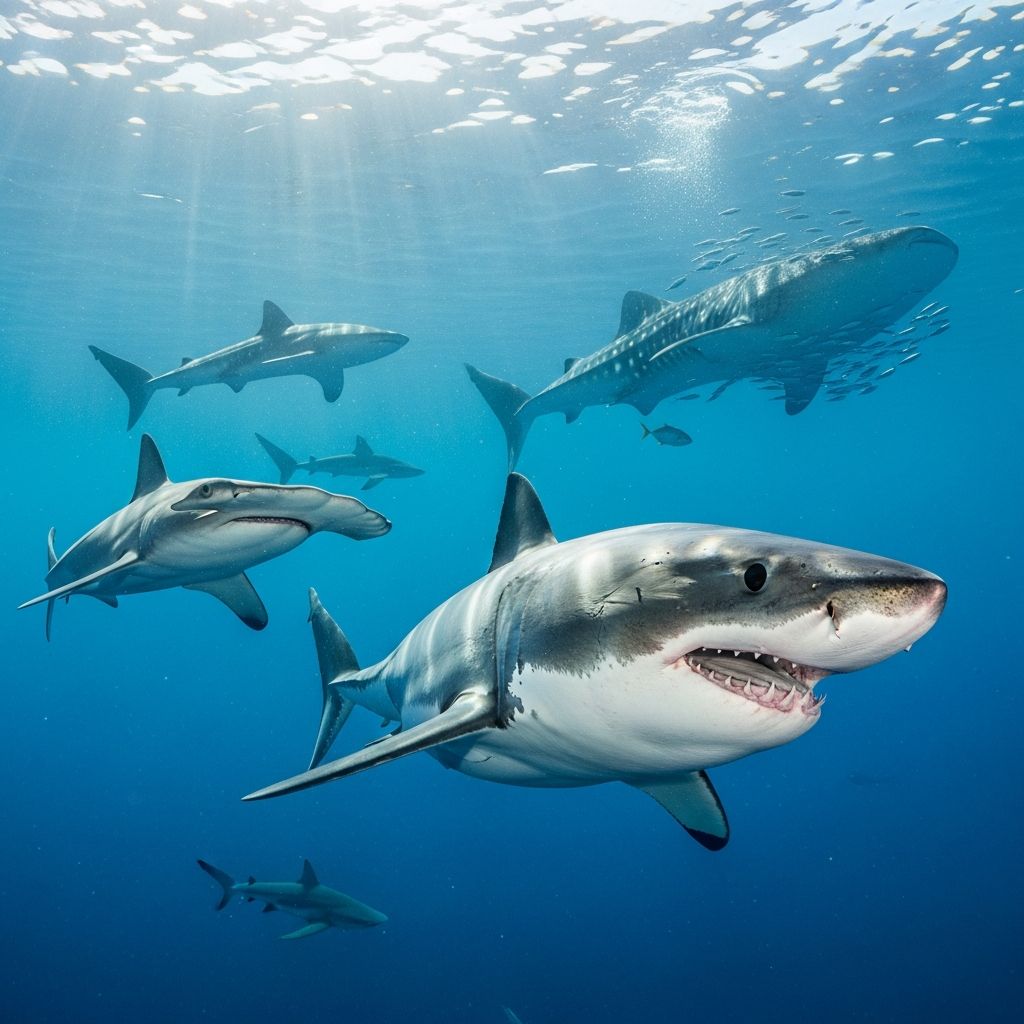
Sharks represent one of the ocean’s most ancient and diverse groups of predators, with over 500 species inhabiting waters worldwide. These remarkable fish exhibit extraordinary adaptations that enable them to thrive in varied environments, from shallow coastal zones to the deepest abysses. This article delves into prominent shark species, examining their physical traits, feeding habits, distribution patterns, and ecological significance. Understanding these apex and mesopredators is crucial for conservation efforts amid growing threats like overfishing and habitat loss.
Understanding Shark Diversity and Classification
Sharks belong to the class Chondrichthyes, characterized by cartilaginous skeletons rather than bony ones. They are divided into numerous orders, each with distinct features. For instance, Carcharhiniformes, or ground sharks, form the largest group, featuring five gill slits, protective nictitating membranes over their eyes, and spineless dorsal fins. These sharks, including many reef and oceanic species, dominate tropical and temperate seas.
Lamniformes, known as mackerel sharks, include speedsters like makos and the iconic great white, boasting powerful tails for bursts of speed and regional endothermy to maintain elevated body temperatures. Orectolobiformes, or carpet sharks, feature barbels and two dorsal fins, often blending seamlessly with seafloors as seen in wobbegongs. This classification helps scientists track evolutionary lineages and conservation priorities.
- Carcharhiniformes: Largest order with species like blacktips and bulls.
- Lamniformes: High-speed hunters including makos and great whites.
- Orectolobiformes: Bottom-dwellers like nurse and whale sharks.
- Squaliformes: Deep-sea dwellers, some bioluminescent, lacking anal fins.
Coastal and Inshore Predators
Many sharks patrol nearshore waters, influencing local ecosystems by controlling prey populations. Blacktip sharks (Carcharhinus limbatus) are a prime example, celebrated by anglers for their acrobatic fights. Ranging from the Canadian Maritimes to Texas and California coasts, they grow to about 6-8 feet and prefer chasing live bait over bottom offerings. Their tips of fins darken distinctly, aiding identification.
Bull sharks (Carcharodon leucas) stand out for their aggression and adaptability. Reaching 12 feet and hundreds of pounds, they venture into freshwater rivers, tolerating low salinity better than any other shark. Documented far inland, they’ve been implicated in attacks due to their bold hunting in murky bays and surf zones.
Nurse sharks (Ginglymostoma cirratum) offer a docile contrast, often resting in groups on reefs. These slow-moving bottom-feeders use barbels to detect crustaceans and fish, growing to 10-14 feet in warm Atlantic and Caribbean waters.
Offshore Powerhouses and Speed Demons
Open ocean realms host some of the fastest and largest sharks. Shortfin mako sharks (Isurus oxyrinchus), the ocean’s sprinters, hit speeds up to 70 km/h thanks to a specialized circulatory system retaining heat. Once tournament favorites for their aerial displays and flavorful meat, they reach 1,000 pounds but face population declines.
Blue sharks (Prionace glauca) are ubiquitous opportunists, tagging along with big game fishers worldwide. Abundant in both warm and cold waters, they seldom approach land, growing slender to 12 feet. Often viewed as bycatch, their global range underscores their resilience.
Thresher sharks (Alopias vulpinus) wield unique weapons: elongated upper tail lobes up to their body length, used to stun schools of fish. Found in temperate oceans, they cruise mid-waters, growing to 20 feet with a sleek build suited for agile pursuits.
Hammerhead Marvels: Unique Head Adaptations
Hammerheads (Sphyrna spp.) captivate with cephalofoils—wide, hammer-shaped heads enhancing sensory capabilities. Great hammerheads (Sphyrna mokarran), the largest at 20 feet, possess complex brains processing vast sensory data from ampullae of Lorenzini and enhanced vision. They roam warm temperate seas, preying on rays and fish.
Scalloped hammerheads (Sphyrna lewini) form massive schools by day, dispersing nocturnally. Their front-margined heads provide near-360-degree vision, and low second dorsal fins distinguish them. Vulnerable per IUCN, they inhabit coastal tropics.
| Species | Max Length | Key Feature | Habitat |
|---|---|---|---|
| Great Hammerhead | 20 ft | Complex brain | Warm temperate worldwide |
| Scalloped Hammerhead | 14 ft | Schooling behavior | Tropical coasts |
| Smooth Hammerhead | 13 ft | Smooth head margin | Pelagic waters |
Gentle Giants and Benthic Dwellers
Not all sharks are ferocious hunters. Whale sharks (Rhincodon typus), the largest fish at 40+ feet, filter-feed on plankton using cavernous mouths. Graceful and docile, they migrate through tropical oceans, drawing divers globally.
Bottom-associated species like bonnetheads (Sphyrna tiburo) are the smallest hammerheads at 5 feet, foraging seagrass beds for crabs. Lemon sharks (Negaprion brevirostris) haunt mangroves and reefs, their yellow-tinged skin and second dorsal fin matching blacktips in size but differing in demeanor.
Sandbar sharks (Carcharhinus plumbeus) dominate nursery areas, growing to 8 feet with high dorsal fins. Protected in some regions, they migrate seasonally along U.S. coasts. Wobbegongs, camouflaged carpet sharks, ambush prey from Australian reefs with ornate patterns.
Deep-Sea Oddities and Ancient Relics
Abyssal zones harbor bizarre forms. Frill sharks (Chlamydoselachus anguineus), living fossils from the Carboniferous, slither like eels at 1,500 meters with trident teeth for grasping. Greenland sharks (Somniosus microcephalus) patrol Arctic depths, growing slowly to 24 feet and living over 400 years, scavenging with toxic flesh.
Sawsharks (Pristiophoriformes) wield elongated rostrums studded with teeth for slashing prey, differing from sawfishes. Angel sharks (Squatiniformes) bury in sand, ambushing with flattened bodies.
Ecological Roles and Human Interactions
Sharks maintain balance by preying on weak or overpopulated species, preventing algal blooms via controlled herbivore numbers. Their removal cascades through food webs, as seen in overfished areas.
Angling targets species like makos and blacktips for sport, but regulations protect slow-maturing ones like duskies, which take 20 years to mature. Many, including great whites (Carcharodon carcharias), are IUCN-vulnerable, hunted for fins despite protections.
Conservation Challenges Facing Sharks
Bycatch, finning, and climate change threaten populations. NOAA guides aid identification to minimize impacts. International efforts like those from the Shark Research Institute catalog species for targeted protection.
Frequently Asked Questions (FAQs)
What is the fastest shark species?
The shortfin mako shark, capable of speeds up to 70 km/h due to its heat-retaining physiology.
Which shark can live in freshwater?
Bull sharks uniquely tolerate and hunt in rivers, confirmed in inland attacks.
Are all sharks dangerous to humans?
No, most like nurse and whale sharks are harmless; attacks are rare and often misidentified.
How many shark species exist?
Over 500, spanning diverse orders from ground sharks to deep-sea forms.
What makes hammerhead heads special?
The cephalofoil boosts sensory detection and maneuverability for hunting.
References
- Types of Sharks: 15 Shark Species You’re Most Likely to Catch — Field & Stream. 2023-05-15. https://fieldandstream.com/stories/fishing/saltwater-fishing/types-of-sharks
- Shark species – The Australian Museum — Australian Museum. 2024-02-10. https://australian.museum/publications/sharks/shark-species/
- Shark Species – Shark Research Institute — Shark Research Institute. 2023-11-20. https://www.sharks.org/species
- Shark Identification for Cooperative Shark Tagging Program — NOAA Fisheries. 2025-01-12. https://www.fisheries.noaa.gov/new-england-mid-atlantic/atlantic-highly-migratory-species/shark-identification-cooperative-shark-0
- Hawaiʻi Sharks | Shark Identification Guide — Hawaii Department of Land and Natural Resources. 2024-08-05. https://dlnr.hawaii.gov/sharks/hawaii-sharks/shark-identification-guide/
- Meet the nine types of sharks in the ocean — Natural History Museum. 2023-07-18. https://www.nhm.ac.uk/discover/nine-types-of-sharks-in-the-ocean.html

- Integrated M.A. in Applied Linguistics, University of Hyderabad
- 5+ years in editorial, instructional, SEO, and research-based writing
Sneha is a relationships and lifestyle writer with a strong foundation in applied linguistics and certified training in relationship coaching. She brings over five years of writing experience to theskillvault, crafting thoughtful, research-driven content that empowers readers to build healthier relationships, boost emotional well-being, and embrace holistic living. Her writing and insights reflect the belief that beauty, happiness, and wellness…