
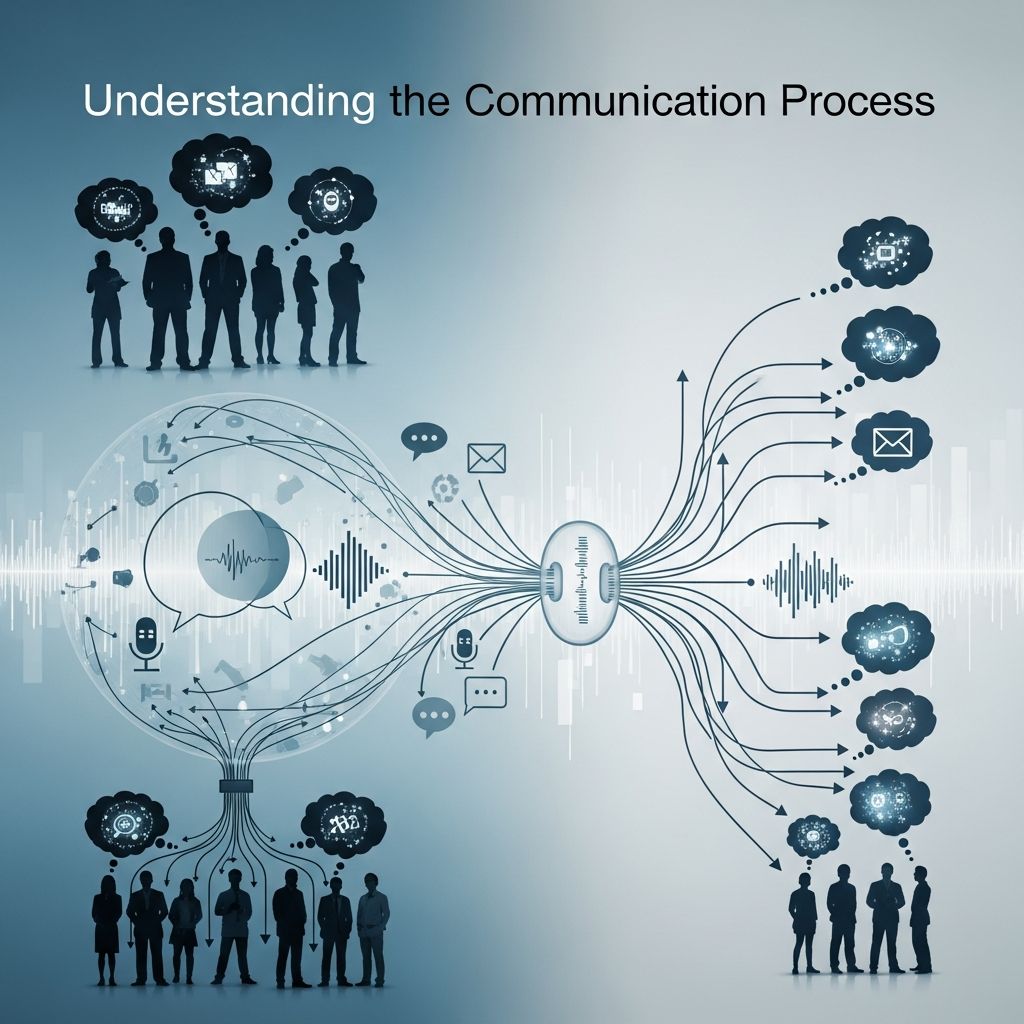
The communication process forms the backbone of human interaction, enabling the exchange of ideas, emotions, and information between individuals or groups. At its core, it involves a dynamic sequence where a sender crafts and transmits a message through a chosen medium to a receiver, who interprets it and may respond. This cyclical exchange ensures mutual understanding, but success hinges on aligning intentions with interpretations. Whether in casual conversations, business meetings, or digital exchanges, grasping this process enhances clarity and reduces misunderstandings.
Core Elements of Effective Communication
Every instance of communication relies on fundamental building blocks. These elements work together to bridge the gap between thought and comprehension.
- Sender (or Source): The originator of the message, responsible for formulating and conveying the idea. This person or entity shapes the content based on their knowledge, emotions, and intent.
- Message: The actual content being shared, which can be verbal, nonverbal, written, or symbolic. It encapsulates the sender’s core idea in a transmittable form.
- Channel: The medium through which the message travels, such as speech, email, video call, or body language. The choice of channel significantly impacts how the message is received.
- Receiver: The individual or group interpreting the message. Their background, experiences, and context influence understanding.
- Encoding: The sender’s act of converting thoughts into communicable symbols, like words or gestures.
- Decoding: The receiver’s process of translating those symbols back into meaningful ideas.
- Feedback: The receiver’s response, closing the loop and confirming comprehension or seeking clarification.
These components interact fluidly. For instance, in a workplace email, the manager (sender) encodes instructions (message) via digital channel to an employee (receiver), who decodes it and replies with confirmation (feedback).
Step-by-Step Breakdown of the Process
The communication process unfolds in a series of deliberate steps, often outlined as a linear or interactive sequence. Here’s a detailed walkthrough:
- Idea Generation: It all begins in the sender’s mind with a concept, need, or information to share. This internal spark drives the entire exchange.
- Encoding the Message: The sender translates the idea into a suitable format—selecting words, tone, visuals, or symbols that match the audience’s capabilities.
- Channel Selection and Transmission: Choosing the right medium (e.g., phone for urgency, report for detail) and sending the message. Physical or digital pathways carry it forward.
- Reception and Decoding: The receiver perceives the message and interprets it based on personal filters like culture, prior knowledge, or emotions.
- Feedback Provision: The receiver responds, verifying accuracy or requesting adjustments. This step transforms one-way transmission into dialogue.
This sequence isn’t always linear; modern views emphasize its cyclical nature, with roles of sender and receiver swapping fluidly.
Key Models Shaping Our View of Communication
Scholars have developed models to illustrate the process, evolving from simple transmission to complex interactions.
| Model | Description | Key Features | Strengths | Limitations |
|---|---|---|---|---|
| Transmission Model | Views communication as a one-way flow from sender to receiver via a channel. | Sender, message, channel, receiver. | Simple for basic info transfer. | Ignores feedback and context. |
| Interaction Model | Highlights back-and-forth exchange with feedback loops. | Adds encoding/decoding, feedback, shared field. | Captures dialogue dynamics. | Overlooks external influences. |
| Transaction Model | Sees communication as simultaneous co-creation by participants. | Mutual influence, noise, context. | Reflects real-life complexity. | More abstract for beginners. |
These models, pioneered by thinkers like Shannon and Weaver, underscore that communication is rarely straightforward. The transmission model suits mass media, while transactional approaches better explain interpersonal talks.
Factors Influencing Communication Success
Beyond basics, several variables determine if a message lands effectively. Context—physical, social, cultural, or psychological—sets the stage. Time, location, and relationships alter interpretations. Noise, any interference distorting the message, poses a constant challenge.
- Physical Noise: Background sounds, poor signal, or distractions like a noisy café.
- Physiological Noise: Hearing issues, fatigue, or hunger affecting focus.
- Psychological Noise: Biases, stress, or preconceptions clouding judgment.
- Semantic Noise: Language barriers, jargon, or ambiguous terms.
To counter these, senders must anticipate receiver perspectives, using clear language and appropriate channels. Cultural differences, for example, demand sensitivity to nonverbal cues varying globally.
Real-World Applications Across Contexts
The communication process adapts to diverse scenarios. In business, it underpins negotiations, where precise encoding prevents costly errors. Leaders use feedback to refine strategies, fostering team alignment.
Educators rely on it for teaching: simplifying complex ideas (encoding) via visuals (channel) and quizzes (feedback). In healthcare, doctors encode diagnoses clearly to patients, decoding their concerns for better outcomes.
Digital communication, like social media, introduces unique channels. Emojis aid encoding emotions, but algorithms add noise, altering reach. Remote work amplifies the need for explicit feedback to bridge virtual gaps.
Strategies for Optimizing the Process
Mastering communication involves proactive techniques:
- Know your audience: Tailor encoding to their knowledge level and preferences.
- Choose channels wisely: Face-to-face for nuance, written for records.
- Minimize noise: Ensure quiet environments and clear phrasing.
- Encourage feedback: Ask open questions like “Does that make sense?”
- Practice active listening: Decode fully before responding.
Regular self-assessment, such as reviewing past exchanges, hones skills. Training in nonverbal cues—facial expressions conveying 55% of meaning—boosts nonverbal encoding.
Common Pitfalls and How to Avoid Them
Miscommunications arise from mismatched encoding/decoding or ignored feedback. Assumptions about shared understanding lead to semantic gaps. Overloading messages with info causes cognitive overload.
To sidestep these:
- Use simple, direct language.
- Confirm via paraphrasing: “So you’re saying…”
- Adapt to feedback promptly.
In global teams, cultural training prevents misdecoding faux pas, like directness perceived as rudeness.
Frequently Asked Questions (FAQs)
What are the main steps in the communication process?
The primary steps include idea formation, encoding, channel selection, transmission, decoding, and feedback, forming a complete cycle.
How does feedback improve communication?
Feedback verifies message accuracy, allows corrections, and turns monologue into dialogue, enhancing mutual understanding.
What role does noise play in communication?
Noise disrupts transmission at any stage, from external distractions to internal biases, requiring proactive mitigation.
Why is encoding crucial?
Encoding converts abstract thoughts into shareable forms; poor encoding leads to misinterpretation regardless of channel.
Can the communication process be one-way?
While transmission models depict it as one-way, effective communication is typically interactive with feedback.
By internalizing these principles, anyone can elevate their interactions, from personal relationships to professional triumphs. The process, though intricate, rewards mindful application with deeper connections and fewer errors.
References
- Steps and Components of the Communication Process — Indeed.com. 2023-05-15. https://www.indeed.com/career-advice/career-development/communication-process
- Communication Process | Steps, Diagram & Examples — Study.com. 2024-01-10. https://study.com/academy/lesson/what-is-the-communication-process-definition-steps.html
- 1.2 The Communication Process — MacEwan Open Books (openbooks.macewan.ca). 2022-08-22. https://openbooks.macewan.ca/professionalcommunication/chapter/1-2-the-communication-process/
- The Communication Process — DePaul Pressbooks (depaul.pressbooks.pub). 2023-03-05. https://depaul.pressbooks.pub/businessprofessionalcomm/chapter/the-communication-process/
- The Communication Process Explained — YouTube (NJIT channel). 2021-11-12. https://www.youtube.com/watch?v=AzBAicGgPws
- Communication Process — NJIT (web.njit.edu). 2020-09-18. https://web.njit.edu/~lipuma/352comproc/comproc.htm
- 1.1: Communication – Definition and The Communication Process — LibreTexts (socialsci.libretexts.org). 2024-02-28. https://socialsci.libretexts.org/Bookshelves/Communication/Interpersonal_Communication/I.C.A.T_Interpersonal_Communication_Abridged_Textbook_(Gerber_and_Murphy)/01:_Introduction_to_Communication/1.01:_Communication-_Definition_and_The_Communication_Process

Medha Deb is an editor with a master's degree in Applied Linguistics from the University of Hyderabad. She believes that her qualification has helped her develop a deep understanding of language and its application in various contexts. Medha specializes in the areas of beauty, health, sports, and wellness and is committed to ensuring that the content on the website is…