
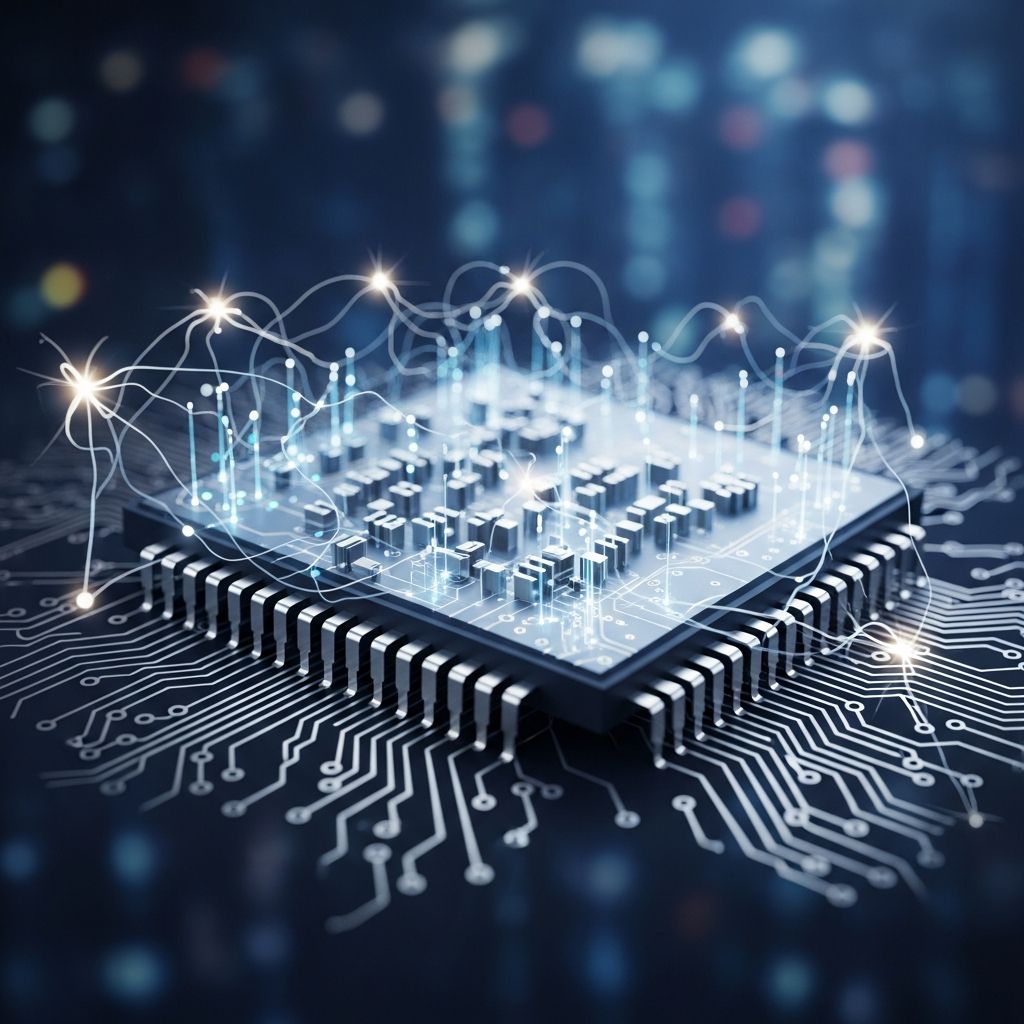
Microchips, also known as integrated circuits or simply chips, are the foundational elements of contemporary electronics. These minuscule devices, often smaller than a fingernail, integrate billions of electronic components to process data, store information, and control systems across countless applications.
Understanding the Core of a Microchip
At its essence, a microchip is a compact piece of semiconductor material, primarily silicon, engineered with intricate layers of electronic circuits. These circuits incorporate transistors, resistors, capacitors, and diodes that work in unison to manipulate electrical signals. Transistors serve as the fundamental building blocks, functioning like microscopic switches that regulate the flow of electricity, enabling the chip to execute complex computations.
The scale of these components is astonishing. Modern microchips feature elements measured in nanometers—one billionth of a meter—with some transistors now under 10 nm in size. This allows for packing up to 50 billion transistors onto a single chip, rivaling the complexity of the human brain in computational density. Silicon’s semiconductor properties make it ideal: it conducts electricity under specific conditions, allowing precise control over signals.
Key Components and Layered Architecture
A typical microchip consists of several critical elements stacked in precise layers. The silicon substrate forms the base, a pure crystal upon which other materials are deposited or etched. Multiple layers follow, created through processes like photolithography and doping, which introduce impurities to alter electrical properties.
- Silicon Wafer Base: Provides the foundational platform for circuit construction.
- Transistors: Act as switches and amplifiers, forming the logic gates essential for processing.
- Interconnects: Thin metal paths that link components, enabling signal transmission across the chip.
- Insulating Layers: Prevent unwanted electrical interference between circuit levels.
- Dopants and Oxides: Modify conductivity and provide isolation.
This multi-layered design replaces bulky discrete components, offering superior speed, efficiency, and miniaturization.
Categories of Microchips in Use Today
Microchips are classified by function, with digital and analog variants serving distinct roles. Digital chips process binary data (0s and 1s), while analog ones handle continuous signals.
| Type | Description | Examples | Applications |
|---|---|---|---|
| Logic Chips | Process instructions and data | CPUs, GPUs | Computers, servers |
| Memory Chips | Store data temporarily or permanently | RAM, Flash | Smartphones, SSDs |
| ASICs | Custom-designed for specific tasks | Mining chips | Cryptocurrency, AI accelerators |
| SoCs | Integrate multiple functions | Mobile processors | Phones, wearables |
Logic chips, like central processing units (CPUs), handle computation heavy-lifting. Memory chips retain information, crucial for running programs. Application-specific integrated circuits (ASICs) and systems-on-a-chip (SoCs) combine elements for tailored efficiency. These categories power everything from household appliances to advanced medical equipment.
The Intricate Manufacturing Process
Creating a microchip involves hundreds of steps in ultra-clean facilities called fabs. It begins with purifying sand to produce high-grade silicon, melted and grown into a single crystal ingot, then sliced into thin wafers.
Photolithography patterns the wafer: light projects circuit designs through masks onto photoresist-coated surfaces, which are then etched to form features. Chemical vapor deposition adds materials, while doping introduces conductivity-altering atoms. This repeats for 20-100 layers, followed by testing, dicing into individual chips, and packaging.
Advanced techniques like extreme ultraviolet (EUV) lithography enable sub-5nm features, pushing Moore’s Law—doubling transistor counts every two years. Yields are low; defects can ruin entire wafers, demanding precision rivaling spacecraft engineering.
Historical Evolution of Microchip Technology
The microchip’s story starts in the late 1950s. Jack Kilby at Texas Instruments demonstrated the first IC in 1958, integrating multiple components on a single germanium chip. Robert Noyce at Fairchild Semiconductor followed with the silicon-based planar IC in 1959, enabling mass production.
The 1971 Intel 4004, the first microprocessor, marked a milestone, integrating CPU functions onto one chip. Subsequent innovations like the 2nm chips from IBM in 2021 have shrunk sizes dramatically, fitting more power into less space. Today, global production centers in Taiwan, South Korea, and the US fuel a trillion-dollar industry.
Everyday Applications and Ubiquitous Presence
Microchips permeate life. In smartphones, SoCs manage calls, apps, and cameras. Automotive chips control engines, brakes, and ADAS in self-driving tech. Medical devices use them for imaging and pacemakers; IoT sensors monitor homes and environments.
Even pets benefit: RFID microchips, rice-grain-sized implants, store ID data scannable for lost animals. Consumer electronics like TVs, ATMs, and calculators rely on them for functionality. Their low power use enables battery-powered gadgets, transforming portability.
Challenges and Future Horizons
Shrinking transistors faces physical limits—quantum effects disrupt signals below 2nm. Solutions include new materials like gallium nitride, 3D stacking, and chiplets for modular designs. Supply chain vulnerabilities, highlighted by 2021 shortages, underscore geopolitical risks.
Quantum computing and neuromorphic chips mimic brains for AI, promising exponential leaps. Sustainability drives efforts to recycle rare earths and reduce water-intensive fabs. Microchips will evolve, enabling immersive VR, autonomous everything, and personalized medicine.
Frequently Asked Questions (FAQs)
What exactly is a microchip made of?
A microchip is primarily silicon semiconductor with dopants, metals, and oxides forming transistors and circuits.
How small can microchips get?
Current tech reaches 2nm features, with billions of transistors per chip; future may go sub-1nm.
Why is silicon used for microchips?
Silicon’s semiconductor properties allow controlled conductivity, abundance, and compatibility with manufacturing.
What are the main types of microchips?
Logic (e.g., CPUs), memory (e.g., RAM), ASICs, and SoCs.
Can microchips be used in animals?
Yes, tiny RFID microchips identify pets by storing unique IDs.
How are microchips powering AI?
Specialized chips like GPUs and TPUs accelerate neural network training and inference.
References
- What is a microchip? – TechTarget Definition — TechTarget. 2023-10-01. https://www.techtarget.com/whatis/definition/microchip
- Microchip – Definition, Meaning & Synonyms — Vocabulary.com. 2024-01-15. https://www.vocabulary.com/dictionary/microchip
- What is a Microchip? – Synopsys — Synopsys. 2024-05-20. https://www.synopsys.com/glossary/what-is-a-microchip.html
- Microchips: everything you need to know – IMEC — IMEC. 2023-11-10. https://www.imec-int.com/en/what-we-offer/semiconductor-education-and-workforce-development/microchips
- The basics of microchips – ASML — ASML. 2024-02-28. https://www.asml.com/technology/all-about-microchips/microchip-basics

- Integrated M.A. in Applied Linguistics, University of Hyderabad
- 5+ years in editorial, instructional, SEO, and research-based writing
Sneha is a relationships and lifestyle writer with a strong foundation in applied linguistics and certified training in relationship coaching. She brings over five years of writing experience to theskillvault, crafting thoughtful, research-driven content that empowers readers to build healthier relationships, boost emotional well-being, and embrace holistic living. Her writing and insights reflect the belief that beauty, happiness, and wellness…