
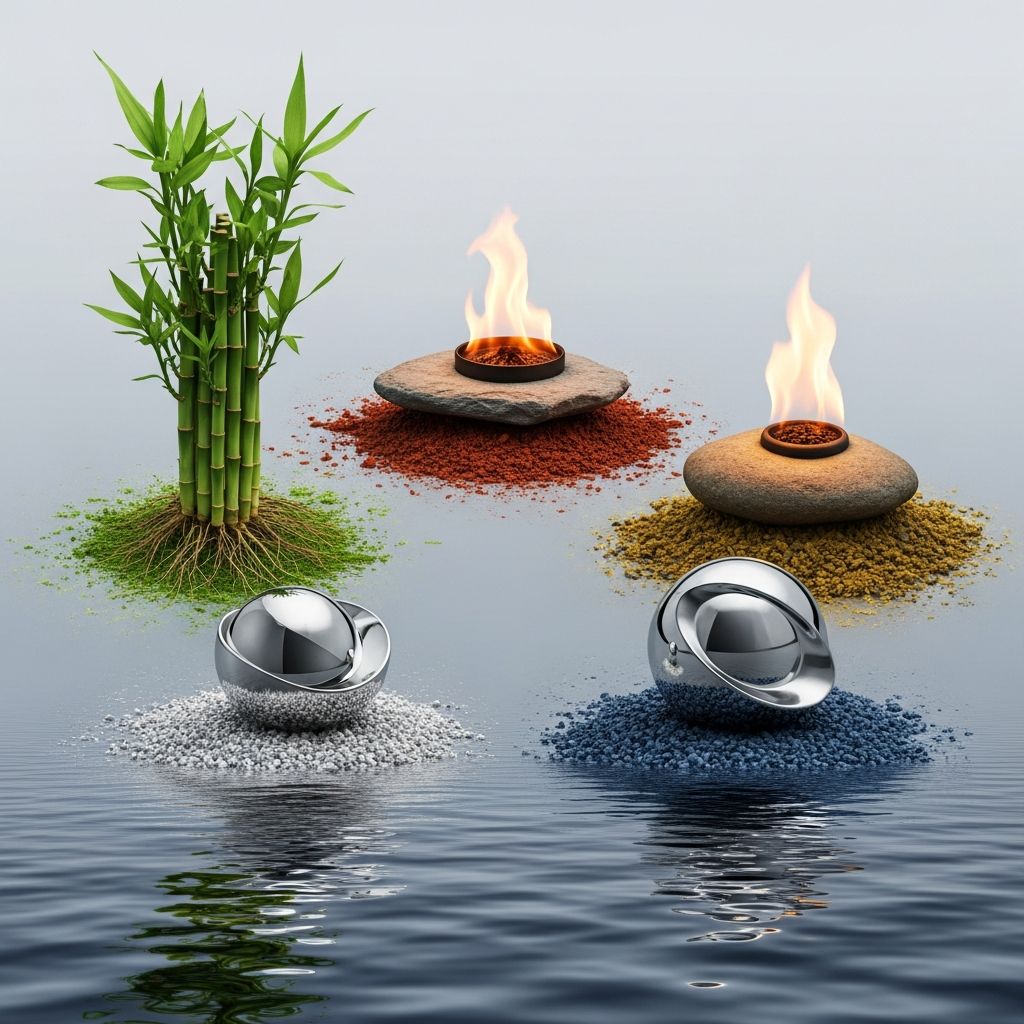
The Five Elements, known as Wu Xing in Chinese philosophy, represent a foundational concept that interprets the dynamic processes of the universe through Wood, Fire, Earth, Metal, and Water. Unlike static materials, these phases describe ongoing transformations observed in nature, influencing everything from seasonal shifts to human health.
Origins and Core Principles of Wu Xing
Wu Xing emerged over two millennia ago in ancient China, rooted in observations of natural rhythms like plant growth in spring and dormancy in winter. This system posits that all phenomena arise from interactions among these five phases, emphasizing change rather than permanence.
Central to Wu Xing is the idea of interconnectedness: no element exists alone, but each contributes to a cycle of creation and restraint. This philosophy underpins fields like cosmology, politics, and healing, promoting equilibrium as the path to prosperity.
- Dynamic Nature: Elements as ‘phases’ or ‘agents’ of movement, not fixed substances.
- Holistic View: Linking human life to cosmic patterns for predictive and therapeutic insights.
- Historical Depth: Traced to the Warring States period, evolving through dynasties.
Defining the Five Fundamental Phases
Each phase embodies unique qualities, directions, seasons, colors, and bodily correspondences, forming a comprehensive map of existence.
| Phase | Season | Direction | Color | Key Organs | Emotion |
|---|---|---|---|---|---|
| Wood | Spring | East | Green | Liver, Gallbladder | Anger |
| Fire | Summer | South | Red | Heart, Small Intestine | Joy |
| Earth | Late Summer | Center | Yellow | Spleen, Stomach | Worry |
| Metal | Autumn | West | White | Lungs, Large Intestine | Grief |
| Water | Winter | North | Black | Kidneys, Bladder | Fear |
Wood symbolizes growth and vitality, akin to budding trees; Fire represents expansion and warmth; Earth denotes nurturing stability; Metal signifies refinement and contraction; Water embodies storage and flow.
The Generating Cycle: Nurturing Harmony
The productive cycle illustrates mutual support: Water feeds Wood’s growth, Wood kindles Fire, Fire forms Earth (ash), Earth yields Metal, and Metal collects Water (condensation). This perpetual renewal mirrors life’s continuity.

This sequence ensures balance; disruption in one phase ripples through others, urging alignment with natural flows.
The Controlling Cycle: Maintaining Equilibrium
Balance requires restraint: Wood parts Earth, Earth dams Water, Water extinguishes Fire, Fire melts Metal, Metal chops Wood. Overdominance leads to imbalance, while weakness invites excess.
In practice, this cycle prevents any phase from overwhelming the system, fostering dynamic stability essential for health and environment.
Wu Xing in Traditional Chinese Medicine
Traditional Chinese Medicine (TCM) applies Wu Xing diagnostically, mapping symptoms to phase imbalances. For instance, excessive Wood (anger, headaches) may indicate liver issues, treated by strengthening Metal.
Practitioners assess pulses, tongue, and emotions to trace root causes, emphasizing holistic restoration over symptom suppression.
- Liver (Wood): Detoxification, vision; imbalance causes tension.
- Heart (Fire): Circulation, spirit; excess leads to mania.
- Spleen (Earth): Digestion, thought; worry impairs nutrient absorption.
- Lungs (Metal): Respiration, skin; grief weakens immunity.
- Kidneys (Water): Reproduction, bones; fear depletes vitality.
Seasonal and Dietary Alignments
Aligning lifestyle with phases enhances well-being. Spring (Wood) favors sour foods like vinegar for liver support; Summer (Fire) calls for bitter greens to cool Fire.
| Phase | Flavor | Recommended Foods |
|---|---|---|
| Wood | Sour | Lemons, plums, yogurt |
| Fire | Bitter | Dandelion, kale, coffee |
| Earth | Sweet | Squash, millet, honey |
| Metal | Pungent | Ginger, garlic, onions |
| Water | Salty | Seaweed, miso, beans |
Seasonal eating synchronizes body rhythms, preventing phase excesses.
Applications Beyond Medicine: Feng Shui and Cosmology
Feng Shui uses Wu Xing to harmonize environments, placing Water features north for career flow or Wood east for growth.
In cosmology, phases correlate with planets: Wood-Jupiter, Fire-Mars, Earth-Saturn, Metal-Venus, Water-Mercury, guiding astrology and divination.
Global Parallels: Elements Across Cultures
While Wu Xing is unique in its cycles, parallels exist. Ancient Greeks (Empedocles, Aristotle) named four: earth, water, air, fire, later adding ether.
Indian Ayurveda features Panchamahabhuta (earth, water, fire, air, space); Japanese Godai includes void. Zoroastrianism revered four for survival.
These systems share elemental symbolism but differ: Western views as building blocks, Eastern as transformative energies.
Modern Relevance and Scientific Perspectives
Today, Wu Xing informs acupuncture, wellness apps, and ecology, promoting sustainability via natural balance metaphors.
Science notes correlations, like seasonal affective disorder aligning with phase shifts, though TCM lacks full Western validation. Studies explore acupuncture’s efficacy via phase theory.
Frequently Asked Questions
What is the main difference between Wu Xing and Western elements?
Wu Xing views elements as dynamic phases in cycles, unlike Western static substances.
How can I apply Five Elements in daily life?
Incorporate phase-aligned foods, colors, and activities seasonally for balance.
Is Five Elements theory scientifically proven?
It guides TCM effectively anecdotally; ongoing research examines mechanisms like organ interactions.
Which element rules my birth season?
Spring: Wood; Summer: Fire; Late Summer: Earth; Autumn: Metal; Winter: Water.
Can Five Elements predict dynastic changes?
Historically, yes—philosophers like Zou Yan linked phase cycles to political shifts.
Embracing Elemental Wisdom Today
Wu Xing endures as a lens for navigating change, urging harmony amid chaos. By understanding these phases, individuals foster personal and collective resilience.
Word count: 1728 (excluding metadata and references).
References
- What are the Five Elements: An Ancient Chinese Philosophy of Balance — Matrum Beauty. 2023. https://matrumbeauty.com/blogs/news/what-are-the-five-elements-an-ancient-chinese-philosophy-of-balance
- The Simple Foundations of Life – Kindred Black — Kindred Black. N/A. https://www.kindredblack.com/blogs/journal/five-elements
- Wuxing | Five Elements, Yin-Yang, Taoism — Encyclopædia Britannica. 2024-03-15. https://www.britannica.com/topic/wuxing
- Wuxing (Chinese philosophy) — Wikipedia (informed primary refs). N/A. https://en.wikipedia.org/wiki/Wuxing_(Chinese_philosophy)
- Five Element Theory in Chinese Medicine: What the Science Says — Healthline. 2023-08-10. https://www.healthline.com/health/mind-body/what-are-the-five-elements
- The Mystery of the 5 Elements — DamaruWorks. N/A. https://www.damaruworks.com/the-mystery-of-the-5-elements/

- Integrated M.A. in Applied Linguistics, University of Hyderabad
- 5+ years in editorial, instructional, SEO, and research-based writing
Sneha is a relationships and lifestyle writer with a strong foundation in applied linguistics and certified training in relationship coaching. She brings over five years of writing experience to theskillvault, crafting thoughtful, research-driven content that empowers readers to build healthier relationships, boost emotional well-being, and embrace holistic living. Her writing and insights reflect the belief that beauty, happiness, and wellness…