
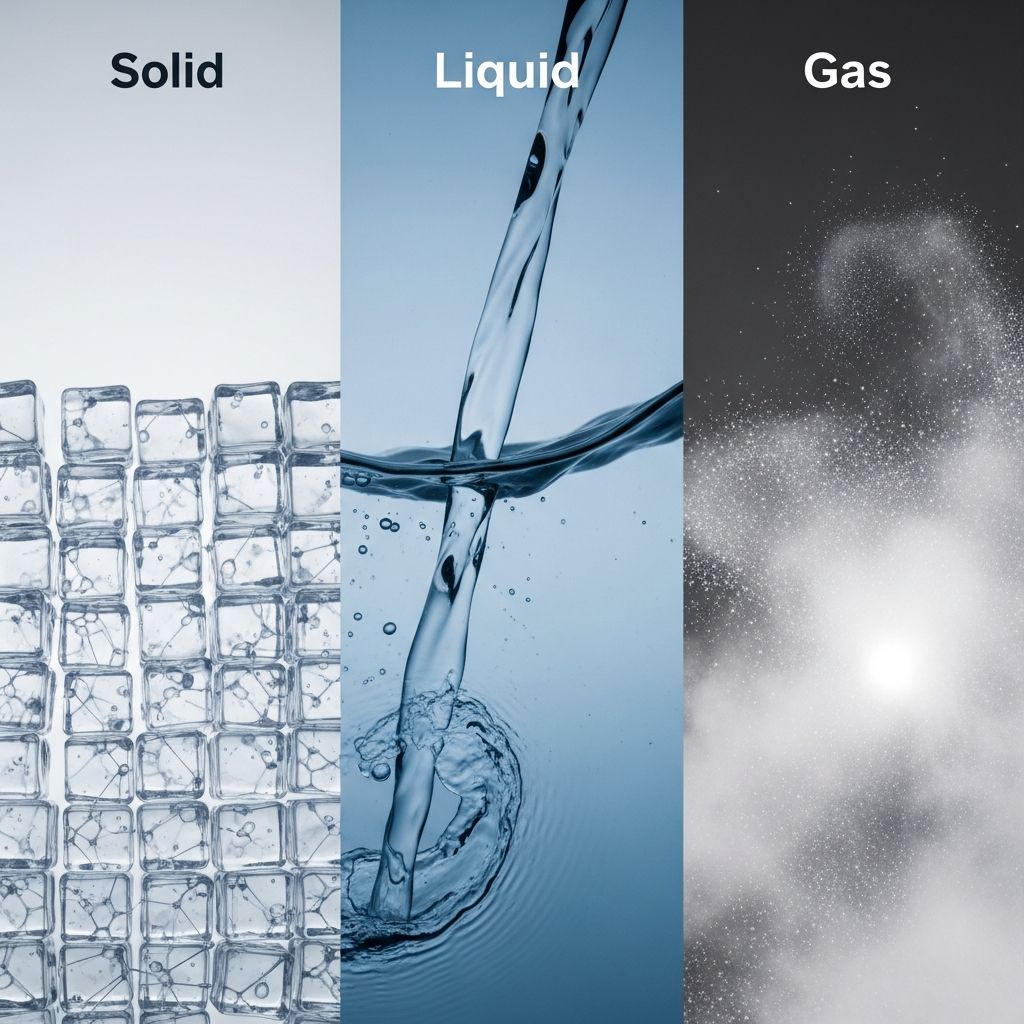
Matter exists in three primary states—solids, liquids, and gases—each defined by distinct particle arrangements and behaviors that dictate their physical properties. These states form the foundation of chemistry and physics, influencing everything from daily phenomena like ice melting to industrial processes.
Understanding the Building Blocks of Matter
All matter consists of atoms or molecules in constant motion, but the degree of this motion and their spacing determine the state. In solids, particles vibrate tightly around fixed positions; in liquids, they slide past each other with more freedom; and in gases, they move rapidly and independently. This kinetic theory explains why substances transition between states under changes in temperature or pressure.
Water exemplifies this versatility, appearing as ice (solid), liquid water, or steam (gas) depending on conditions. Most substances follow similar patterns, though some like metals remain solid at room temperature while others, such as oxygen, are gaseous.
Characteristics of Solid Matter
Solids maintain a fixed shape and volume due to strong intermolecular forces locking particles into a rigid lattice. Particles only vibrate in place, resisting deformation unless external force exceeds their structural integrity.
- Definite shape and volume: A block of wood or cube of ice retains form regardless of container.
- Incompressibility: Minimal empty space between particles prevents significant volume reduction under pressure.
- High density: Tightly packed structure results in greater mass per unit volume compared to other states.
Solids are categorized into crystalline (ordered lattices like salt crystals) and amorphous (disordered like glass). This rigidity makes solids ideal for construction but limits fluidity.
Properties Defining Liquid Matter
Liquids possess a definite volume but adopt the shape of their container, flowing to level out due to weaker forces allowing particles to move freely while remaining close.
- Fluidity: Particles slide over one another, enabling pouring and spreading.
- Surface tension: Cohesive forces create a surface ‘skin,’ seen in water droplets.
- Incompressibility: Like solids, little free space exists between particles.
In zero gravity, liquids form spheres to minimize surface area, highlighting gravitational influence on Earth. Mercury, a liquid metal, and oils demonstrate varied viscosities affecting flow rates.
Dynamic Nature of Gaseous Matter
Gases expand to fill any container, lacking fixed shape or volume as particles are widely spaced with negligible forces, moving at high speeds in random directions.
- High compressibility: Vast empty space allows volume reduction under pressure, as in scuba tanks compressing 600 liters into 3 liters.
- Low density: Spread-out particles yield minimal mass per volume.
- Diffusion: Rapid mixing, like perfume spreading in a room.
Air, a gas mixture of nitrogen and oxygen, exemplifies everyday gaseous behavior. Gases escape open containers, emphasizing confinement needs.
Visualizing Particle Arrangements
A comparison table illustrates key differences:
| Property | Solid | Liquid | Gas |
|---|---|---|---|
| Shape | Definite | Indefinite (container-shaped) | Indefinite |
| Volume | Definite | Definite | Indefinite |
| Particle Motion | Vibrate in place | Slide past each other | Free, rapid movement |
| Compressibility | Low | Low | High |
| Arrangement | Tightly packed, ordered | Close, disordered | Far apart, random |
This table, derived from molecular models, underscores why gases behave fluidly while solids resist change.
Phase Transitions: From One State to Another
Substances shift states via heating or cooling: melting (solid to liquid), freezing (liquid to solid), vaporization (liquid to gas), condensation (gas to liquid), sublimation (solid to gas), and deposition (gas to solid). Water’s melting point (0°C) and boiling point (100°C at sea level) are benchmarks.
Dry ice sublimes directly from solid to gas, bypassing liquid. Pressure alters these points; increased pressure favors denser states like liquid over gas.
Real-World Applications Across Industries
Understanding states enables innovations: solids in electronics (silicon chips), liquids in hydraulics (brake fluids), gases in propulsion (rocket fuels). Cryogenics cools gases to liquids for storage, while refrigeration exploits phase changes.
In medicine, liquid oxygen tanks supply patients, and solid-state batteries promise efficient energy storage. Food preservation uses freezing to halt microbial growth in solids and liquids.
Beyond the Basics: Other States of Matter
Though rare on Earth, plasmas (ionized gases in stars), Bose-Einstein condensates (ultra-cold quantum states), and quark-gluon plasmas exist under extremes. These expand matter’s classification but solids, liquids, and gases dominate terrestrial conditions.
Frequently Asked Questions (FAQs)
What defines a solid at the molecular level?
Solids feature tightly packed particles vibrating in fixed positions, granting definite shape and volume.
Why do liquids flow but maintain volume?
Liquid particles are close yet mobile, sliding past each other while cohesive forces preserve volume.
How are gases compressible unlike solids or liquids?
Gases have large intermolecular spaces, allowing particles to be forced closer under pressure.
Can all substances exist in all three states?
Yes, by adjusting temperature and pressure, though some require extremes.
What causes phase changes like melting or boiling?
Added thermal energy overcomes intermolecular forces, increasing particle motion and spacing.
Experimental Insights for Hands-On Learning
Simple demos reveal states: freeze water for solid, heat for gas; compare oil (viscous liquid) and air (gas). Track volume changes in a sealed syringe for compressibility. These reinforce theoretical concepts.
Advanced setups monitor triple points where all states coexist, like water’s 0.01°C at 611.657 Pa.
References
- 3.3: Classifying Matter According to Its State—Solid, Liquid, and Gas — LibreTexts Chemistry. 2023-10-15. https://chem.libretexts.org/Bookshelves/Introductory_Chemistry/Introductory_Chemistry_(LibreTexts)/03:_Matter_and_Energy/3.03:_Classifying_Matter_According_to_Its_StateSolid_Liquid_and_Gas
- Classification of Matter (Solid, Liquid, Gas) — UEN Pressbooks Introductory Chemistry. 2023-05-20. https://uen.pressbooks.pub/introductorychemistry/chapter/classification-of-matter-solid-liquid-gas/
- Gases, Liquids, and Solids — Purdue University Chemistry. 2024-01-10. https://www.chem.purdue.edu/gchelp/liquids/character.html
- Phases of Matter — NASA Glenn Research Center. 2023-11-05. https://www.grc.nasa.gov/www/k-12/airplane/state.html
- Solids, Liquids and Gases — Generation Genius. 2024-02-14. https://www.generationgenius.com/videolessons/solids-liquids-and-gases/
- Solids, liquids and gases — Science Learning Hub. 2023-08-22. https://www.sciencelearn.org.nz/resources/607-solids-liquids-and-gases

Medha Deb is an editor with a master's degree in Applied Linguistics from the University of Hyderabad. She believes that her qualification has helped her develop a deep understanding of language and its application in various contexts. Medha specializes in the areas of beauty, health, sports, and wellness and is committed to ensuring that the content on the website is…