
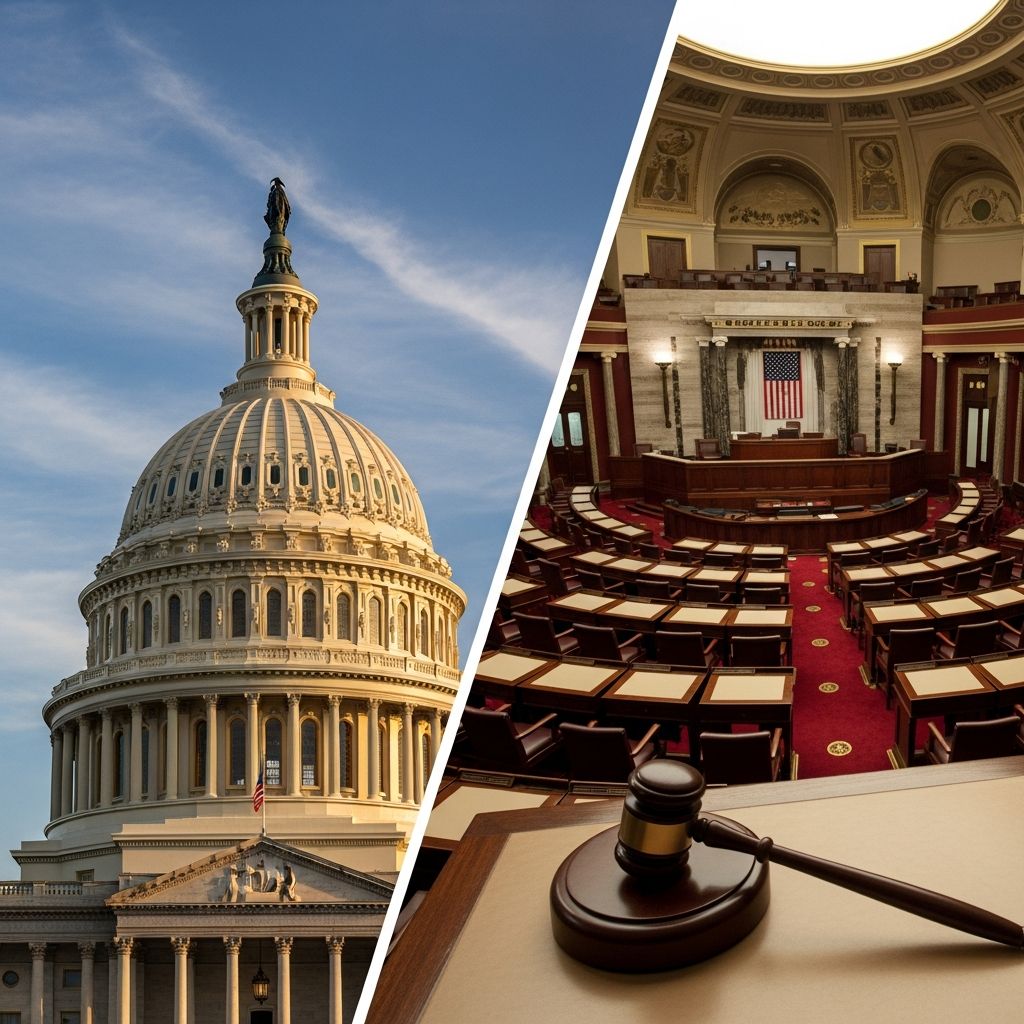
The United States Congress operates as a bicameral legislature, comprising the House of Representatives and the Senate, each designed to reflect distinct aspects of national representation and governance. This structure, rooted in the Constitution, ensures balanced power-sharing among states of varying sizes while preventing any single group from dominating federal lawmaking.
Historical Origins of the Dual-Chamber System
The creation of two legislative chambers stemmed from intense debates at the 1787 Constitutional Convention. Delegates grappled with how to allocate representation fairly in a union of sovereign states. Larger states advocated for population-based voting power, while smaller states demanded equality regardless of size. The resulting Great Compromise established proportional representation in the House and equal representation in the Senate, satisfying both sides and enabling the Constitution’s ratification.
Article I of the U.S. Constitution formally vests all legislative powers in this bicameral Congress. The framers drew inspiration from colonial legislatures and the British Parliament but tailored the design to America’s federal structure. This setup not only resolved convention deadlock but also embodied federalism by giving states a direct voice alongside the populace.
Structural Differences Between the Chambers
The House and Senate differ fundamentally in size, composition, and election processes, shaping their operational dynamics.
- House of Representatives: Fixed at 435 voting members, apportioned by state population every decade via census. Each district averages about 760,000 residents, ensuring direct reflection of demographic shifts.
- Senate: Comprises 100 members—two per state—providing equal footing for all states, from California to Wyoming.
| Aspect | House of Representatives | Senate |
|---|---|---|
| Members | 435 (plus non-voting delegates) | 100 |
| Term Length | 2 years | 6 years (staggered) |
| Minimum Age | 25 | 30 |
| Citizenship Requirement | 7 years | 9 years |
| Representation Basis | Population | Equal per state |
These variations foster unique chamber cultures: the House, with shorter terms and more members, tends toward rapid response to public sentiment, while the Senate’s longer terms and smaller size promote deliberation.
Distinct Powers and Responsibilities
While both chambers collaborate on most legislation, constitutional provisions grant exclusive powers to each, enhancing checks within the legislative branch itself.
House’s Exclusive Authorities
The House initiates all revenue bills, including taxes and appropriations, underscoring its role as the ‘people’s chamber’ tied to fiscal accountability. It also holds sole power to impeach federal officials, including the president, by majority vote—acting akin to a grand jury.
- Originates bills for raising revenue (Article I, Section 7).
- Impeaches officials.
- Elects president if no Electoral College majority (Article II, Section 1).
Senate’s Exclusive Authorities
The Senate conducts impeachment trials, requiring a two-thirds vote for conviction, and confirms presidential appointments like Supreme Court justices and cabinet members. It ratifies treaties by two-thirds consent, safeguarding foreign policy from hasty decisions.
- Tries impeachments.
- Confirms appointments.
- Ratifies treaties.
- Elects vice president if no Electoral College majority.
This division ensures thorough vetting: the House’s speed complements the Senate’s caution.
Election and Leadership Mechanisms
Members of both chambers are elected directly by voters, a democratic evolution from the framers’ original plan. The 17th Amendment (1913) mandated popular Senate elections, addressing corruption in state legislatures.
House leadership centers on the Speaker, elected by majority party, who controls the legislative agenda. Senate leadership features the Vice President as presiding officer (with tie-breaking vote) and the Majority Leader steering floor action.
Procedural differences abound: House rules emphasize majority rule and limited debate, managed by the Rules Committee. The Senate prioritizes unlimited debate (filibuster-prone) and unanimous consent, fostering minority protections.
Balancing Representation: Equal vs. Proportional
The bicameral model’s genius lies in dual representation. House seats, reapportioned decennially, amplify populous states’ influence—California holds 52 seats versus Wyoming’s one. Senate equality empowers smaller states, preventing majority tyranny.
This balance extends to the Electoral College, where each state’s electors equal its congressional delegation, giving smaller states disproportionate presidential election sway.
The framers intended the House to mirror public will closely, with frequent elections, while the Senate provides stability and state sovereignty.
Legislative Process Across Chambers
Bills must pass both houses identically before presidential consideration. Origination in one chamber leads to committee review, floor debate, amendments, and reconciliation via conference committees if versions differ.
Recent polarization has slowed output; the 118th Congress (2023) passed only 34 public laws in its first year, down from historical averages, highlighting bicameral gridlock risks.
Checks and Balances in Action
Congress’s internal divisions bolster inter-branch checks. The House’s revenue origination reins in executive spending, while Senate confirmations scrutinize appointees. Impeachment bifurcates accountability between accusation and judgment.
Courts uphold these boundaries, as in McCulloch v. Maryland (1819), affirming enumerated powers while allowing implied authority under strict limits.
Modern Challenges and Adaptations
Today’s Congress faces partisanship, gerrymandering in House districts, and Senate filibuster debates. Yet the bicameral framework endures, adapting via rules changes like budget reconciliation to bypass filibusters on fiscal matters.
Non-voting delegates from territories (e.g., Puerto Rico, D.C.) add representational nuance without full voting rights.
Frequently Asked Questions (FAQs)
What is the Great Compromise?
The Great Compromise resolved Constitutional Convention disputes by creating a House based on population and a Senate with two seats per state.
Why must revenue bills start in the House?
Article I, Section 7 mandates this to tie taxation closely to population representation, reflecting the people’s direct financial stake.
How does the Senate check the president?
Through treaty ratification (2/3 vote) and confirmation of nominees, ensuring executive actions align with legislative will.
What happens if the Electoral College ties?
The House chooses the president (one vote per state delegation); the Senate selects the vice president.
Can the Senate introduce spending bills?
No, but it can amend House-originated bills extensively.
Evolving Role in American Democracy
Over 230 years, the House and Senate have evolved yet preserved their core purposes: responsive populism in the House, deliberative federalism in the Senate. This duality fortifies democracy against hasty or tyrannical impulses, embodying the framers’ vision of balanced governance.
Understanding these institutions illuminates ongoing debates on representation, power, and reform, from term limits to filibuster abolition.
References
- American Government 101: Difference Between House and Senate — Maryville Online. 2023. https://online.maryville.edu/blog/difference-between-house-and-senate/
- United States Congress — Wikipedia (informational overview). N/A. https://en.wikipedia.org/wiki/United_States_Congress
- What are the roles of the US House and Senate? — Voice of America (VOANews). 2023. https://www.youtube.com/watch?v=YPn1P1-VyR8
- The House Explained — U.S. House of Representatives (house.gov). 2024. http://www.house.gov/the-house-explained
- Government Information: Congress: House and Senate — Portland State University Library. 2023. https://guides.library.pdx.edu/c.php?g=271224&p=8160208
- The House of Representatives and Senate – What’s the Difference? — U.S. Capitol Visitor Center. N/A. https://www.visitthecapitol.gov/sites/default/files/documents/resources-and-activities/CVC_EED_StudentEssay_HouseSenate.pdf

- Integrated M.A. in Applied Linguistics, University of Hyderabad
- 5+ years in editorial, instructional, SEO, and research-based writing
Sneha is a relationships and lifestyle writer with a strong foundation in applied linguistics and certified training in relationship coaching. She brings over five years of writing experience to theskillvault, crafting thoughtful, research-driven content that empowers readers to build healthier relationships, boost emotional well-being, and embrace holistic living. Her writing and insights reflect the belief that beauty, happiness, and wellness…