
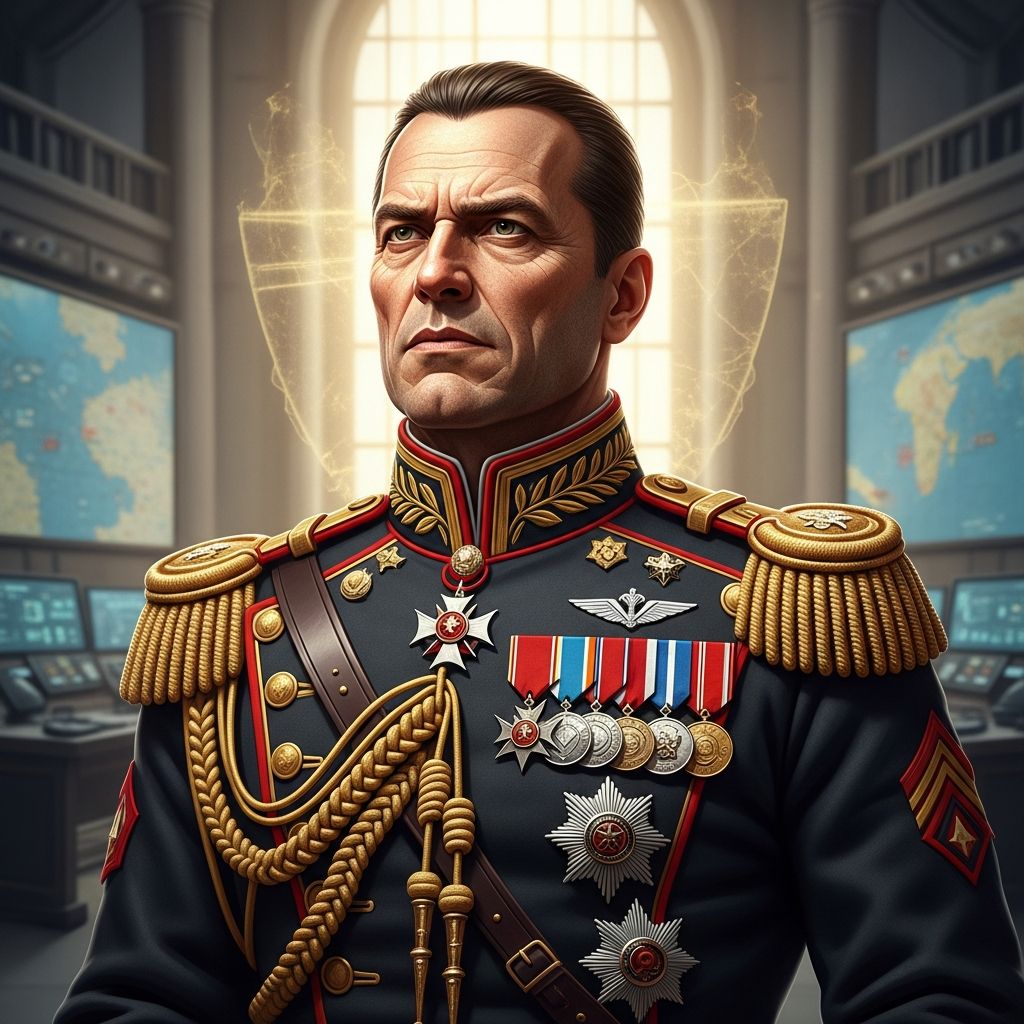
The Commander in Chief represents the pinnacle of military leadership in most nations, embodying the ultimate authority over armed forces. This position ensures unified direction during crises, blending civilian oversight with strategic command to safeguard national interests.
Defining the Role of Supreme Military Leader
A Commander in Chief holds supreme command and control over a country’s armed forces, including army, navy, air force, and sometimes militia. This role is typically vested in the head of state or government, distinguishing it from subordinate military officers by its comprehensive scope and political accountability.
Core responsibilities include directing military operations, setting strategic objectives, enforcing regulations, and mobilizing resources for defense or humanitarian efforts. Unlike tactical commanders, the Commander in Chief focuses on high-level policy, often without needing prior military experience, emphasizing civilian control to prevent military coups.
- Supreme decision-making on deployments and engagements.
- Oversight of military budgets and personnel appointments.
- Coordination with allies in multinational operations.
Constitutional Foundation in the United States
Article II, Section 2 of the U.S. Constitution explicitly designates the President as “Commander in Chief of the Army and Navy of the United States, and of the Militia of the several States, when called into the actual Service of the United States.”
This clause, drafted by the Founding Fathers, ensures executive agility in military matters while Congress retains powers to declare war, fund forces, and regulate the military. It reflects a deliberate balance: the President directs operations, but legislative checks prevent unchecked power.
State governors also serve as Commanders in Chief of their National Guards for domestic emergencies, federalized only when called by the President.
Historical Evolution and Key Precedents
The concept traces back to English Civil War terminology but gained prominence in the U.S. with George Washington, the first President to exercise these powers during the Whiskey Rebellion in 1794.
Over time, presidents like Abraham Lincoln during the Civil War expanded the role, suspending habeas corpus and blockading ports without immediate congressional approval. Franklin D. Roosevelt navigated World War II, coordinating vast Allied efforts, while later leaders like Lyndon B. Johnson and George W. Bush managed Vietnam and post-9/11 conflicts.
| President | Key Action as Commander in Chief | Outcome |
|---|---|---|
| George Washington | Suppressed Whiskey Rebellion | Established federal authority |
| Abraham Lincoln | Civil War mobilizations | Preserved Union |
| Harry S. Truman | Relieved Gen. Douglas MacArthur | Reaffirmed civilian control |
| George W. Bush | Post-9/11 invasions | Global War on Terror |
These examples illustrate how the role adapts to threats, from rebellions to global wars.
Powers and Limitations: A Balanced Framework
The Commander in Chief can deploy troops, appoint senior officers, and respond to imminent threats unilaterally. However, the War Powers Resolution of 1973 requires congressional notification within 48 hours and limits engagements to 60 days without approval.
Congress controls funding via appropriations, a critical check. Courts rarely intervene in military matters due to the political question doctrine, leaving balance to elected branches.
- Exclusive Powers: Tactical direction, troop movements, commander appointments/dismissals.
- Shared Powers: War declarations (Congress), funding (Congress).
- Emergency Actions: Rapid response to attacks without prior approval.
Global Perspectives on Military Command
Approximately 40 countries, including the U.S., designate their head of state as Commander in Chief, promoting civilian supremacy. In parliamentary systems like the UK, the monarch holds the title symbolically, with the Prime Minister exercising power.
France’s President is Commander in Chief, wielding direct authority, while Russia’s President oversees forces amid centralized control. Variations exist: some nations split roles between head of state and defense minister.
This diversity highlights cultural and structural differences in balancing military power with democracy.
Modern Challenges and Contemporary Applications
Today’s Commanders in Chief face cyber threats, terrorism, and hybrid warfare. U.S. Presidents have authorized drone strikes and special operations without full wars, sparking debates on executive overreach.
During the Clinton era, interventions in Bosnia and Kosovo tested NATO coordination. Recent acting presidents under the 25th Amendment, like Vice Presidents, briefly assumed the role, ensuring continuity.
Climate-induced disasters increasingly invoke militia call-ups, blending domestic and federal command.
Appointing and Managing Military Leadership
Presidents nominate flag officers (generals/admirals) confirmed by the Senate, allowing strategic alignment. Dismissals, as Truman’s of MacArthur in 1951, underscore civilian primacy over military dissent.
This process maintains loyalty to constitutional orders, preventing insubordination.
Frequently Asked Questions (FAQs)
What does Commander in Chief mean?
The supreme leader of a nation’s armed forces, responsible for overall military strategy and operations.
Is the U.S. President always the Commander in Chief?
Yes, per the Constitution, with temporary transfers possible under the 25th Amendment.
Can the President declare war alone?
No, Congress declares war; the President directs military actions.
Do governors have Commander in Chief powers?
Yes, over state National Guards until federalized.
How many countries have a head of state as Commander in Chief?
Around 40, including major democracies.
Implications for Democracy and Security
Civilian command prevents praetorianism, fostering accountability. Yet, it demands presidents master complex geopolitics. As threats evolve, this role remains central to sovereignty.
In summary, the Commander in Chief embodies executive military authority, checked by democratic institutions for balanced governance.
References
- Commander-in-Chief | Political Science | Research Starters — EBSCO. Accessed 2026. https://www.ebsco.com/research-starters/political-science/commander-chief
- Commander-in-chief — Wikipedia. Accessed 2026. https://en.wikipedia.org/wiki/Commander-in-chief
- COMMANDER IN CHIEF Definition & Meaning — Dictionary.com. Accessed 2026. https://www.dictionary.com/browse/commander-in-chief
- Commander in Chief powers — Wex | Legal Information Institute, Cornell Law School. Accessed 2026. https://www.law.cornell.edu/wex/commander_in_chief_powers
- Commander in Chief — William J. Clinton Presidential Library. Accessed 2026. https://www.clintonlibrary.gov/education/commander-chief
- ArtII.S2.C1.1.11 Presidential Power and Commander in Chief Clause — Constitution Annotated | Congress.gov. Accessed 2026. https://constitution.congress.gov/browse/essay/artII-S2-C1-1-11/ALDE_00013473/
- Commander in Chief – THE PRESIDENTIAL HATS — George W. Bush Library. 2026. https://www.georgewbushlibrary.gov/learn/presidential-hats-program/commander
- Who is the Commander in Chief of the military? — Smithsonian National Museum of American History. Accessed 2026. https://americanhistory.si.edu/citizenship/learn/presidency/32/learn

Medha Deb is an editor with a master's degree in Applied Linguistics from the University of Hyderabad. She believes that her qualification has helped her develop a deep understanding of language and its application in various contexts. Medha specializes in the areas of beauty, health, sports, and wellness and is committed to ensuring that the content on the website is…