
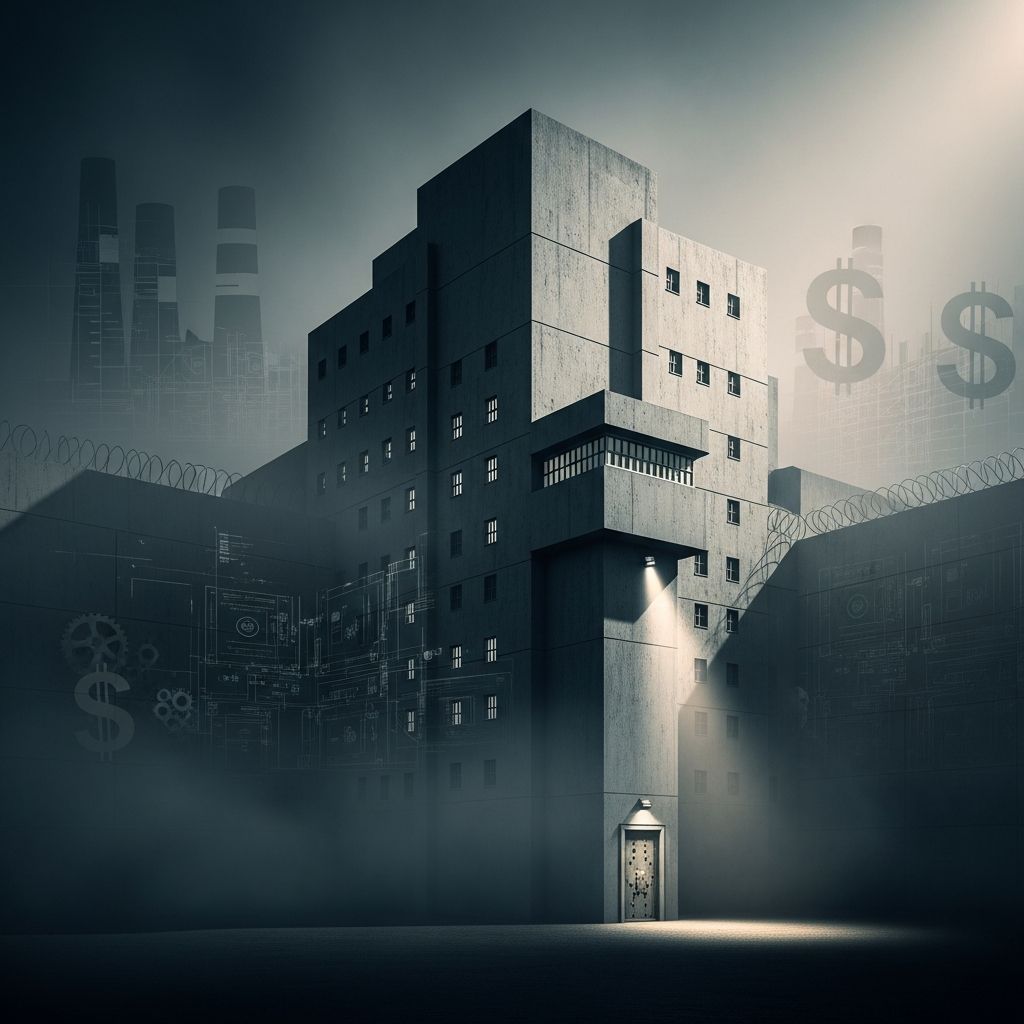
The prison industrial complex represents a vast network where government policies intersect with corporate profits, turning incarceration into a lucrative enterprise. This system prioritizes punishment over rehabilitation, perpetuating cycles of poverty and inequality across the United States.
Defining the Core Mechanism
At its heart, the prison industrial complex describes the intertwined relationships between correctional institutions and profit-seeking businesses. Modeled after the military-industrial complex warned about by President Dwight D. Eisenhower in the 1950s, it encompasses private companies that construct facilities, provide services, and exploit inmate labor. These entities benefit from high incarceration rates, lobbying for policies that ensure a steady supply of prisoners.
Government agencies at federal and state levels contract with these corporations, creating a feedback loop where tougher sentencing laws fill beds in privately operated prisons. Surveillance tech firms, food service providers, and medical contractors all thrive within this ecosystem, generating billions in annual revenue.
Historical Evolution and Expansion
The surge in U.S. incarceration began in the 1980s amid the War on Drugs and ‘tough-on-crime’ rhetoric. Prison populations exploded from about 500,000 in 1980 to over 2 million by the early 2000s, driven by mandatory minimums and three-strikes laws. This growth aligned perfectly with the rise of for-profit prisons.
Companies like CoreCivic (formerly Corrections Corporation of America) and GEO Group pioneered privatization, promising cost savings to governments. However, studies show private facilities often cut corners on staffing and programming, leading to higher recidivism and violence rates. By the 2010s, immigration detention added another layer, with 73% of undocumented detainees in private centers, prioritizing occupancy over humane treatment.
Key Players in the Profit Chain
The complex spans multiple sectors, each contributing to its resilience:
- Private Prison Operators: Manage facilities for a per-diem fee per inmate, incentivizing longer detentions.
- Service Providers: Supply meals, healthcare, and telecom services at inflated prices to inmates and families.
- Labor Exploiters: Contract prisoners for pennies per hour, producing goods for major brands.
- Tech Vendors: Sell electronic monitoring, AI surveillance, and prison management software.
- Unions and Lobbyists: Correctional officer unions advocate for more prisons to protect jobs.
This diversification ensures the system endures even if one segment faces scrutiny.
Economic Incentives Driving Incarceration
Private prisons generate around $4 billion yearly, but the broader complex taps into a $80 billion corrections budget. Investors, including major banks and pension funds, pour money into these stocks, linking public retirement savings to incarceration profits. Rural communities, promised economic revival, build prisons that become their largest employers, locking in dependency.
| Sector | Annual Revenue Estimate | Key Companies |
|---|---|---|
| Private Prisons | $4B | CoreCivic, GEO Group |
| Prison Labor | $2B+ | UNICOR, private contractors |
| Telecom & Commissary | $1.6B | Securus, JPay |
| Healthcare | $5B | Centurion, Wellpath |
These figures underscore how incarceration subsidizes corporate bottom lines while taxpayers foot the bill.
Forced Labor: The 13th Amendment Loophole
The 13th Amendment abolished slavery ‘except as a punishment for crime,’ enabling widespread prison labor. Inmates earn wages as low as $0.23 per hour, manufacturing furniture, fighting wildfires, or processing agricultural products. Federal Prison Industries (UNICOR) alone employs over 20,000 inmates, generating $500 million annually for the government but minimal pay for workers.
States like California and Texas rely on inmate labor for public works, from license plates to firefighting. Critics argue this modern peonage disproportionately affects Black and Latino populations, echoing historical convict leasing post-Reconstruction.
Disproportionate Impacts on Vulnerable Groups
Mass incarceration ravages communities of color: Black Americans are imprisoned at five times the rate of whites, Latinos at 1.3 times. The system funnels the poor into cycles of arrest, conviction, and reentry barriers like felony disenfranchisement and employment discrimination.
Women, now the fastest-growing prison demographic, face unique harms in under-resourced facilities. Immigration detention warehouses families, with private operators facing lawsuits over abuse and neglect.
Political Machinery and Lobbying Power
Lobbyists from private prison firms spend millions influencing legislation. In 2018, CoreCivic and GEO donated over $1.5 million to campaigns, supporting bills that expand detention. Prosecutors and politicians benefit from ‘law and order’ platforms, while public unions resist decarceration to safeguard jobs.
This political entrenchment blocks reforms like ending cash bail or reducing sentences, ensuring the inmate population remains a commodity.
Case Studies: Failures of Privatization
High-profile scandals illuminate the dangers. In 2016, a Pennsylvania ‘kids-for-cash’ scheme saw judges sentencing juveniles to private facilities for kickbacks. Mississippi’s Walnut Grove prison, run by GEO, endured riots and deaths due to understaffing, prompting a federal takeover.
Even after the Obama-era DOJ phased out federal private prison contracts, state-level reliance persists, with for-profit facilities housing 8% of inmates but a higher share of immigrants.
Pathways to Dismantling the Complex
Reform demands multifaceted action: divestment campaigns urging universities and states to pull investments; policy shifts like ending private prisons (achieved in some states); and community investments in education and mental health over policing.
Abolitionist groups advocate shrinking the carceral footprint entirely, redirecting funds to restorative justice. Recent wins include Biden’s 2021 executive order limiting private prison use federally.
Frequently Asked Questions (FAQs)
What percentage of U.S. prisoners are in private facilities?
Approximately 8% of the total prison population, but up to 73% of immigration detainees.
Does prison labor benefit the economy?
It provides cheap goods to companies and governments but exploits inmates and suppresses wages for free workers.
Can the prison industrial complex be ended?
Through divestment, policy reform, and alternatives to incarceration, significant reduction is possible.
Who profits most from mass incarceration?
Private operators, service providers, and investors in corrections-related stocks.
How does the PIC affect recidivism?
Private facilities often have higher recidivism due to profit-focused, under-resourced rehabilitation programs.
References
- Prison–industrial complex — Wikipedia. 2023-10-15. https://en.wikipedia.org/wiki/Prison–industrial_complex
- Understanding and Confronting the Prison-Industrial Complex — Arabella Advisors. 2018-11-01. https://www.arabellaadvisors.com/wp-content/uploads/2018/11/Understanding-and-Confronting-the-Prison-Industrial-Complex.pdf
- The Prison Industry — Center on Juvenile and Criminal Justice. 2001-01-01. https://www.cjcj.org/media/import/documents/the_prison_industry.pdf
- Prison Industrial Complex Through Film — Prison Policy Initiative. 2023-01-01. https://www.prisonpolicy.org/prisonclass/
- 10.2: The Prison Industrial Complex — Social Sci LibreTexts (Tufts University). 2023-08-20. https://socialsci.libretexts.org/Bookshelves/Ethnic_Studies/Introduction_to_Ethnic_Studies_(Fischer_et_al.)/10:_The_State_of_Human_Caging-_Incarceration_Policing_and_State-Sanctioned_Violence/10.02:_The_Prison_Industrial_Complex

- Integrated M.A. in Applied Linguistics, University of Hyderabad
- 5+ years in editorial, instructional, SEO, and research-based writing
Sneha is a relationships and lifestyle writer with a strong foundation in applied linguistics and certified training in relationship coaching. She brings over five years of writing experience to theskillvault, crafting thoughtful, research-driven content that empowers readers to build healthier relationships, boost emotional well-being, and embrace holistic living. Her writing and insights reflect the belief that beauty, happiness, and wellness…