
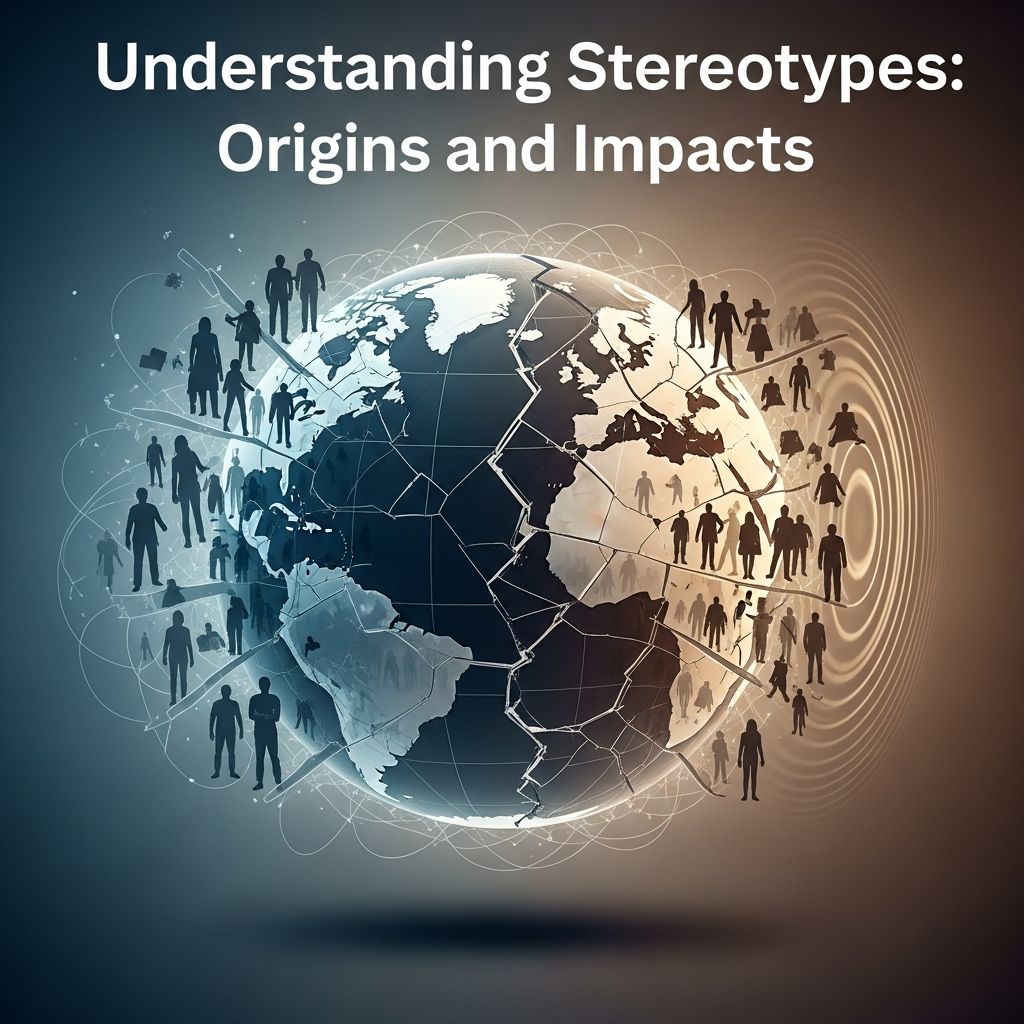
Stereotypes represent fixed, oversimplified ideas about groups of people, often leading to unfair judgments. These mental shortcuts shape perceptions but can perpetuate bias and division in society.
The Fundamental Concept of Stereotypes
At its core, a stereotype is a standardized mental image held by members of a group about another group, typically oversimplifying complex realities. Dictionaries like Merriam-Webster define it as ‘a standardized mental picture that is held in common by members of a group and that represents an oversimplified opinion, prejudiced attitude, or uncritical judgment.’ Similarly, Britannica describes it as ‘an often unfair and untrue belief that many people have about all people or things with a particular characteristic.’
This concept extends beyond people to objects, professions, or situations, but its most profound effects occur in social contexts. Stereotypes act as cognitive heuristics—mental rules of thumb—that help process vast amounts of information quickly, though at the cost of accuracy.
Historical Roots in Printing Technology
The term ‘stereotype’ originated in the late 18th century printing industry. Printers created solid metal plates from movable type to produce identical copies efficiently, revolutionizing mass production of texts. This process, called stereotyping, symbolized duplication without variation—much like how social stereotypes duplicate simplistic views across individuals.
By the 19th century, the word evolved metaphorically into psychology and sociology, describing rigid, unvarying perceptions of groups. This shift mirrored industrialization’s emphasis on standardization, influencing how societies categorized diverse populations during rapid urbanization and immigration waves.
Psychological Foundations of Stereotyping
In social psychology, stereotypes arise from categorization, a basic cognitive process where the brain groups similar stimuli to simplify the world. According to experts, ‘a stereotype is a fixed, over-generalized belief about a particular group or class of people.’ This leads to inferences about individuals based on group membership, ignoring personal traits.
Social identity theory explains stereotypes as tools for enhancing self-esteem by favoring one’s in-group over out-groups. Prejudiced attitudes emerge from an ‘us versus them’ mentality, fostering discrimination. Cognitive biases like confirmation bias reinforce stereotypes: people notice evidence supporting preconceptions while overlooking contradictions.
Categories and Varieties of Stereotypes
Stereotypes vary by nature and target:
- Positive Stereotypes: Seem complimentary but harmful, e.g., ‘Asians excel in math’ pressures individuals and dismisses effort.
- Negative Stereotypes: Directly damaging, like ‘Women are emotional leaders,’ limiting opportunities.
- Gender-Based: Men as stoic providers; women as nurturing caregivers.
- Racial/Ethnic: Oversimplifications like ‘Latinos are lazy,’ rooted in historical prejudices.
- Age-Related: Youth as tech-savvy but irresponsible; elders as wise but frail.
These categories often intersect, compounding effects in multifaceted identities.
Real-World Manifestations Across Society
Stereotypes infiltrate media, education, workplaces, and daily interactions. In advertising, women are frequently depicted in domestic roles, reinforcing traditional norms. Hollywood typecasts minorities in criminal or comedic sidekick roles, shaping public views.
| Stereotype Type | Example | Common Medium | Potential Harm |
|---|---|---|---|
| Occupational | Absent-minded professor | Films/TV | Undermines expertise |
| Racial | Aggressive Black athlete | Sports media | Fuels discrimination |
| Gender | Nurturing nurse (female) | Ads | Limits career choices |
| Age | Tech-illiterate senior | Commercials | Promotes isolation |
This table illustrates how pervasive and damaging these portrayals are.
Societal and Individual Consequences
Stereotypes yield ‘stereotype threat,’ where awareness of negative expectations impairs performance, as seen in academic settings for underrepresented groups. On a societal level, they underpin systemic inequalities: hiring biases favor candidates fitting prototypes, perpetuating underrepresentation.
Interpersonally, stereotyping erodes trust and empathy, escalating conflicts. During elections or social movements, amplified stereotypes polarize communities, hindering dialogue.
Mechanisms That Sustain Stereotypes
Several psychological processes perpetuate stereotypes:
- Illusory Correlation: Perceiving stronger links between groups and traits than exist.
- Outgroup Homogeneity: Viewing out-group members as more similar than they are.
- Media Amplification: Repeated exposure normalizes biased images.
These mechanisms create self-fulfilling prophecies: stereotyped individuals internalize expectations, behaving in ways that confirm biases.
Strategies for Overcoming Stereotype Influence
Challenging stereotypes requires deliberate effort:
- Promote Contact: Intergroup interactions reduce bias via personal connections.
- Encourage Perspective-Taking: Imagining others’ viewpoints fosters empathy.
- Media Literacy: Critically analyzing representations debunks myths.
- Mindfulness Training: Awareness of biases enables pause before judgment.
Educational programs emphasizing diversity and individual stories prove effective in long-term attitude shifts.
Stereotypes in the Digital Era
Social media accelerates stereotype spread through algorithms favoring sensational content. Viral memes and echo chambers reinforce divisions, making counter-narratives harder to access. Yet, digital platforms also enable stereotype-busting campaigns, showcasing diverse role models.
Global Perspectives on Stereotyping
Stereotypes transcend borders but vary culturally. In Europe, national tropes like ‘efficient Germans’ persist; in Asia, collectivism stereotypes contrast individualism myths. Globalization challenges these through cross-cultural exchanges, though migration sparks new biases.
Frequently Asked Questions (FAQs)
What is the primary definition of a stereotype?
A stereotype is an oversimplified, generalized belief about a group, often unfair and ignoring individual differences.
Can stereotypes ever be positive?
Yes, but even positive ones harm by creating pressure and overlooking diversity, like assuming all athletes are disciplined.
How do stereotypes form psychologically?
They stem from cognitive categorization and social identity needs, simplifying complex social worlds.
What are the long-term effects of stereotyping?
They lead to discrimination, reduced opportunities, and societal division.
How can individuals combat their own stereotypes?
Through self-reflection, diverse interactions, and questioning assumptions.
This FAQ section addresses common queries for quick reference.
Conclusion: Toward a Stereotype-Free Mindset
While stereotypes offer cognitive efficiency, their costs to equity and understanding are too high. By recognizing origins, mechanisms, and impacts, society can foster inclusive thinking. Education, exposure, and empathy pave the way for nuanced perceptions.
References
- STEREOTYPE Definition & Meaning — Merriam-Webster. Accessed 2026. https://www.merriam-webster.com/dictionary/stereotype
- Stereotype Definition & Meaning — Britannica Dictionary. Accessed 2026. https://www.britannica.com/dictionary/stereotype
- STEREOTYPE Definition & Meaning — Dictionary.com. Accessed 2026. https://www.dictionary.com/browse/stereotype
- Stereotype – Definition, Meaning & Synonyms — Vocabulary.com. Accessed 2026. https://www.vocabulary.com/dictionary/stereotype
- Stereotypes in Psychology: Definition & Examples — Simply Psychology. Accessed 2026. https://www.simplypsychology.org/katz-braly.html
- What is a Stereotype? (Explained in 4 Minutes) — YouTube (Helpful Professor). 2025-02-15. https://www.youtube.com/watch?v=42vPbF523uU
- STEREOTYPE | definition in the Cambridge English Dictionary — Cambridge Dictionary. Accessed 2026. https://dictionary.cambridge.org/us/dictionary/english/stereotype

- Integrated M.A. in Applied Linguistics, University of Hyderabad
- 5+ years in editorial, instructional, SEO, and research-based writing
Sneha is a relationships and lifestyle writer with a strong foundation in applied linguistics and certified training in relationship coaching. She brings over five years of writing experience to theskillvault, crafting thoughtful, research-driven content that empowers readers to build healthier relationships, boost emotional well-being, and embrace holistic living. Her writing and insights reflect the belief that beauty, happiness, and wellness…