
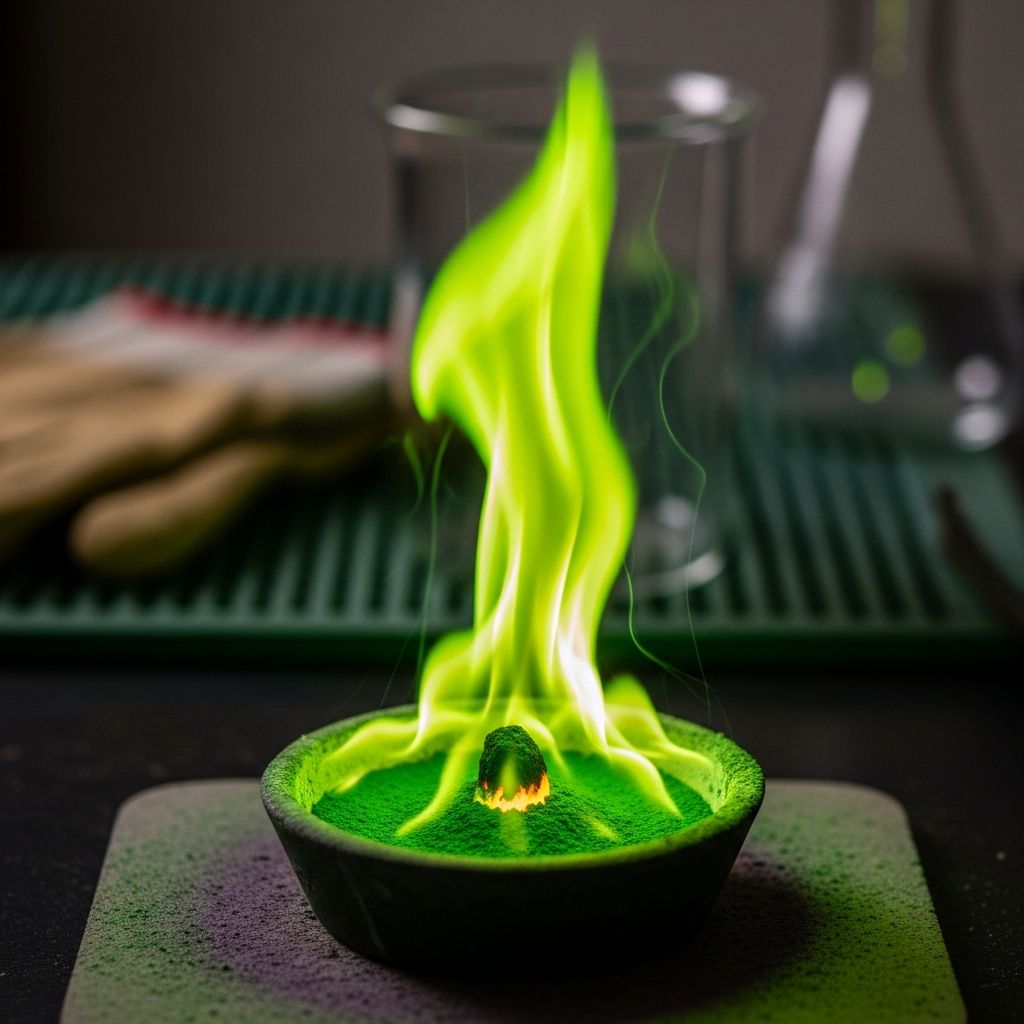
Producing green flames offers a captivating way to explore chemistry through visual spectacle. These experiments rely on specific chemical elements that emit green light when heated in a flame, transforming ordinary fire into a glowing emerald display. Whether for educational demonstrations or backyard entertainment, mastering green fire involves selecting the right materials, following precise procedures, and prioritizing safety.
The Science of Colored Flames
Flame colors arise from atomic excitation. When metal salts are introduced to a high-temperature flame, electrons in the atoms absorb energy and jump to higher orbitals. As they return to ground state, they release photons of specific wavelengths, producing visible colors. Boron compounds yield green due to emissions around 546 nm, while copper ions contribute blue-green hues from similar electronic transitions.
This phenomenon, known as atomic emission spectroscopy, underpins flame tests used in labs to identify elements. Temperature influences intensity—hotter flames enhance emission—but the characteristic color remains tied to the element’s electron structure.
Essential Materials for Green Fire Experiments
Gather these accessible items before starting:
- Fire-resistant container: Metal bowl or ceramic dish to contain the flame safely.
- Flammable solvent: Methanol (e.g., gasline antifreeze like Heet), ethanol, or rubbing alcohol.
- Color agents: Boric acid (roach killer), borax (laundry booster), or copper sulfate (root killer).
- Ignition source: Long matches or lighter.
- Safety gear: Gloves, goggles, fire extinguisher.
These materials are inexpensive and available at hardware stores, pharmacies, or supermarkets.
Method 1: Boron-Based Green Fire with Boric Acid
This approach produces the purest green flames without sodium interference, which can introduce yellow tones.
- Dissolve 1-2 teaspoons of boric acid powder in 1/2 cup methanol or ethanol in a fireproof bowl. Stir until mostly dissolved; some residue is normal.
- Work in a well-ventilated outdoor area or under a fume hood.
- Dim lights for better visibility, then ignite with a long match from a distance.
- Observe the vivid green flame as trimethyl borate forms and volatilizes, burning with boron’s signature glow.
- Extinguish by covering with a metal lid; the boron residue remains for reuse—add more solvent to reignite.
Expect 5-10 minutes of burn time per batch. If yellow appears, it’s likely from impurities; use purer solvents.
Method 2: Borax and Alcohol for Beginner-Friendly Green
Borax (sodium tetraborate) is a household staple, making this ideal for novices.
- Add 1-2 spoonfuls of borax to 1/2 cup methanol in a metal bowl.
- Stir vigorously for 30 seconds to form a suspension; full dissolution isn’t required.
- Light carefully—the initial flame may flicker before stabilizing to green as boron esterizes.
- Monitor for yellow shifts from sodium; minimize borax to sustain green dominance.
This method synthesizes a boron ester in situ, explaining the color. Reuse by adding fuel after cooling.
Method 3: Copper Sulfate for Blue-Green Variations
For a teal twist, copper sulfate offers emerald tones with broader applications.
| Step | Action | Expected Result |
|---|---|---|
| 1. Preparation | Dissolve copper sulfate in rubbing alcohol or soak pinecones/logs. | Blue-green solution. |
| 2. Ignition | Sprinkle powder or ignite soaked items on coals. | Pure green in alcohol; rainbow on wood. |
| 3. Sustain | Add fuel incrementally. | Consistent color without consumption. |
Copper’s d-orbital transitions produce green-blue (around 500-570 nm). Effective on campfires for natural displays.
Advanced Technique: Sulfuric Acid Enhancement
For intensified green, combine boric acid with sulfuric acid and ethanol.
- Mix 5g boric acid and a few ml concentrated sulfuric acid into 50ml ethanol.
- Allow reaction to form volatile boron compounds.
- Ignite in porcelain cups—the acid catalyzes ester formation for brighter flames.
This lab-style method yields professional results but requires handling strong acids cautiously.
Safety Protocols and Precautions
Fire experiments demand vigilance:
- Ventilation: Perform outdoors to avoid CO2 buildup and smoke alarm triggers.
- Flammables: Methanol is toxic—avoid skin contact and inhalation.
- Fire control: Keep extinguisher nearby; never leave unattended.
- Skin/eye protection: Wear gloves and goggles; extinguish flames fully before refueling.
- Supervision: Adults only; keep away from children/pets.
Boron compounds are low-toxicity, but combustion produces particulates—rinse residues properly.
Creative Applications and Variations
Elevate your experiments:
- Fireball effect: Soak cotton balls in mixture for handheld bursts (use tongs).
- Campfire enhancement: Pre-soak wood in copper solution.
- Multi-color mixes: Layer salts for rainbows (boron green, sodium yellow, copper blue).
- Halloween displays: Ignite in carved pumpkins for eerie glows.
These adaptations suit parties, science fairs, or educational outreach.
Understanding Flame Color Charts
Reference this table for expanding your palette:
| Element/Ion | Color | Common Source |
|---|---|---|
| Boron (B) | Green | Boric acid, Borax |
| Copper (Cu) | Blue-Green | Copper sulfate |
| Sodium (Na) | Yellow | Table salt |
| Strontium (Sr) | Red | Strontium nitrate |
| Potassium (K) | Purple | Potassium chloride |
Select salts soluble in your fuel for best dispersion.
Frequently Asked Questions (FAQs)
What causes the green color in flames?
Boron or copper atoms emit green light via excited electron transitions when vaporized in heat.
Is green fire safe for indoor use?
No—always use outdoors or ventilated areas due to toxic fumes and fire risk.
Why do flames turn yellow during burning?
Sodium impurities in borax dominate, overpowering boron’s green; use boric acid to avoid this.
Can I reuse the residue for multiple burns?
Yes, boron/copper compounds aren’t consumed—just add fresh solvent.
What if I don’t have methanol?
Substitute ethanol or rubbing alcohol; results are slightly dimmer but effective.
Troubleshooting Common Issues
- Weak color: Increase salt concentration or use purer fuel.
- No ignition: Ensure good mixing; try warming solvent slightly.
- Smoke/excess yellow: Reduce sodium sources; ventilate better.
Patience refines results—experiment iteratively.
References
- How To: Ghastly Green Fire At Home! (And Why It Burns Green) — Instructables. 2015-10-15. https://www.instructables.com/How-To-Ghastly-Green-Fire-At-Home-And-Why-It-Burns/
- How to make Green Fire from Scratch — YouTube (Amateur Chemistry). 2020-08-12. https://www.youtube.com/watch?v=0dBlWVpLd8Y
- Two Ways to Make Green Fire — Science Notes. 2023-05-20. https://sciencenotes.org/green-fire/
- “Green Flame” experiment — MEL Chemistry. 2022-11-10. https://melscience.com/US-en/articles/green-flame-experiment/

- Integrated M.A. in Applied Linguistics, University of Hyderabad
- 5+ years in editorial, instructional, SEO, and research-based writing
Sneha is a relationships and lifestyle writer with a strong foundation in applied linguistics and certified training in relationship coaching. She brings over five years of writing experience to theskillvault, crafting thoughtful, research-driven content that empowers readers to build healthier relationships, boost emotional well-being, and embrace holistic living. Her writing and insights reflect the belief that beauty, happiness, and wellness…