
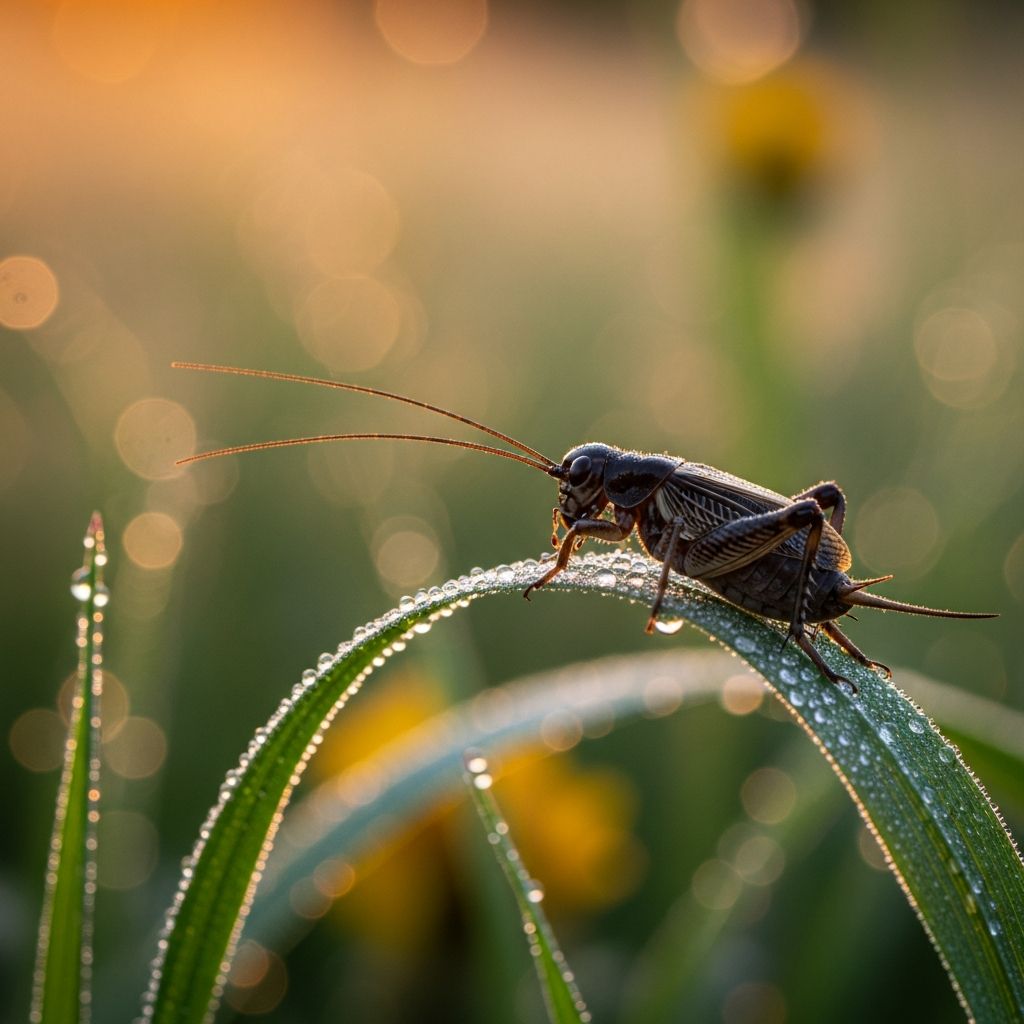
Crickets have long enchanted summer nights with their steady chirping, but these sounds do more than provide a soothing backdrop—they serve as a natural indicator of air temperature. This phenomenon, rooted in biology and physics, allows anyone to estimate the outdoor temperature with remarkable precision using just their ears and a bit of math. Pioneered in the late 19th century, this method transforms casual observation into a scientific tool, bridging the gap between wildlife behavior and environmental monitoring.
The Biological Basis of Chirping Rates
Crickets are ectotherms, meaning their body temperature aligns closely with the surrounding environment. This directly affects their metabolic processes, including the speed of muscle contractions used for chirping. Warmer conditions accelerate these contractions, resulting in faster chirps, while cooler temperatures slow them down. The wings of male crickets rub together in a process called stridulation, producing species-specific chirp patterns that correlate strongly with thermal conditions.
Research shows this relationship is not random; enzymes in cricket muscles operate optimally within certain temperature ranges, influencing chirp frequency. For instance, at higher temperatures, neural signals fire more rapidly, leading to quicker sound production. This bioacoustic response makes crickets reliable proxies for thermometry in natural settings.
Historical Discovery and Dolbear’s Breakthrough
The connection between cricket chirps and temperature was first quantified by American physicist Amos Emerson Dolbear in 1897. In his publication “The Cricket as a Thermometer,” Dolbear analyzed chirp rates of the snowy tree cricket (Oecanthus fultoni), deriving a formula that linked chirps per minute to Fahrenheit degrees. His work built on earlier informal observations, formalizing what had been folk wisdom into a precise law known today as Dolbear’s Law.
Dolbear’s original equation was: T_F = 50 + (N_60 - 40)/4, where T_F is temperature in Fahrenheit and N_60 is chirps per 60 seconds. This applied primarily to tree crickets, whose chirps are among the most temperature-sensitive. His findings were groundbreaking, offering a low-tech method for temperature estimation before widespread thermometer use.
Practical Formulas for Everyday Use
Modern simplifications make Dolbear’s Law accessible without stopwatches or complex math. The most popular version for field crickets involves counting chirps over 14-15 seconds and adding 40 to approximate Fahrenheit temperature.
| Species/Type | Count Duration | Formula (Fahrenheit) | Example |
|---|---|---|---|
| Snowy Tree Cricket | 15 seconds | Chirps + 40 | 25 chirps = 65°F |
| Field Cricket | 14 seconds | Chirps + 40 | 30 chirps = 70°F |
| General (Celsius) | 8 seconds | Chirps + 5 | 20 chirps = 25°C |
For Celsius, Dolbear’s reformulated equation is T_C = (N_60 + 30)/7, or the quick 8-second count plus 5, accurate between 5-30°C. These shortcuts stem from algebraic rearrangements of the original, prioritizing ease for outdoor enthusiasts, educators, and campers.
Step-by-Step Guide to Measuring Temperature
- Locate a Chirping Cricket: Find a consistent singer in a quiet spot, ideally a snowy tree cricket for best accuracy.
- Time the Chirps: Use a phone timer for 14-15 seconds (Fahrenheit) or 8 seconds (Celsius). Start counting on the first chirp.
- Apply the Formula: Add 40 to Fahrenheit counts or 5 to Celsius ones.
- Verify Nearby: Compare with a thermometer; expect ±1-2°F accuracy under ideal conditions.
- Repeat for Average: Test multiple crickets to account for individual variation.
Practice in familiar environments hones this skill, turning evening walks into impromptu science lessons.
Factors Affecting Accuracy and Reliability
While reliable, cricket thermometry has caveats. Chirp rates vary by species—field crickets (Gryllus spp.) are less precise than tree crickets due to influences like age, hunger, or mating. Humidity, wind, and time of night also play roles, as crickets chirp more post-sunset.
- Temperature Range: Best between 55-100°F (13-38°C); outside this, metabolic limits apply.
- Species Specificity: Snowy tree crickets yield top results; others need adjusted formulas.
- Environmental Noise: Urban settings or choruses dilute individual counts.
Mathematical models highlight limits: extrapolating Dolbear’s equation predicts impossible chirp rates at extremes, like 116 chirps/second at 1000°C, underscoring biological boundaries.
Scientific Validation and Modern Research
Empirical tests confirm Dolbear’s predictions. A 2019 study in Journal of Experimental Biology measured chirp-temperature correlations across cricket species, validating the law with R² values over 0.95 in controlled settings. Field trials, like those in educational programs, show real-world accuracy within 2°F.
Bioacoustics research extends this to climate monitoring, where automated chirp analysis via microphones tracks microclimates in forests.
Educational Applications in Classrooms and Camps
This method engages students in biology, math, and ecology. Teachers use it for hands-on data collection, graphing chirp rates vs. thermometer readings to explore linear regression. Scout groups apply it during campouts, fostering observation skills.
Sample Lesson Activity:
- Collect data from 5 crickets.
- Plot points and fit a trendline.
- Discuss error sources and model limits.
It demonstrates real-world math, where models approximate rather than perfect reality.
Crickets in Broader Environmental Monitoring
Beyond casual use, cricket chirps inform ecology. Changes in chirp patterns signal climate shifts or pollution, as temperature-sensitive species indicate habitat health. Citizen science apps now crowdsource chirp data for biodiversity maps.
In agriculture, farmers gauge field conditions without gadgets, aiding pest management since crickets thrive in warm, moist soils.
Comparing Cricket Method to Traditional Tools
| Method | Accuracy | Cost | Portability | Fun Factor |
|---|---|---|---|---|
| Cricket Chirps | ±1-2°F | Free | High | Very High |
| Digital Thermometer | ±0.5°F | $10-50 | High | Low |
| Mercury Thermometer | ±1°F | $5-20 | Medium | Low |
Crickets excel in remote areas, offering zero-cost, immersive measurement.
Frequently Asked Questions (FAQs)
What types of crickets work best for this method?
Snowy tree crickets provide the highest accuracy; field crickets are common alternatives but slightly less reliable.
Does this work in Celsius countries?
Yes, count chirps in 8 seconds and add 5 for °C between 5-30°C.
Why do crickets chirp faster when warm?
Warmer temperatures boost metabolism and muscle speed, accelerating stridulation.
Can I use this at night?
Absolutely—crickets are nocturnal, chirping most reliably after dusk.
Is it 100% accurate?
No, expect minor variations from individuals or conditions, but it’s within 1-2°F typically.
Conclusion: Embracing Nature’s Clever Indicators
Cricket chirps reveal the elegance of nature’s design, turning a simple sound into a temperature gauge. From Dolbear’s 1897 insight to today’s apps, this tool educates, amuses, and connects us to our environment. Next summer evening, listen closely—you might just hear the weather forecast.
References
- How Crickets Determine Temperature with Their Chirps — Grissom Heat and Air. 2023. https://www.grissomheatandair.com/blog/how-crickets-determine-temperature-with-their-chirps/
- Using Crickets to Tell Temperature — Trail Life USA (YouTube). 2015-10-15. https://www.youtube.com/watch?v=43uCBECGmUE
- Dolbear’s law — Wikipedia (citing original 1897 publication). 2024-01-12. https://en.wikipedia.org/wiki/Dolbear’s_law

Medha Deb is an editor with a master's degree in Applied Linguistics from the University of Hyderabad. She believes that her qualification has helped her develop a deep understanding of language and its application in various contexts. Medha specializes in the areas of beauty, health, sports, and wellness and is committed to ensuring that the content on the website is…