
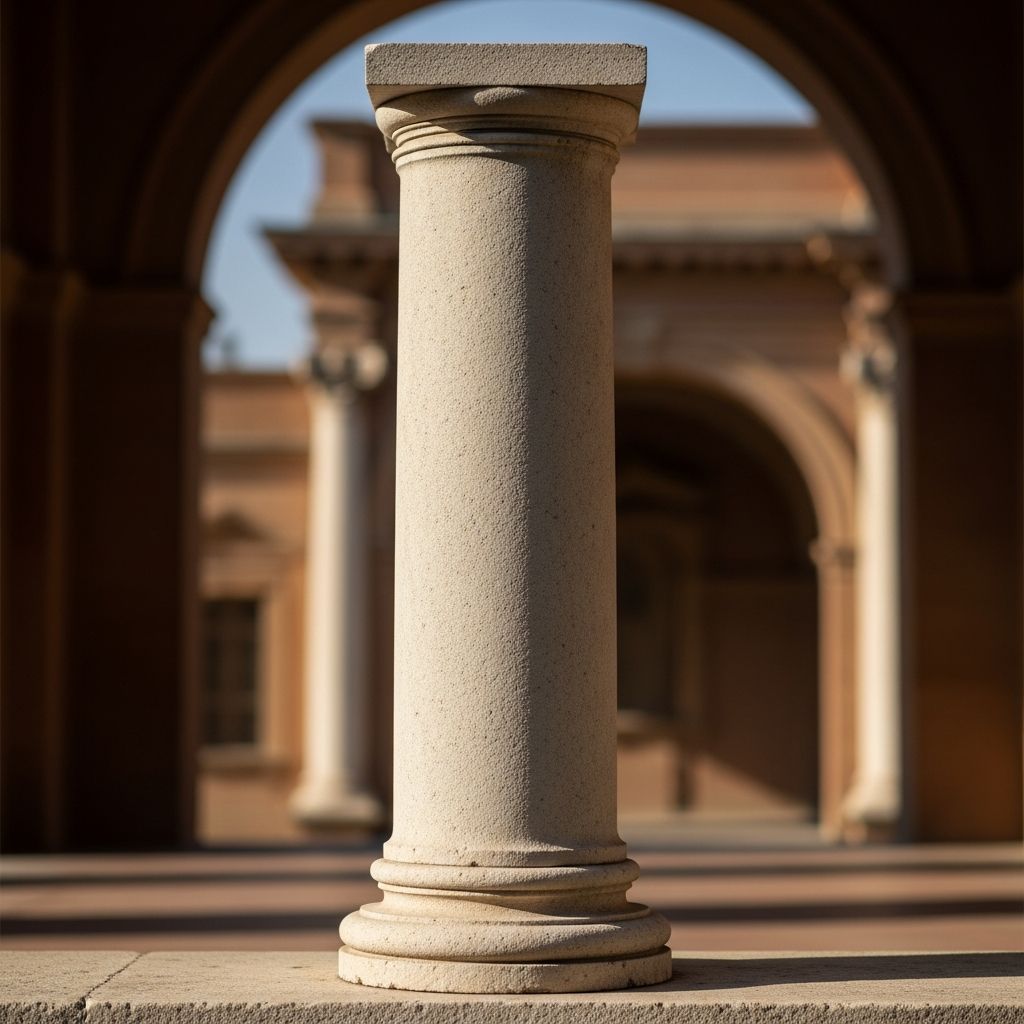
The Tuscan column stands as the epitome of architectural minimalism within the classical orders, prized for its robust form and lack of ornamentation. This order combines the sturdy proportions of earlier styles with a smooth, practical aesthetic that has endured for centuries.
Origins in Ancient Traditions
Tracing back to the Etruscans, who inhabited northern Italy before the rise of Rome, the Tuscan order reflects a primitive Italic form predating Greek influences. Etruscan temples exclusively featured these columns, supporting structures dedicated to deities like Jupiter, Juno, and Minerva.
Roman adoption refined this style, distinguishing it from Greek Doric, Ionic, and Corinthian orders. Vitruvius, in his seminal work De Architectura, outlined the classical canon but did not initially classify Tuscan as separate, viewing it as a vernacular evolution.
Renaissance scholars like Sebastiano Serlio and Andrea Palladio elevated its status, interpreting it as an ancient, rustic order ideal for fortifications. Serlio deemed it suitable for city gates, fortresses, and seaports due to its strength.
Defining Characteristics of Tuscan Columns
Tuscan columns emphasize functionality over decoration, with key elements including:
- Smooth Shaft: Unfluted surface for ease of construction and a clean appearance, unlike the grooved Doric.
- Proportions: Height typically seven times the base diameter (1:7 ratio), though Serlio proposed a stockier 1:6.
- Base: Simple circular design with a torus and collar, more rounded than other orders.
- Capital: Plain and unadorned, featuring a basic astragal ring beneath a flat cap.
- Entablature: Simplified without triglyphs or guttae, promoting open spacing.
These traits yield a column that conveys stability, blending Doric robustness with Ionic slenderness.
| Order | Height-to-Diameter Ratio | Shaft Fluting | Capital Style |
|---|---|---|---|
| Tuscan | 1:7 (standard) | None | Plain round |
| Doric | 1:5-1:8 | 20 flutes | Simple echinus |
| Ionic | 1:9 | 24 flutes | Volutes |
| Corinthian | 1:10 | 24 flutes | Acanthus leaves |
This table highlights Tuscan’s unique balance, making it versatile for both structural and decorative roles.
Historical Development and Codification
While Etruscan roots provided the foundation, Renaissance Italy formalized the Tuscan order. Architects like Vignola in Cinque ordini d’architettura (1562) and Palladio in I quattro libri dell’architettura (1570) illustrated precise modules, standardizing its use.
Vitruvius’s descriptions influenced these codifications, though he focused on Greek-derived orders. The Tuscan’s evolution from vernacular wood construction to stone exemplifies Roman innovation, enabling arches and vaults alongside entablatures.
Debates persist on its precedence over Doric; some scholars argue it as an independent Italic tradition, supported by surviving Etruscan temples.
Practical Applications Across Eras
Tuscan columns suited utilitarian needs, from military structures to civic buildings. Serlio recommended them for prisons, treasuries, and warehouses, where durability trumped elegance.
In doorways and entrances, pairs of Tuscan columns offer understated grandeur without ostentation. Their carpenter-friendly design popularized them in Georgian vernacular architecture, persisting in New England farmhouses and Ohio colonnades into the 19th century.
Modern revivals appear in neoclassical gateways, garden fences, and even commercial facades, valuing their clean lines.
Comparing Tuscan to Doric: Subtle Distinctions
Authorities sometimes blur Tuscan and Doric lines, but key differences emerge:
- Tuscan lacks fluting and decorative moldings.
- Entablature is plainer, without Doric’s triglyphs.
- Proportions lean slimmer, echoing Ionic grace.
This simplification rendered Tuscan ideal for rapid construction in wood or stone, especially in non-monumental contexts.
Influence on Broader Classical Architecture
Roman engineers expanded column use beyond bearing loads to decorative pilasters and engaged columns on concrete structures like the Pantheon. Tuscan’s simplicity complemented this flexibility.
Neoclassical periods in England and America embraced it during Georgian and Revival eras, seen in public buildings and private estates.
Today, Tuscan orders enhance sustainable designs, where minimal material use aligns with eco-friendly principles.
Construction Techniques and Materials
Originally timber-based in Etruscan practice, Tuscan columns transitioned to marble and stone under Romans. Smooth shafts reduced carving labor, while plain capitals allowed mass production.
Modular proportions (1:7) facilitated scaling for temples or gates. In fortifications, widely spaced columns supported heavy loads without fragility.
Contemporary fabrications use fiberglass or concrete casts, replicating classical forms economically.
Regional Examples and Legacy
In Italy, Etruscan sites showcase early Tuscan temples. Roman adaptations appear in utilitarian ports. Canterbury, England, features local stout examples blending with Doric influences.
American neoclassicism integrated Tuscan pilasters in federal-style homes, symbolizing republican virtue.
Frequently Asked Questions (FAQs)
What makes Tuscan columns different from Doric?
Tuscan columns are unfluted with simpler capitals and entablatures, offering a smoother, more proportional form inspired by Ionic slenderness.
Where are Tuscan orders commonly used today?
They appear in doorways, garden gates, porches, and rustic facades for their practical, unpretentious strength.
Who first codified the Tuscan order?
Renaissance theorists like Serlio, Vignola, and Palladio formalized it based on Vitruvius and Etruscan precedents.
Is the Tuscan order older than Doric?
Scholars debate this; it’s viewed as an independent Etruscan/Italic form predating Greek Doric in Italy.
Can Tuscan columns support arches?
Yes, Roman innovations allowed Tuscan columns to carry both entablatures and arches effectively.
References
- Columns – Historic Reno Preservation Society — Historic Reno Preservation Society. Accessed 2026. http://www.historicreno.org/index.php/resources/elements/168-columns
- Tuscan order – Wikipedia — Wikipedia Contributors. 2026-04-05. https://en.wikipedia.org/wiki/Tuscan_order
- The Language of Classical Architecture: Understanding the Orders — Skurman Architects. Accessed 2026. https://www.skurman.com/post/the-language-of-classical-architecture-understanding-the-orders-tuscan-order
- Tuscan order | architecture — Encyclopædia Britannica. Accessed 2026. https://www.britannica.com/technology/Tuscan-order
- Tuscan Order – Buffalo Architecture and History — Buffalo Architecture and History. Accessed 2026. https://buffaloah.com/a/DCTNRY/t/tuscan.html
- Tuscan column – Canterbury Historical and Archaeological Society — Canterbury Historical and Archaeological Society. Accessed 2026. https://www.canterbury-archaeology.org.uk/tuscan
- Origin and Evolution of the Tuscan Order – Review Questions — The Institute of Classical Architecture & Art. Accessed 2026. https://www.classicist.org/tuscan-order-review-questions/

Medha Deb is an editor with a master's degree in Applied Linguistics from the University of Hyderabad. She believes that her qualification has helped her develop a deep understanding of language and its application in various contexts. Medha specializes in the areas of beauty, health, sports, and wellness and is committed to ensuring that the content on the website is…