
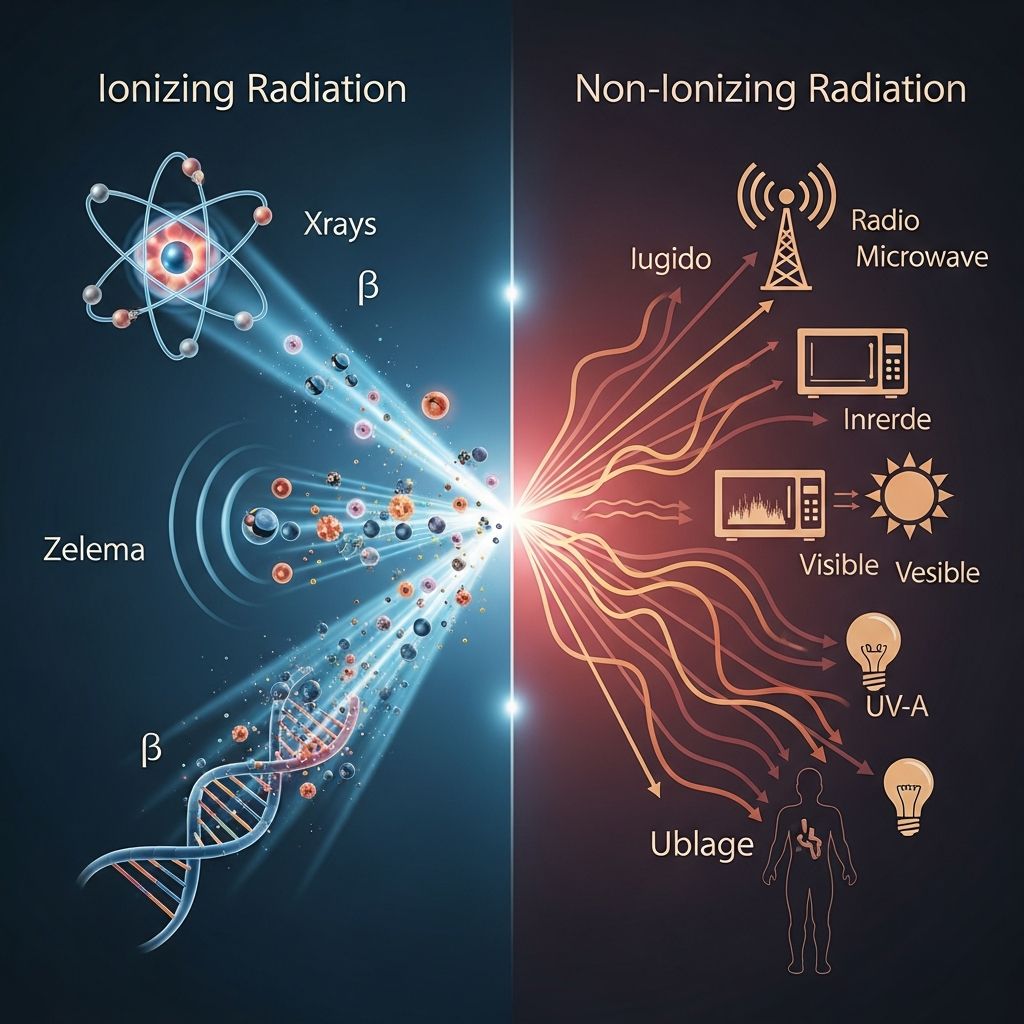
Radiation is a fundamental form of energy transmission that occurs naturally and through human-made sources, manifesting as electromagnetic waves or particle streams that interact with matter in distinct ways. Broadly categorized into ionizing and non-ionizing types, these differ primarily in their energy levels and capacity to alter atomic structures.
Defining Radiation in Modern Science
At its core, radiation refers to energy propagating through space or substances as waves or particles. This energy spans the electromagnetic spectrum, determined by factors like wavelength, frequency, and photon energy. Low-energy forms gently excite atoms, while high-energy variants possess the power to eject electrons, fundamentally changing material composition.
The electromagnetic spectrum serves as a visual map, with longer wavelengths (lower frequencies) on one end and shorter wavelengths (higher frequencies) on the other. This continuum underpins everything from radio communications to cosmic phenomena, influencing technology, health, and environmental safety.
Non-Ionizing Radiation: The Everyday Energy Around Us
Non-ionizing radiation encompasses electromagnetic emissions lacking the intensity to dislodge electrons from atoms or molecules. Instead, it induces vibrations or excitations, often resulting in thermal effects without causing ionization.
Common manifestations include:
- Radiofrequency (RF) waves: Power cell phones, Wi-Fi, and broadcasting, carrying information wirelessly without structural atomic damage.
- Microwaves: Heat food by agitating water molecules, as seen in ovens, but safe at controlled levels.
- Infrared (IR): Delivers warmth from sunlight or heaters, felt as radiant heat.
- Visible light: Enables vision, spanning colors from red to violet.
- Ultraviolet (UV) light (near range): Tanning beds or black lights, which can cause skin reactions with overexposure.
These forms permeate daily environments—from sunlight filtering through windows to signals bouncing between devices—posing minimal risk under normal conditions. However, intense or prolonged exposure, such as in industrial settings, can lead to burns or tissue heating.
Ionizing Radiation: High-Energy Transformers
In contrast, ionizing radiation carries sufficient energy—typically above 10-33 electronvolts—to strip electrons, creating charged ions and potentially breaking chemical bonds. This capability makes it invaluable in medicine yet hazardous without safeguards.
| Type | Sources | Effects |
|---|---|---|
| Electromagnetic | X-rays, gamma rays, far-UV | Penetrates tissue, damages DNA |
| Particle | Alpha, beta particles, neutrons | Ionizes matter directly |
Natural origins include cosmic rays and radon gas from soil, while artificial ones stem from nuclear reactors, medical scanners, and particle accelerators. Unlike their non-ionizing counterparts, these penetrate deeply, posing risks like cellular mutations if unchecked.
Key Differences: A Side-by-Side Comparison
Understanding distinctions is crucial for public health and safety protocols.
| Aspect | Non-Ionizing | Ionizing |
|---|---|---|
| Energy Level | <10-33 eV; excites only | >10-33 eV; ejects electrons |
| Spectrum Position | Left side (RF to UV) | Right side (UV+ to gamma) |
| Health Impact | Thermal, low cancer risk | DNA damage, cancer risk |
| Examples | Cell phones, sunlight | X-rays, radon |
This table highlights how energy thresholds dictate behavior: non-ionizing warms, ionizing alters.
Ubiquitous Sources in Daily Life
Non-ionizing radiation is omnipresent. Wireless tech like smartphones and routers emit RF waves constantly, while microwaves and TVs add to the mix. Natural sunlight provides IR, visible, and some UV, filtered by the atmosphere to block most harmful rays.
- Consumer devices: Baby monitors, garage openers, GPS.
- Industrial: High-power lasers, welding arcs.
- Environmental: Earth’s magnetic field fluctuations (ELF).
Ionizing sources are less pervasive but critical: medical diagnostics expose patients briefly, and background levels from rocks contribute chronically at low doses.
Navigating Health Risks and Safety
Non-ionizing radiation’s primary concern is heating—think microwave burns or UV sunburns. Prolonged high-intensity exposure in workplaces may cause cataracts or skin issues, but consumer levels remain safe per regulatory standards. Studies show no strong cancer links for most types, though research continues on long-term RF effects.
Ionizing radiation risks escalate with dose: acute high exposure causes radiation sickness; chronic low doses heighten cancer probabilities via DNA disruptions. Protective measures include shielding, time limits, and distance.
Agencies like the CDC emphasize that while daily non-ionizing exposure is unavoidable and benign, awareness prevents misuse—like avoiding staring at lasers.
Technological Applications and Innovations
Non-ionizing harnessed wisely drives progress:
- Communications: RF enables global connectivity.
- Medical: IR for therapy, UV for sterilization.
- Imaging: MRI uses RF pulses safely.
Ionizing excels in diagnostics (CT scans), therapy (radiotherapy), and research (particle physics), balancing benefits against controlled risks.
Regulatory Frameworks and Guidelines
Governments enforce limits: FCC caps RF emissions, OSHA mandates workplace controls for UV/IR. International bodies harmonize standards, ensuring devices like cell phones stay below thresholds.
Frequently Asked Questions (FAQs)
Is cell phone radiation dangerous?
Cell phones emit non-ionizing RF radiation, which does not damage DNA directly. Regulatory limits prevent harmful heating, and major health agencies find no consistent cancer evidence from typical use.
Can non-ionizing radiation cause cancer?
Most forms lack energy for DNA ionization, showing no causal cancer link. High-exposure scenarios warrant caution, but everyday levels are safe.
How does sunlight fit into radiation types?
Sunlight mixes non-ionizing (visible, IR, near-UV) with trace ionizing (far-UV, filtered out). Use sunscreen against UV effects.
What’s the safe exposure to X-rays?
Medical X-rays are ionizing; benefits outweigh minimized risks. ALARA principle (As Low As Reasonably Achievable) guides dosing.
Do microwaves leak harmful radiation?
Modern ovens emit negligible non-ionizing microwaves externally, safe if undamaged. Heating inside is controlled and non-ionizing.
Future Directions in Radiation Research
Ongoing studies probe subtle non-thermal effects of RF on biology, alongside 5G deployments. Ionizing research advances safer isotopes for therapy. Public education remains key to dispelling myths.
(Word count: 1678)
References
- Radiation Basics — Utah Department of Environmental Quality. 2023. https://deq.utah.gov/waste-management-and-radiation-control/radiation-basics
- Non-ionizing radiation — Wikipedia (informed by primary sources). 2023. https://en.wikipedia.org/wiki/Non-ionizing_radiation
- About Non-Ionizing Radiation — Centers for Disease Control and Prevention (CDC). 2024-01-15. https://www.cdc.gov/radiation-health/about/non-ionizing-radiation.html
- Definition of non-ionizing radiation — National Cancer Institute (NCI). 2023. https://www.cancer.gov/publications/dictionaries/cancer-terms/def/non-ionizing-radiation
- Non-Ionizing Radiation – Overview — Occupational Safety and Health Administration (OSHA). 2023. http://www.osha.gov/non-ionizing-radiation
- Types and sources of radiation — Canadian Nuclear Safety Commission. 2023. https://www.cnsc-ccsn.gc.ca/eng/resources/radiation/types-and-sources-of-radiation/

- Integrated M.A. in Applied Linguistics, University of Hyderabad
- 5+ years in editorial, instructional, SEO, and research-based writing
Sneha is a relationships and lifestyle writer with a strong foundation in applied linguistics and certified training in relationship coaching. She brings over five years of writing experience to theskillvault, crafting thoughtful, research-driven content that empowers readers to build healthier relationships, boost emotional well-being, and embrace holistic living. Her writing and insights reflect the belief that beauty, happiness, and wellness…