
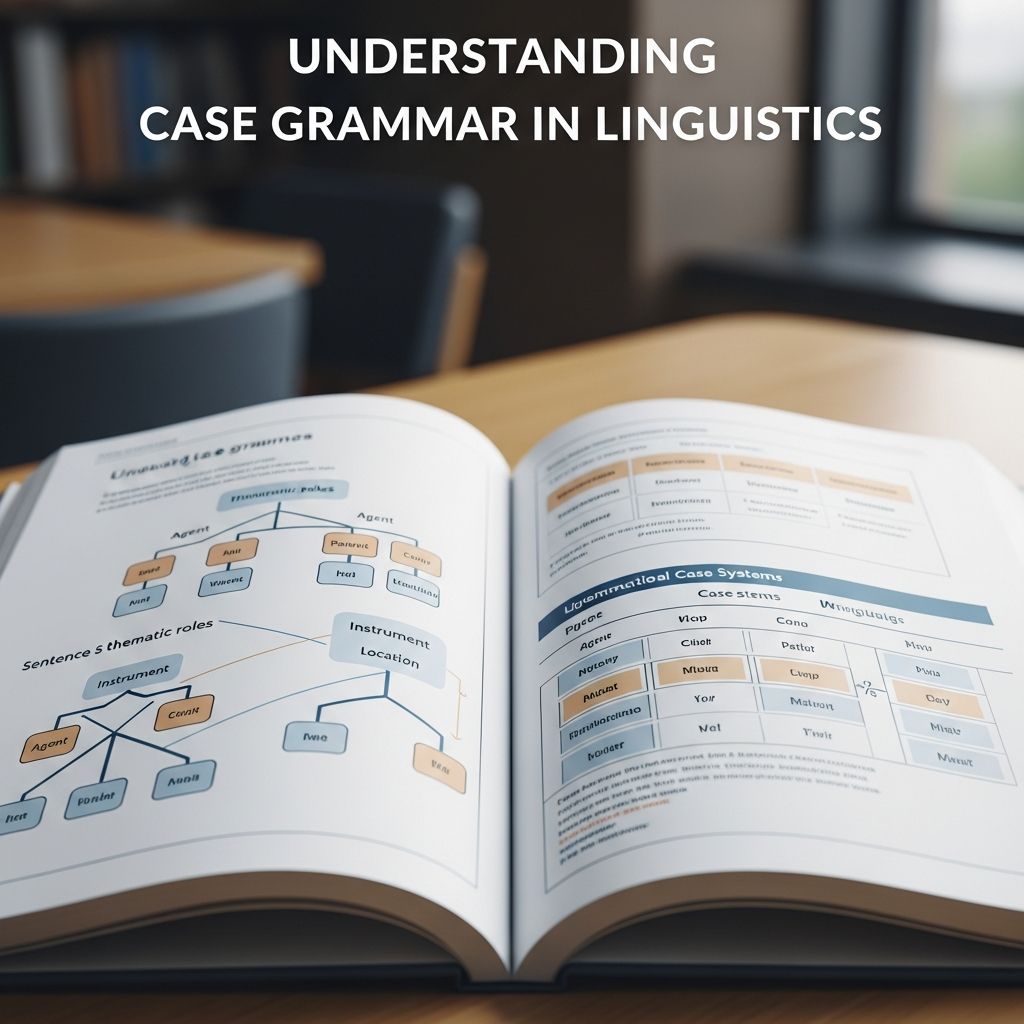
Case grammar represents a foundational concept in linguistics that clarifies how nouns, pronouns, and related words indicate their roles within sentences. By examining inflections and structural markers, linguists can decode the relationships between elements in a clause, enhancing both theoretical analysis and practical language instruction.
Defining the Core Principles of Case Grammar
At its essence, case grammar involves systematic modifications to words that signal their grammatical function. These modifications, often through suffixes or form changes, help distinguish subjects from objects, possessors from possessed, and instruments from locations. Unlike rigid word order in analytic languages, synthetic languages rely heavily on cases to convey meaning flexibly.
- Inflections apply primarily to nouns, pronouns, adjectives, and sometimes numerals.
- Each case corresponds to specific semantic roles, such as agency or recipient.
- Modern linguistics distinguishes case from thematic roles, emphasizing its syntagmatic nature within phrases.
This system enables concise expression, as seen in languages like Latin or Russian, where a single word form encapsulates multiple relational details.
Primary Types of Grammatical Cases
Languages worldwide feature a variety of cases, each tailored to express distinct relationships. The most prevalent include nominative for subjects, accusative for direct objects, and genitive for possession. Understanding these builds a scaffold for analyzing complex sentences.
| Case Name | Primary Function | Example in Sentence |
|---|---|---|
| Nominative | Subject of the verb | She runs quickly. |
| Accusative | Direct object | They read the book. |
| Dative | Indirect object or beneficiary | Give the gift to him. |
| Genitive | Possession or relation | The house of the family. |
| Instrumental | Means or tool | Write with a pen. |
| Vocative | Direct address | Listen, friends! |
These cases vary in number across languages; Finnish boasts 15, while English retains traces in pronouns only.
Historical Development and Linguistic Evolution
Case systems trace back to Proto-Indo-European, where eight cases dominated. Over millennia, many languages simplified, merging functions or shifting to prepositions. English, for instance, evolved from Old English’s four cases to a minimalist approach, retaining full inflections solely in personal pronouns.
Ancient grammarians like those in Sanskrit traditions formalized case theory, influencing Latin scholars who identified five core cases: nominative, genitive, dative, accusative, and vocative. This framework persists in classical studies, providing tools for dissecting texts from Homer to Cicero.
Case Grammar in the English Language
Contemporary English employs three primary cases: subjective (nominative), objective (accusative/dative), and possessive (genitive). Pronouns exemplify this: ‘I’ (subjective) shifts to ‘me’ (objective) or ‘my/mine’ (possessive).
- Subjective Case: Identifies the doer, e.g., ‘We traveled far.’
- Objective Case: Marks recipients or targets, e.g., ‘She called us.’
- Possessive Case: Denotes ownership, e.g., ‘Their decision mattered.’
- Vocative Case: Signals address, e.g., ‘Come here, team.’
Nouns use apostrophes for possession (‘dog’s bone’), but lack other inflections, relying on position and prepositions for clarity. Debates arise with pronouns after ‘but,’ where some advocate objective forms when preceding the verb.
Contrasting Case-Rich and Case-Poor Languages
Inflected languages like German or Polish mark cases explicitly on multiple word classes, allowing free word order for emphasis. English, analytic by nature, prioritizes sequence: subject-verb-object. Yet, remnants persist, aiding parsing in ambiguous contexts.
For learners, case-rich systems demand memorization of paradigms, while English speakers transitioning to German appreciate familiar patterns in pronouns.
Applications in Syntactic Analysis
Case grammar underpins dependency parsing in computational linguistics, where algorithms assign roles based on morphological cues. In second-language acquisition, explicit case instruction accelerates proficiency in heritage languages.
Theoretically, cases bridge form and meaning, distinct from theta roles like agent or patient, which operate at phrase levels. This separation clarifies why a dative noun might encode a beneficiary without implying instrumentality.
Challenges and Common Misconceptions
Learners often conflate cases with prepositions, overlooking how English ‘to’ mimics dative without inflection. Another pitfall: assuming English lacks cases entirely, ignoring pronoun shifts and genitive markers.
Historical mergers, like accusative and dative in pronouns (‘him’ for both), complicate teaching, yet reinforce the language’s efficiency.
Frequently Asked Questions
What is the main purpose of grammatical cases?
Cases primarily indicate a word’s syntactic role, such as subject, object, or possessor, enabling clear sentence interpretation regardless of word order.
How many cases does modern English have?
English features three main cases for pronouns—subjective, objective, and possessive—with nouns using possessive via apostrophe.
Why did English lose most of its case system?
Through simplification from Old English, influenced by Norse contact and analytic tendencies, shifting reliance to prepositions and order.
Can cases appear on adjectives?
Yes, in languages like Russian or Latin, adjectives agree in case, number, and gender with the nouns they modify.
How does case grammar aid language learning?
It provides a framework for understanding roles, improving translation accuracy and comprehension in inflected languages.
Advanced Topics: Case in Typological Studies
Typologists classify languages by case inventory: agglutinative (Turkish, 7 cases), fusional (Latin, 6-7), or isolating (Vietnamese, none). Ergative languages like Basque invert nominative-accusative alignment, using absolutive for intransitive subjects and transitive objects.
Recent computational models leverage case for neural machine translation, predicting inflections from context. In creole genesis, case loss correlates with substrate simplification.
Exploring split ergativity in Indo-Iranian languages reveals context-dependent alignments, challenging universal grammars. These insights fuel debates on innateness versus usage-based acquisition.
Practical Exercises for Mastering Cases
To internalize cases, practice declensions:
- Decline ‘child’ in a case-rich paradigm: nominative ‘child,’ genitive ‘child’s,’ etc.
- Transform English sentences: ‘The teacher gave the students books’ → Identify cases.
- Compare: German ‘Ich gebe dem Mann das Buch’ (dative ‘dem’).
Tools like Anki flashcards with example sentences reinforce patterns effectively.
Case grammar not only demystifies syntax but empowers nuanced expression across languages. By grasping these markers, one unlocks interpretive depth in texts from ancient epics to AI-generated prose.
References
- Grammatical Case: What It Is and Why English (Almost) Doesn’t Have It — Glossika. 2023-05-15. https://ai.glossika.com/blog/what-is-a-grammatical-case
- Grammatical case — Wikipedia (citing primary linguistic sources). 2026-04-01. https://en.wikipedia.org/wiki/Grammatical_case
- Case in Grammar — Grammar Monster. 2024-02-20. https://www.grammar-monster.com/glossary/case.htm
- Cases of Nouns and Pronouns — Guide to Grammar and Writing (Purdue). 2023-11-10. https://guidetogrammar.org/grammar/cases.htm
- The Cases in English — Ohio State University Department of Classics (.edu). 2025-01-15. https://classics.osu.edu/Undergraduate-Studies/Latin-Program/Grammar/Cases/English-Case
- Grammar Basics: What Is Grammar Case? — Grammarly Blog. 2024-08-05. https://www.grammarly.com/blog/grammar/grammar-basics-what-is-grammar-case/

Medha Deb is an editor with a master's degree in Applied Linguistics from the University of Hyderabad. She believes that her qualification has helped her develop a deep understanding of language and its application in various contexts. Medha specializes in the areas of beauty, health, sports, and wellness and is committed to ensuring that the content on the website is…