
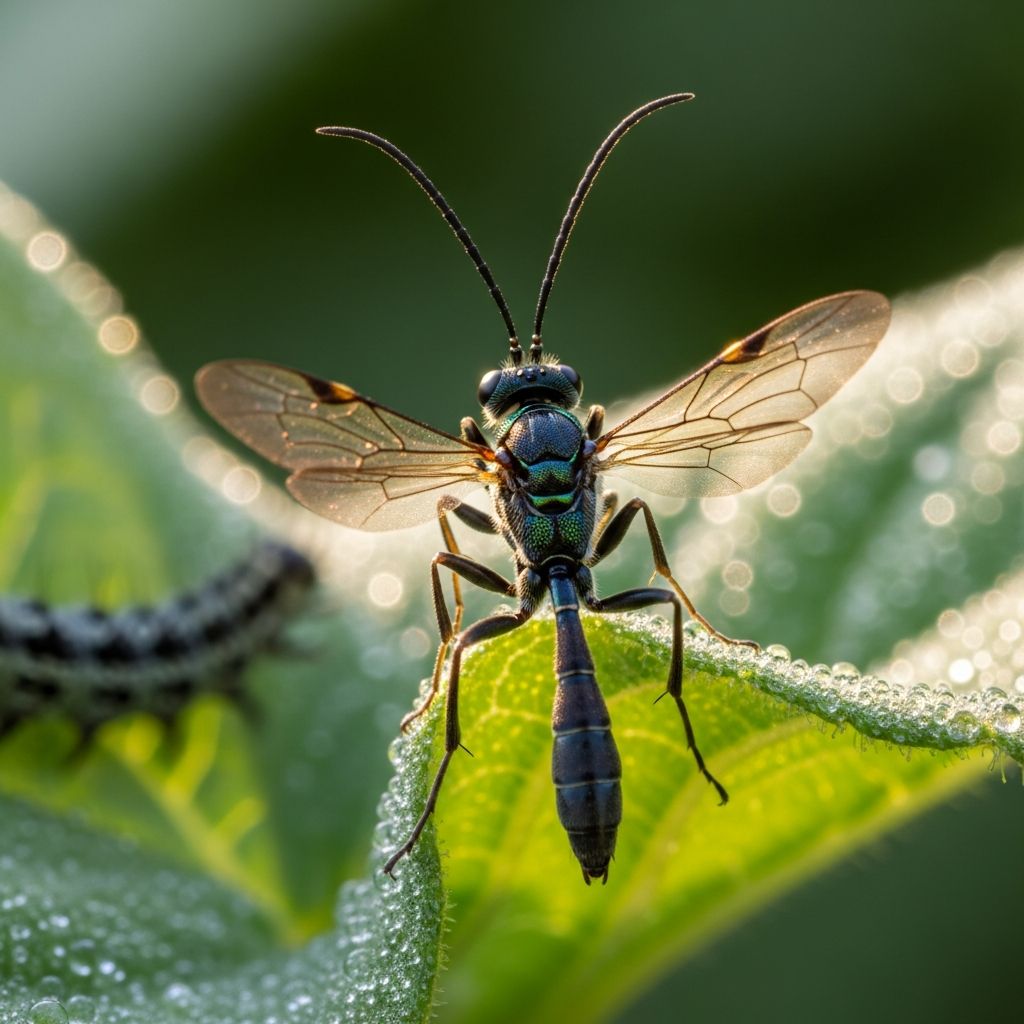
Braconid wasps, belonging to the family Braconidae within the superfamily Ichneumonoidea, represent one of the most diverse and ecologically significant groups of insects. With tens of thousands of described species and likely many more undiscovered, these tiny parasitoids play a crucial role in regulating populations of pest insects, particularly caterpillars that damage crops and gardens. Unlike predatory wasps that consume their prey outright, braconids lay their eggs inside or on host insects, allowing their larvae to develop by feeding on the host’s tissues. This parasitoid lifestyle makes them invaluable allies in integrated pest management (IPM) programs, offering a sustainable alternative to chemical pesticides.
Understanding the Biology of Braconid Wasps
The biology of braconid wasps is a testament to evolutionary ingenuity. Adults are typically small, ranging from 2-3 mm to over 1.5 inches in some species, with slender bodies, long legs, and often a prominent ovipositor—a needle-like extension of the female’s abdomen used to deposit eggs precisely into hosts. Many species target lepidopteran larvae, such as those of moths and butterflies, including notorious pests like the tomato hornworm or European corn borer.
Ichneumonoid wasps, encompassing both Braconidae and Ichneumonidae, exhibit remarkable morphological diversity adapted to their parasitoid habits. Comprehensive studies highlight their anatomy, including specialized venom glands that paralyze hosts without killing them immediately, ensuring the larvae have fresh food. This superfamily boasts around 60,000 described species, with braconids forming a major portion, particularly diverse in tropical regions.
- Adult Morphology: Slender, long-legged; abdomen often longer than head and thorax.
- Ovipositor Variations: From short for external egg-laying to extremely long for deep host penetration.
- Sensory Adaptations: Antennae equipped with chemoreceptors to detect host pheromones and volatiles.
Life Cycle and Parasitism Strategies
The life cycle of braconid wasps is intimately tied to their hosts. Females locate suitable hosts using keen senses, then insert eggs via the ovipositor into the host’s body, often the hemolymph (insect blood). Larvae hatch within days, feeding internally on non-vital tissues first, sparing the host until the final instars. For instance, in Cotesia congregata, a common braconid, about 65 eggs are laid into hornworm larvae. Larvae emerge after 2-3 days, feeding voraciously for 12-16 days before exiting through the host’s cuticle to spin white cocoons and pupate. Adults emerge from cocoons after 3-8 days, depending on temperature.
Braconids employ diverse strategies: endoparasitism (internal feeding), ectoparasitism (external), or koinobiosis (host remains alive initially). Some species, like Bracon brevicornis and B. hebetor, demonstrate temperature-dependent reproduction. Laboratory experiments show optimal offspring production at 27°C, with fewer at extremes like 12°C or 36°C, though paralysis occurs even at non-viable temperatures.
| Life Stage | Duration | Key Behaviors |
|---|---|---|
| Egg | 1-3 days | Laid in host hemolymph |
| Larva | 12-16 days | Internal feeding, host paralysis |
| Pupae | 3-8 days | Cocoon spinning, metamorphosis |
| Adult | Variable | Mating, host-seeking, oviposition |
Diversity and Systematics of the Braconidae
Braconidae is one of the largest wasp families, with over 20,000 described species across numerous subfamilies like Euphorinae and Microgastrinae. Systematics reveal close ties to Ichneumonidae, yet distinct evolutionary paths. Detailed taxonomic treatments emphasize anatomy, phylogeny, and biogeography, noting higher diversity in tropics and hotspots like Southeast Asia.
Fossil records extend back millions of years, underscoring their ancient origins. Books like The Braconid and Ichneumonid Parasitoid Wasps provide exhaustive coverage, from morphology to ecology, aiding identification and research.
Ecological Roles and Impact on Ecosystems
In natural ecosystems, braconids are keystone regulators of herbivorous insects. They suppress outbreaks of defoliators, maintaining plant health and biodiversity. Many reside in riparian zones near gardens, naturally colonizing agricultural areas. Their role in population dynamics is profound; hosts like plant-feeding lepidopterans rarely reach pest levels where braconids thrive.
Globally, their species richness—estimated far exceeding described numbers—highlights untapped potential for conservation and study.
Braconid Wasps in Biological Pest Control
Braconids shine in IPM as biological control agents. Species like Cotesia congregata target hornworms effectively; wasps paralyze and consume the host from within, reducing pest pressure without residues. Lab tests with B. brevicornis and B. hebetor on Ephestia kuehniella show high efficacy (>80%) across temperatures and host densities, with more hosts yielding higher total offspring.
Practitioners release them in greenhouses or fields, especially at moderate temperatures. Unlike broad-spectrum pesticides, they spare beneficials and pollinators. Scouting for white cocoons on pests signals natural control at work—avoid disrupting them.
- Advantages: Targeted, self-sustaining populations; no chemical resistance.
- Challenges: Temperature sensitivity; need for host availability.
- Success Stories: Suppression of corn borers, stored-product moths.
Identification and Observation Tips
Spotting braconids requires patience. Look for tiny wasps (2-3mm) hovering over caterpillars or clusters of white cocoons on wilted larvae. Larger species have visible ovipositors. In gardens, check tomato plants for hornworm parasitism—emerged cocoons often drop to soil.
They pose no threat to humans, lacking stings. Encourage them by planting nectar-rich flowers like dill or fennel for adults.
Challenges and Future Research Directions
Despite promise, challenges persist: climate change may alter temperature optima, affecting efficacy. Limited identification keys hinder widespread use. Future research should focus on rearing techniques, genetic diversity, and augmentative releases.
Books and reviews stress culturing methods and taxonomic updates to unlock potential.
Frequently Asked Questions (FAQs)
Are braconid wasps dangerous to humans?
No, braconid wasps are harmless to people. They lack stingers and do not bite or sting; their ovipositor targets insect hosts only.
How do I know if a caterpillar is parasitized by braconids?
Look for white oval cocoons protruding from the caterpillar’s body or a lethargic, paralyzed host. Larvae exit after feeding internally.
Can I buy braconid wasps for my garden?
Yes, commercial suppliers offer species like Cotesia for release against hornworms. Ensure compatibility with local climate.
What temperatures are best for braconid activity?
Optimal reproduction occurs around 27°C; efficacy drops at extremes, though paralysis persists.
Do braconids control all caterpillar pests?
They target many lepidopterans effectively but are host-specific. Combine with other IPM for broad control.
Conclusion: Embracing Braconids for Sustainable Pest Management
Braconid wasps exemplify nature’s balance, turning pests into resources for the next generation. By fostering these allies, gardeners and farmers can reduce chemical reliance, promoting healthier ecosystems. Continued research will enhance their role in global agriculture.
References
- Braconid and Ichneumonid Parasitoid Wasps: Biology, Systematics… — James B. Whitfield, American Entomologist. 2016-06-01. https://academic.oup.com/ae/article-abstract/62/2/131/1751546
- Bracon wasps for ecological pest control-a laboratory experiment — PubMed. 2021-06-11. https://pubmed.ncbi.nlm.nih.gov/34123600/
- IPM – Biological Control: The Braconid Wasp (Cotesia congregata) — University of Florida IFAS Extension. 2021-09-19. https://blogs.ifas.ufl.edu/stjohnsco/2021/09/19/ipm-biological-control-the-braconid-wasp-cotesia-congreta/
- Parasitic Wasps: Ichneumonid and Braconid Wasps — Washington State University Hortsense. n.d. https://hortsense.cahnrs.wsu.edu/fact-sheet/parasitic-wasps-ichneumonid-and-braconid-wasps/
- The Braconid and Ichneumonid Parasitoid Wasps — Donald L.J. Quicke, Wiley Online Library. 2014-11-14. https://onlinelibrary.wiley.com/doi/book/10.1002/9781118907085

Medha Deb is an editor with a master's degree in Applied Linguistics from the University of Hyderabad. She believes that her qualification has helped her develop a deep understanding of language and its application in various contexts. Medha specializes in the areas of beauty, health, sports, and wellness and is committed to ensuring that the content on the website is…