
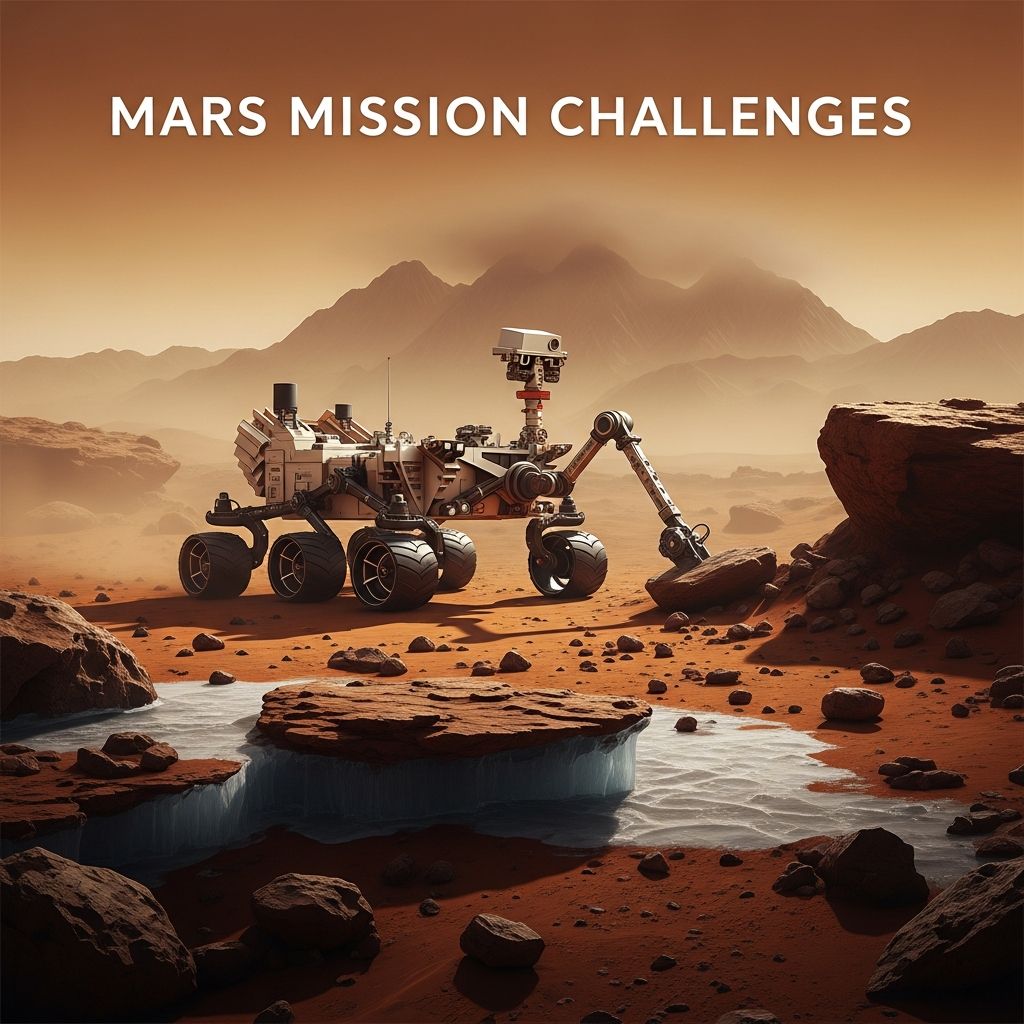
Humanity’s ambition to set foot on Mars captivates imaginations, yet the journey poses unprecedented engineering and scientific barriers. Unlike lunar trips, a Mars voyage demands overcoming colossal distances, managing immense fuel requirements, executing precise landings in a tenuous atmosphere, shielding crews from deadly radiation, and sustaining life during prolonged isolation. These factors elevate Mars exploration to a realm far beyond current capabilities, requiring revolutionary advancements in technology and strategy.
The Vast Gulf: Distance and Travel Time Constraints
The primary obstacle begins with sheer distance. Mars orbits approximately 225 million kilometers from Earth on average, though optimal launch windows every 26 months shrink this to about 55 million kilometers when planets align favorably. This separation dwarfs the Moon’s 384,000-kilometer jaunt, demanding missions lasting 6-9 months outbound, extended surface stays, and another 6-9 months return, totaling up to 2.5 years.
Launch windows dictate strict timelines; deviations inflate fuel needs exponentially due to inefficient trajectories. Crews must time departures precisely, enduring long waits on Mars—potentially 500 days—for favorable Earth return alignments. Such durations strain spacecraft reliability, as no rapid resupply exists, unlike the International Space Station.
- Travel Duration: 539 days in transit exposes systems to failure risks without immediate repairs.
- Orbital Mechanics: Hohmann transfer orbits minimize energy but enforce rigid schedules.
- Communication Lag: Up to 20-minute round-trip delays hinder real-time support from Earth.
Propulsion Quandaries: Fuel Mass and the Tyranny of the Rocket Equation
Fuel dominates mission design due to the Tsiolkovsky rocket equation, where added mass spirals propellant demands. A round-trip requires accelerating to escape Earth, decelerating into Mars orbit, landing, ascending, and returning—each phase devouring propellant. Lunar missions carried return fuel; Mars demands 150 times more supplies for doubled crew over 73 times longer durations.
Strategies like aerocapture—using Mars’ atmosphere to brake without rockets—promise efficiency but remain untested for crewed vehicles. Precision is critical: too steep an entry incinerates the craft; too shallow skips it past the planet. Traditional retro-rockets burden vehicles with extra fuel mass from Earth, compounding weight issues.
| Aspect | Earth-Moon | Earth-Mars |
|---|---|---|
| Distance | 0.384 million km | 55-225 million km |
| Trip Time | 3-12 days | 2-2.5 years |
| Fuel Multiplier | Baseline | 150x supplies needed |
| Deceleration Method | Rockets/Atmosphere | Aerocapture (untested) |
In-situ resource utilization (ISRU), producing fuel from Martian CO2 and water ice via processes like Sabatier reaction, could alleviate ascent burdens. NASA’s MOXIE experiment on Perseverance demonstrated oxygen production, a vital step. Yet scaling to full propellant loads remains a colossal engineering feat.
Descent Dilemmas: Mastering the Seven Minutes of Terror
Landing on Mars earns its “seven minutes of terror” moniker, with over 50% of attempts failing historically. The planet’s thin atmosphere—1% Earth’s density—poses a paradox: dense enough for frictional heating requiring heat shields, yet too sparse for parachutes to decelerate heavy payloads adequately.
Successful strategies evolved: Viking used parachutes plus retrorockets; Pathfinder inflated airbags; Perseverance employed a sky crane. However, human-scale landers (50-100 metric tons) exceed these limits. Aerodynamic drag insufficiently slows such masses, necessitating supersonic retropropulsion or novel tech like inflatable decelerators.
- Atmospheric Friction: Demands robust heat shields despite low density.
- Parachute Limits: Ineffective for >1-ton vehicles without supplementation.
- Precision Landing: Terrain-relative navigation essential for safe sites amid craters and dunes.
ESA notes navigation precision as paramount, given infrequent launch windows. Future missions may integrate laser-guided systems or propulsive landings, but reliability under Mars’ dust storms and variable weather remains unproven.
Return Journey Hurdles: Launching from an Alien World
Ascent from Mars compounds difficulties. At 38% Earth’s gravity, escape demands less delta-v than Earth (5.0 km/s vs. 11.2 km/s), but harder than the Moon’s 2.4 km/s. No equivalent to Earth’s thick atmosphere aids aerobraking; crews must propel upward to orbit, rendezvous with transfer vehicles, and burn for home.
Carrying all ascent propellant from Earth is impractical—potentially 80% mission mass. ISRU offers salvation, but demands robust power (nuclear reactors?), extraction infrastructure, and cryogenic storage on a world lacking infrastructure. Reliability over years, amid quakes or dust, is uncertain.
Invisible Killers: Radiation and Microgravity Menaces
Beyond mechanics, cosmic threats loom. Galactic cosmic rays (GCRs) and solar particle events (SPEs) bombard deep-space travelers, unshielded by Mars’ negligible magnetosphere or thin air. A 539-day transit could deliver radiation doses risking cancer, cataracts, and acute illness.
Microgravity exacerbates woes: bone density loss (1-2% monthly), muscle atrophy, fluid shifts, and vision impairment plague astronauts. No artificial gravity solutions exist at scale; crews face weakened states upon Mars arrival, complicating surface ops. Countermeasures like exercise, drugs, or centrifugation show promise but fall short for multi-year trips.
Human Factors: Isolation, Psychology, and Life Support
Confinement in a finite-volume habitat for 2+ years tests mental resilience. Delayed communications foster isolation; interpersonal conflicts, monotony, and mission stress mirror submarine deployments but amplified. Six-person crews require meticulous selection, training, and autonomy.
Life support must recycle air, water, and waste near-closed loop, generating food via hydroponics or bioreactors. A lunar mission’s 12-day supplies pale against Mars’ 150-fold escalation, demanding ultra-reliable ECLSS with no Earth backups.
Emerging Solutions and Future Prospects
Optimism persists through innovation. NASA’s Artemis program builds lunar testing grounds for Mars tech: Starship prototypes target Mars reusability; nuclear thermal propulsion (NTP) promises 30% faster transits, slashing exposure. Aerocapture trials, advanced ISRU, and radiation shelters (water walls, regolith bunkers) address core issues.
Private ventures like SpaceX accelerate timelines, aiming uncrewed Mars landings soon, crewed by 2030s. Yet experts caution: full integration of systems remains years away, with 2030s-2040s realistic for boots on Mars.
Frequently Asked Questions (FAQs)
What is the biggest barrier to Mars travel?
The combination of distance, fuel requirements, and landing challenges in a thin atmosphere tops the list, demanding entirely new technologies.
How often can we launch to Mars?
Every 26 months during alignment windows for efficient trajectories; otherwise, fuel costs skyrocket.
Can parachutes land humans on Mars?
No, Mars’ atmosphere is too thin for heavy vehicles; retrorockets or advanced methods are essential.
Will radiation kill Mars astronauts?
Not inevitably, but poses severe risks; shielding and storm shelters mitigate, though GCRs penetrate most materials.
When will humans reach Mars?
Optimistic targets: 2030s via NASA/SpaceX; realistic consensus points to 2040s after tech maturation.
References
- Why is it IMPOSSIBLE for Humans to Reach Mars — YouTube (Science and Technology channel). 2023. https://www.youtube.com/watch?v=fGSAl71pwsU
- Why Is It So Hard to Travel to Mars? — Space.com. 2011-10-27 (updated). https://www.space.com/11417-mars-missions-space-travel-challenges.html
- Why is Landing on Mars so Difficult? — YouTube (AumSum channel). 2023. https://www.youtube.com/watch?v=BpzYRuAJYaE
- Mars is Hard. Here’s Why. — NASA.gov. 2022-06-22. https://www.nasa.gov/podcasts/houston-we-have-a-podcast/mars-is-hard-heres-why-2/
- Landing On Mars: A Tricky Feat! — NASA Science. 2024. https://science.nasa.gov/solar-system/skywatching/night-sky-network/landing-on-mars-a-tricky-feat/
- Challenges facing the human exploration of Mars — Planetary.org. 2023-09-20. https://www.planetary.org/articles/challenges-facing-the-human-exploration-of-mars
- The hazards of landing on Mars — ESA.int. 2012-11-20 (evergreen technical doc). https://sci.esa.int/web/mars/-/58307-the-hazards-of-landing-on-mars

Medha Deb is an editor with a master's degree in Applied Linguistics from the University of Hyderabad. She believes that her qualification has helped her develop a deep understanding of language and its application in various contexts. Medha specializes in the areas of beauty, health, sports, and wellness and is committed to ensuring that the content on the website is…