
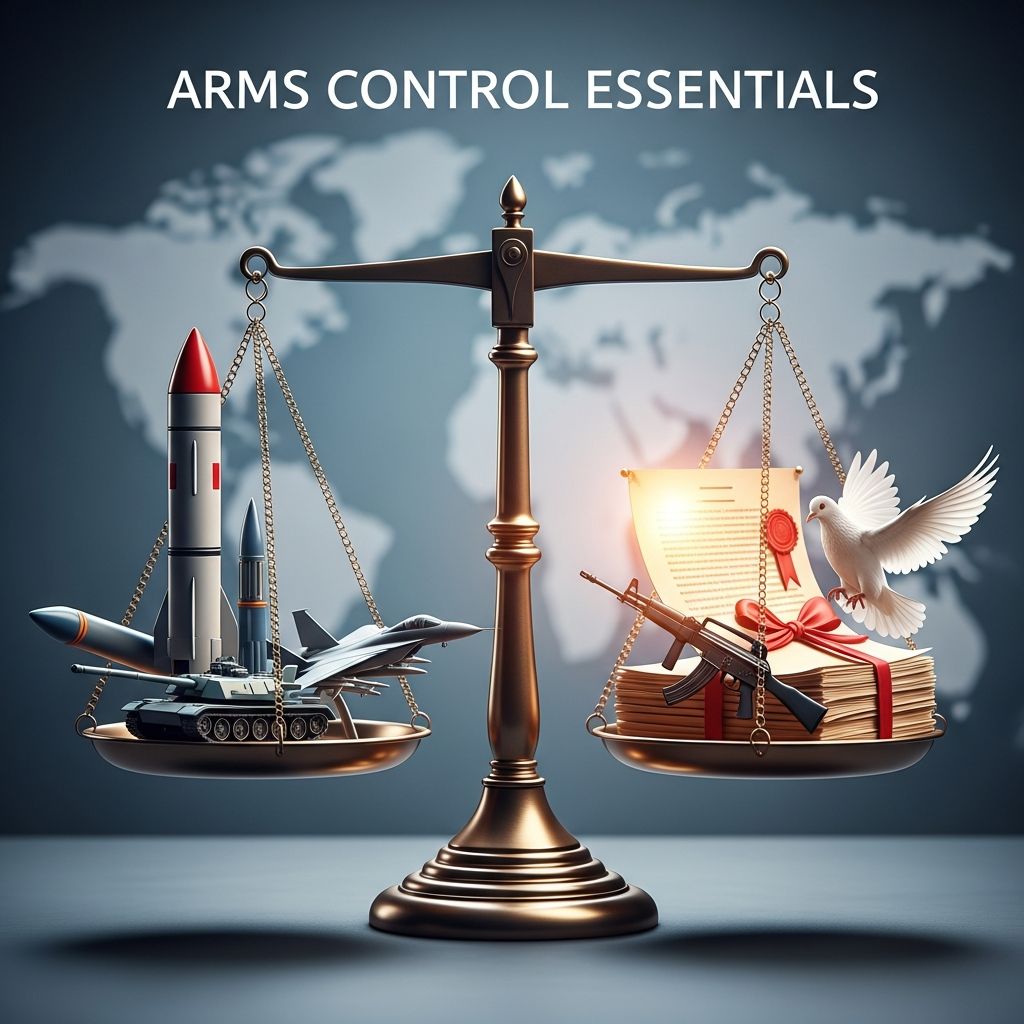
Arms control represents a cornerstone of international security, focusing on negotiated limits to prevent unchecked military buildups and reduce conflict risks. Through bilateral and multilateral agreements, nations collaborate to cap arsenals, enhance transparency, and mitigate escalation dangers.
Core Concepts and Distinctions
At its heart, arms control involves mutual restraints on the development, production, stockpiling, deployment, and employment of military capabilities, spanning small arms to weapons of mass destruction (WMDs) like nuclear, chemical, and biological arms. Unlike outright disarmament, which seeks weapon elimination, arms control accepts certain forces while stabilizing them to avoid arms races.
Key related terms include:
- Disarmament: Reducing or abolishing specific weapons or entire categories, often unilaterally or reciprocally.
- Non-proliferation: Preventing spread of WMDs and advanced conventional systems to new actors, reversing proliferation without force.
These efforts foster stability by promoting verification, transparency, and confidence-building, addressing mutual interests in averting war and curbing costs.
Historical Foundations
Arms control emerged prominently in the 20th century amid rising destructive technologies. Early precedents trace to the 19th century, like the 1817 Rush-Bagot Agreement demilitarizing the U.S.-Canada border, but modern frameworks arose post-World War II with nuclear threats.
The Cold War catalyzed major initiatives. U.S. and Soviet leaders recognized mutual vulnerability, leading to strategies emphasizing stable deterrence over supremacy. Thomas Schelling and Morton Halperin’s 1961 Strategy and Arms Control framed it as extending military strategy to shared interests in war avoidance and arms competition minimization.
Post-1945, the nuclear age spurred urgency. The 1963 Partial Test Ban Treaty prohibited atmospheric nuclear tests, followed by the 1968 Nuclear Non-Proliferation Treaty (NPT), ratified by 191 states, committing nuclear powers to disarmament pursuits while barring others from acquiring bombs.
Major Treaties and Agreements
Landmark pacts have shaped the field. Here’s a table of pivotal agreements:
| Treaty | Year | Parties | Key Provisions |
|---|---|---|---|
| NPT | 1968/1970 | 191 states | Prevents nuclear spread; nuclear states pursue disarmament; promotes peaceful nuclear tech. |
| SALT I/II | 1972/1979 | U.S.-USSR | Limited strategic offensive arms, including ICBMs and SLBMs. |
| START I/II | 1991/1993 | U.S.-Russia | Deep cuts to strategic nuclear warheads and delivery systems. |
| New START | 2010 (extended) | U.S.-Russia | Caps deployed warheads at 1,550; verification via inspections. |
| CTBT | 1996 | 187 signatories | Bans all nuclear explosions (not yet in force). |
Bilateral U.S.-Russia deals dominate strategic nuclear control, balancing deterrence while cutting arsenals by over 80% from Cold War peaks. Multilateral efforts like the NPT target proliferation, with review conferences assessing progress.
Mechanisms of Implementation
Success hinges on verification: on-site inspections, satellite monitoring, and data exchanges build trust. U.S. law mandates preparation for such systems under the Arms Control and Disarmament Act, defining it as verification, limitation, or elimination via international pacts.
NATO integrates arms control into its framework, emphasizing transparency to avert miscalculation. Enforcement varies; consenting parties adhere voluntarily, but sanctions target violators like North Korea’s nuclear program.
Strategic Benefits and Objectives
Arms control yields multifaceted gains:
- War Risk Reduction: Caps eliminate flashpoints, stabilizing crises.
- Cost Savings: Avoids expensive races; U.S. saved billions via START reductions.
- Damage Limitation: Restricts civilian and environmental harm.
- Stability Enhancement: Promotes ‘invulnerable’ retaliatory forces, deterring first strikes.
Henry Kissinger stressed complicating aggressor calculations while bolstering defenders. Overall, it aligns competitive states on common ground: no side benefits from catastrophic war.
Challenges and Criticisms
Despite achievements, hurdles persist. Verification gaps erode trust; Russia’s 2023 New START suspension cited U.S. inspections bans. Emerging tech like hypersonics and cyber weapons evade old treaties.
Proliferation endures: Iran’s program and North Korea’s tests defy NPT norms. Disarmament asymmetry irks non-nuclear states, who demand faster nuclear cuts. Geopolitical shifts, like China’s arsenal growth, complicate multilateralism.
Critics argue arms control legitimizes weapons or favors status quo powers. Yet, without it, unchecked escalation looms, as in pre-WWI naval races.
Contemporary Landscape
As of 2026, tensions define the era. U.S.-Russia New START expires in 2026 without successor, risking unchecked buildups. China’s expansion prompts calls for trilateral talks. Conventional arms treaties like the Conventional Armed Forces in Europe (CFE) lapsed amid NATO-Russia frictions.
New domains demand adaptation: AI-guided munitions, space weapons, and biotech raise proliferation risks. NATO prioritizes non-proliferation of missiles and small arms alongside WMDs. UN efforts push Treaty on the Prohibition of Nuclear Weapons (2017), though boycotted by possessors.
Future Directions
Revitalizing arms control requires innovation. Risk reduction measures, like de-alerting warheads, could bridge gaps. Including China via caps on all nuclear powers offers promise.
Civil society and NGOs amplify diplomacy, as in the Ottawa Process banning landmines. Digital verification using blockchain enhances trust without intrusive inspections.
Ultimately, arms control endures as vital for mutual survival, evolving with threats to ensure diplomacy outpaces destruction.
Frequently Asked Questions (FAQs)
What distinguishes arms control from disarmament?
Arms control limits and stabilizes arsenals for security, while disarmament eliminates them entirely.
Why do nuclear powers pursue arms control?
To reduce war risks, cut costs, and maintain stable deterrence amid mutual assured destruction.
Is the NPT still effective?
It has prevented new nuclear states but faces challenges from non-signatories and slow disarmament.
How is arms control verified?
Through inspections, national technical means, and data exchanges mandated in treaties.
What role does NATO play?
It promotes transparency and non-proliferation to lower miscalculation risks.
References
- Arms control – Wikipedia — Wikipedia contributors. 2023-10-15. https://en.wikipedia.org/wiki/Arms_control
- Arms control, disarmament and non-proliferation in NATO — NATO. 2024-01-22. https://www.nato.int/en/what-we-do/wider-activities/arms-control-disarmament-and-non-proliferation-in-nato
- Arms control | History | Research Starters — EBSCO. 2023-05-10. https://www.ebsco.com/research-starters/history/arms-control
- Arms control | Nuclear Disarmament, Treaty Negotiations — Encyclopædia Britannica. 2024-02-28. https://www.britannica.com/topic/arms-control
- Defining Arms Control — Arms Control Wonk. 2006-06-12. https://www.armscontrolwonk.com/archive/402497/defining-arms-control/
- 22 USC Ch. 35: ARMS CONTROL AND DISARMAMENT — U.S. House of Representatives. 2024-01-01. https://uscode.house.gov/view.xhtml?path=%2Fprelim%40title22%2Fchapter35&edition=prelim
- What is Arms Control? | Arms Control 101 Module 1 — Center for Strategic & International Studies (YouTube). 2022-09-15. https://www.youtube.com/watch?v=xdEHhKSAEMU

Medha Deb is an editor with a master's degree in Applied Linguistics from the University of Hyderabad. She believes that her qualification has helped her develop a deep understanding of language and its application in various contexts. Medha specializes in the areas of beauty, health, sports, and wellness and is committed to ensuring that the content on the website is…