
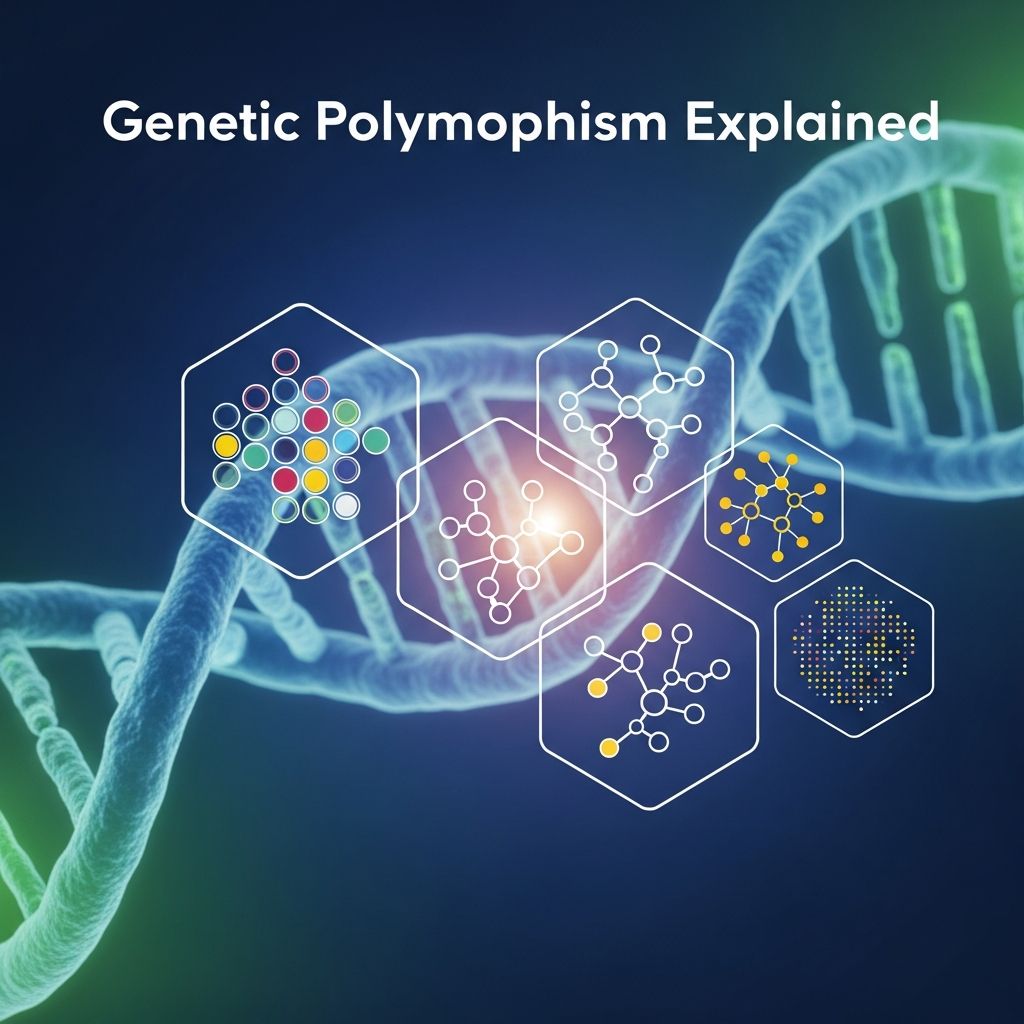
Genetic polymorphism represents the cornerstone of biological diversity, manifesting as multiple forms of genes or DNA sequences within a population that occur at frequencies greater than 1%. These variations underpin everything from evolutionary adaptation to individual differences in disease susceptibility and drug response.
Defining Genetic Polymorphism in Modern Biology
At its core, genetic polymorphism occurs when a specific gene locus features more than one allele across a population, with each allele present at a frequency of at least 1%. This threshold distinguishes polymorphisms from rare mutations, which affect less than 1% of individuals. In populations undergoing sexual reproduction, such as humans, these variants arise from germline mutations that persist and spread rather than being lost.
Polymorphisms contribute to genetic diversity, enabling populations to adapt to changing environments. They are classified by their molecular nature—changes in DNA sequence—and their phenotypic effects, ranging from silent (no change in protein) to those altering fitness and driving natural selection.
- Key Threshold: Allele frequency ≥1% in population.
- Origin: Germline mutations that evade lethality and propagate.
- Scope: Applies to multi-cellular organisms with sexual reproduction.
Molecular Foundations: How Polymorphisms Emerge
Polymorphisms originate primarily from mutations during DNA replication, though recombination and gene flow also play roles. In sexual reproduction, only germline mutations are heritable, as somatic changes (e.g., UV-induced skin cell mutations) do not pass to offspring. Once established, neutral or advantageous variants increase in frequency via genetic drift or selection.
Mechanisms include point mutations, insertions/deletions, and larger structural changes. These alterations can be neutral, beneficial, or deleterious, but only those maintaining population frequency qualify as polymorphisms.
| Mechanism | Description | Example Impact |
|---|---|---|
| Mutation | Base substitution or indel during replication | SNP creation |
| Recombination | Crossing over during meiosis | New allele combinations |
| Gene Flow | Migration introducing variants | Increased diversity |
Primary Types of Genetic Polymorphisms
Genetic variations span a spectrum from single-base changes to complex structural rearrangements. Understanding these categories is essential for genomics research and clinical applications.
Single Nucleotide Polymorphisms (SNPs)
SNPs, the most prevalent form, involve a single nucleotide substitution (e.g., C to T) at a specific genomic position. They account for ~90% of human genetic variation, occurring roughly once every 1,000 bases, yielding 4-5 million SNPs per genome. To qualify as SNPs, variants must appear in ≥1% of the population.
SNPs can be synonymous (no amino acid change) or nonsynonymous (altering protein function). Regulatory SNPs in non-coding regions influence gene expression, splicing, or stability.
- Frequency: ~1 per 1,000 nucleotides.
- Total in Humans: Over 600 million identified globally.
- Applications: Disease mapping, ancestry tracing.
Insertions and Deletions (Indels)
Indels involve the addition or removal of small DNA segments (1-50 bases). These can shift reading frames, drastically altering proteins, or create novel functions. Less common than SNPs but impactful in coding regions.
Copy Number Variations (CNVs) and Structural Variants
CNVs feature duplicated or deleted segments (>1kb), affecting gene dosage. Structural variants include inversions, translocations, and repeats like VNTRs/STRs. These contribute to ~12% of human variation and are linked to complex traits.
Evolutionary Dynamics of Polymorphisms
Polymorphisms fuel evolution by providing raw material for natural selection. Variants conferring fitness advantages spread, while deleterious ones decline. Neutral polymorphisms persist via drift. Historical milestones include the 1978 beta-globin polymorphism discovery and 1980s RFLP mapping.
In humans, SNPs like those in HLA genes enhance immune diversity, exemplifying balancing selection where heterozygotes thrive.
Polymorphisms in Human Health and Disease
Genetic polymorphisms profoundly influence health. They modulate disease risk (e.g., APOE SNPs in Alzheimer’s), drug metabolism (pharmacogenomics), and phenotypic traits.
- Cancer: SNPs in TP53 affect tumor suppression.
- Cardiovascular: CNVs in lipid genes raise heart disease odds.
- Infectious Disease: CCR5 deletion confers HIV resistance.
Locus heterogeneity occurs when mutations in different genes cause the same disorder, complicating diagnosis.
Pharmacogenomics: Tailoring Treatments
Polymorphisms guide personalized medicine. CYP2D6 SNPs predict responses to antidepressants; TPMT variants dictate thiopurine dosing to avoid toxicity. Genome-wide association studies (GWAS) link SNPs to drug efficacy/side effects.
| Gene | Polymorphism Type | Clinical Impact |
|---|---|---|
| CYP2C19 | SNP | Clopidogrel response in heart patients |
| TPMT | SNP | Leukemia drug toxicity risk |
| ABCB1 | SNP | Antiepileptic efficacy |
Techniques for Detecting Polymorphisms
Modern tools identify polymorphisms efficiently:
- Sequencing: NGS reveals SNPs/indels across genomes.
- Microarrays: Genotype millions of SNPs simultaneously.
- PCR/RFLPs: Early methods for targeted detection.
Haplotypes—linked SNP sets—enhance mapping precision.
Challenges and Future Directions
Despite advances, challenges persist: most SNPs are non-coding with subtle effects; population stratification biases GWAS; ethical issues surround direct-to-consumer testing. Future efforts focus on functional annotation and polygenic risk scores.
With projects like 1000 Genomes, we catalog variants comprehensively, paving the way for precision health.
Frequently Asked Questions (FAQs)
What distinguishes a polymorphism from a mutation?
A mutation is a rare change (<1% frequency); polymorphisms are common variants (≥1%).
How many SNPs exist in the human genome?
Approximately 4-5 million per individual, with over 600 million population-wide.
Can polymorphisms cause disease?
Yes, via altered protein function or regulation, e.g., in cystic fibrosis or diabetes risk.
Are all polymorphisms harmful?
No, many are neutral or beneficial, driving diversity and adaptation.
How do SNPs aid medicine?
They inform drug responses and disease predictions in pharmacogenomics.
References
- Gene polymorphism – Wikipedia — Wikipedia Contributors. 2023-10-15. https://en.wikipedia.org/wiki/Gene_polymorphism
- An Overview of Mechanisms, Types and Implications in Human Health — OMICS International. 2023. https://www.omicsonline.org/open-access-pdfs/gene-polymorphism-an-overview-of-mechanisms-types-and-implications-in-human-health.pdf
- Genetic Polymorphisms — IntechOpen. 2019-10-10. https://www.intechopen.com/chapters/68164
- Genetic Polymorphism and SNPs — McGill University. 2023. https://www.cs.mcgill.ca/~kaleigh/compbio/snp/snp_summary.html
- Genetics, Mutations, and Polymorphisms — NCBI Bookshelf (NIH). 2023-05-01. https://www.ncbi.nlm.nih.gov/books/NBK6475/
- What are single nucleotide polymorphisms (SNPs)? — MedlinePlus (NIH). 2024-01-20. https://medlineplus.gov/genetics/understanding/genomicresearch/snp/
- What is a functional genetic polymorphism? Defining classes — PMC (NIH). 2011-09-27. https://pmc.ncbi.nlm.nih.gov/articles/PMC3201989/

- Integrated M.A. in Applied Linguistics, University of Hyderabad
- 5+ years in editorial, instructional, SEO, and research-based writing
Sneha is a relationships and lifestyle writer with a strong foundation in applied linguistics and certified training in relationship coaching. She brings over five years of writing experience to theskillvault, crafting thoughtful, research-driven content that empowers readers to build healthier relationships, boost emotional well-being, and embrace holistic living. Her writing and insights reflect the belief that beauty, happiness, and wellness…