
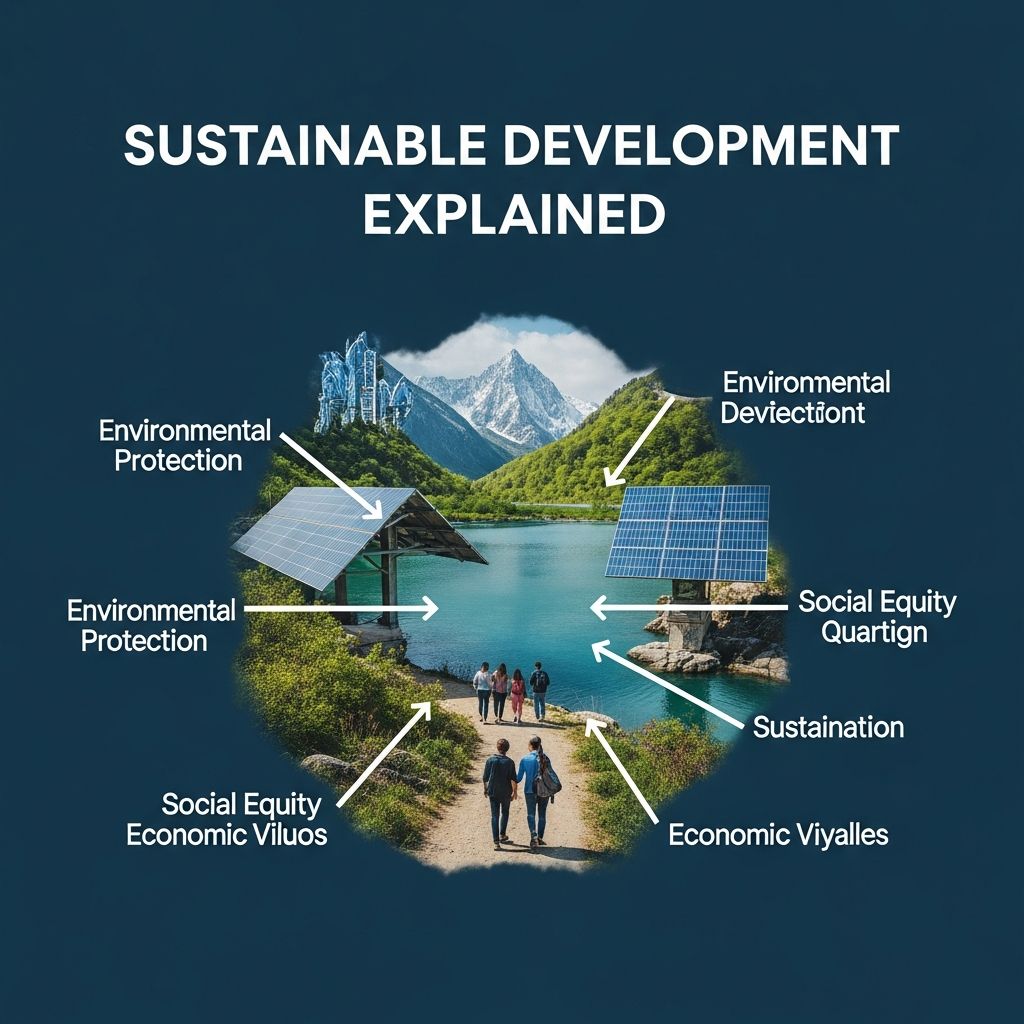
Sustainable development represents a strategic approach to progress that fulfills current human requirements while safeguarding resources and opportunities for future generations. This framework seeks to harmonize economic advancement, social justice, and ecological preservation.
Core Definition and Foundational Principles
The most widely recognized definition originates from the 1987 Brundtland Report, formally titled Our Common Future, produced by the World Commission on Environment and Development. It states: “Sustainable development is development that meets the needs of the present without compromising the ability of future generations to meet their own needs.” This concept embeds two fundamental ideas: prioritizing the essential needs of the global poor and acknowledging the constraints imposed by technology and social structures on environmental capacity.
At its heart, sustainable development transcends mere environmental conservation. It integrates human well-being, equitable resource distribution, and long-term viability. Policies and initiatives under this banner aim to deliver immediate benefits—such as improved health, education, and employment—without depleting natural capital or exacerbating inequalities.
Historical Evolution of the Concept
The roots of sustainable development trace back decades, but the Brundtland Report marked a pivotal moment, popularizing the term globally. Prior discussions on resource limits, like the 1972 Limits to Growth report by the Club of Rome, laid groundwork by warning of exponential growth’s perils against finite resources.
The 1992 United Nations Conference on Environment and Development (Earth Summit) in Rio de Janeiro advanced this agenda, producing Agenda 21—a comprehensive action plan. The 2002 World Summit on Sustainable Development in Johannesburg formalized the three interdependent pillars: environmental, social, and economic. By 2015, the UN General Assembly adopted the 2030 Agenda, embedding these principles into 17 Sustainable Development Goals (SDGs).
The Three Pillars: A Balanced Foundation
Sustainable development rests on three mutually reinforcing dimensions, often visualized as interconnected circles.
- Environmental Pillar: Focuses on preserving ecosystems, biodiversity, and natural resources. This includes combating climate change, reducing pollution, and promoting renewable energy to ensure planetary health.
- Social Pillar: Emphasizes equity, health, education, and inclusion. It seeks to eradicate poverty, ensure gender equality, and provide universal access to quality services, fostering resilient communities.
- Economic Pillar: Advocates for growth that is inclusive and resource-efficient, avoiding boom-and-bust cycles. This pillar supports decent jobs, innovation, and fair trade while minimizing waste.
These pillars are interdependent; neglecting one undermines the others. For instance, unchecked economic expansion can degrade environments, sparking social unrest through resource scarcity.
| Pillar | Key Focus Areas | Examples |
|---|---|---|
| Environmental | Resource conservation, pollution control | Reforestation, clean energy transitions |
| Social | Equity, health, education | Universal healthcare, inclusive education |
| Economic | Growth efficiency, job creation | Circular economy models, green jobs |
United Nations Sustainable Development Goals (SDGs)
The 17 SDGs, adopted in 2015, operationalize sustainable development into actionable targets by 2030. They address interconnected challenges like poverty (SDG 1), zero hunger (SDG 2), good health (SDG 3), quality education (SDG 4), and climate action (SDG 13).
These goals recognize synergies: advancing gender equality (SDG 5) boosts economic productivity (SDG 8), while sustainable cities (SDG 11) support life on land (SDG 15). Progress tracking via annual UN reports highlights successes, such as expanded electricity access, and setbacks amid COVID-19 and conflicts.
- SDG 6: Clean Water and Sanitation
- SDG 7: Affordable and Clean Energy
- SDG 12: Responsible Consumption and Production
- SDG 17: Partnerships for the Goals
Real-World Applications and Success Stories
Sustainable development manifests in diverse initiatives. Costa Rica’s renewable energy dominance—over 98% of electricity from hydro, wind, and geothermal—exemplifies environmental-economic synergy, boosting tourism and GDP.
In urban settings, Singapore’s green building standards integrate social housing with eco-designs, reducing energy use by 30% while housing millions equitably. Corporate shifts toward circular economies, like designing durable electronics for recycling, cut waste and create jobs.
Agriculture innovations, such as precision farming in India, optimize water and fertilizers, enhancing yields for smallholders and curbing environmental harm.
Challenges and Criticisms
Despite progress, hurdles persist. Economic priorities often overshadow environmental ones, as seen in deforestation for agriculture. Developing nations struggle with funding; wealthier countries pledged $100 billion annually for climate aid, yet delivery lags.
Critics argue the market-driven global system perpetuates inequalities, with vague SDG metrics complicating accountability. Geopolitical tensions and pandemics further derail efforts.
Measurement issues abound: GDP ignores ecological costs, prompting alternatives like the Genuine Progress Indicator.
Strategies for Achieving Sustainability
Transitioning requires multifaceted action:
- Policy Reforms: Carbon pricing, subsidies for renewables, and biodiversity laws.
- Innovation: AI for resource optimization, biotech for sustainable agriculture.
- Education and Awareness: Integrating sustainability into curricula to empower citizens.
- Global Cooperation: Strengthening partnerships per SDG 17.
Individuals contribute via mindful consumption, voting for green policies, and community projects like urban gardens.
The Role of Circular Economy
Shifting from linear ‘take-make-waste’ to circular models—reuse, repair, recycle—is pivotal. Denmark’s policies mandate product longevity, slashing landfill waste by 50%. Businesses adopting this reap cost savings and brand loyalty.
Future Outlook and Imperative Action
By 2030, achieving SDGs demands accelerated efforts amid climate tipping points. Youth movements like Fridays for Future amplify urgency, pressuring leaders. Technological leaps in fusion energy and carbon capture offer hope, but equity must guide deployment.
Sustainable development is not utopian—it’s pragmatic. Balancing pillars ensures prosperity endures, turning peril into potential for all generations.
Frequently Asked Questions (FAQs)
What is the Brundtland definition of sustainable development?
It’s development meeting present needs without compromising future generations’ ability to meet theirs, from the 1987 report.
How many Sustainable Development Goals are there?
There are 17 SDGs, adopted in 2015, targeting economic, social, and environmental dimensions by 2030.
What are the three pillars of sustainability?
Environmental protection, social equity, and economic viability, which are interdependent.
Why is sustainable development important?
It prevents resource depletion, reduces inequalities, and builds resilient societies against shocks like climate change.
Can businesses contribute to sustainable development?
Yes, through circular practices, green supply chains, and ESG reporting, driving profit with purpose.
References
- Sustainable development – Wikipedia — Wikipedia. 2023-10-01. https://en.wikipedia.org/wiki/Sustainable_development
- Sustainable Development — International Institute for Sustainable Development (IISD). 2023-01-15. https://www.iisd.org/mission-and-goals/sustainable-development
- Sustainable development – Glossary — UNESCO World Heritage Centre. 2022-05-20. https://whc.unesco.org/en/glossary/375
- Sustainable development — World Health Organization (WHO). 2023-11-10. https://www.who.int/health-topics/sustainable-development
- Sustainable development: Meaning, history, principles, pillars — Taylor & Francis Online. 2019-10-15. https://www.tandfonline.com/doi/full/10.1080/23311886.2019.1653531
- Fast Facts – What is Sustainable Development? — United Nations. 2023-08-15. https://www.un.org/sustainabledevelopment/blog/2023/08/what-is-sustainable-development/
- Sustainable Development Definition — Arena Solutions. 2024-02-28. https://www.arenasolutions.com/resources/glossary/sustainable-development/
- Sustainable Development Goals — United Nations Development Programme (UNDP). 2023-09-01. https://www.undp.org/sustainable-development-goals

Medha Deb is an editor with a master's degree in Applied Linguistics from the University of Hyderabad. She believes that her qualification has helped her develop a deep understanding of language and its application in various contexts. Medha specializes in the areas of beauty, health, sports, and wellness and is committed to ensuring that the content on the website is…