
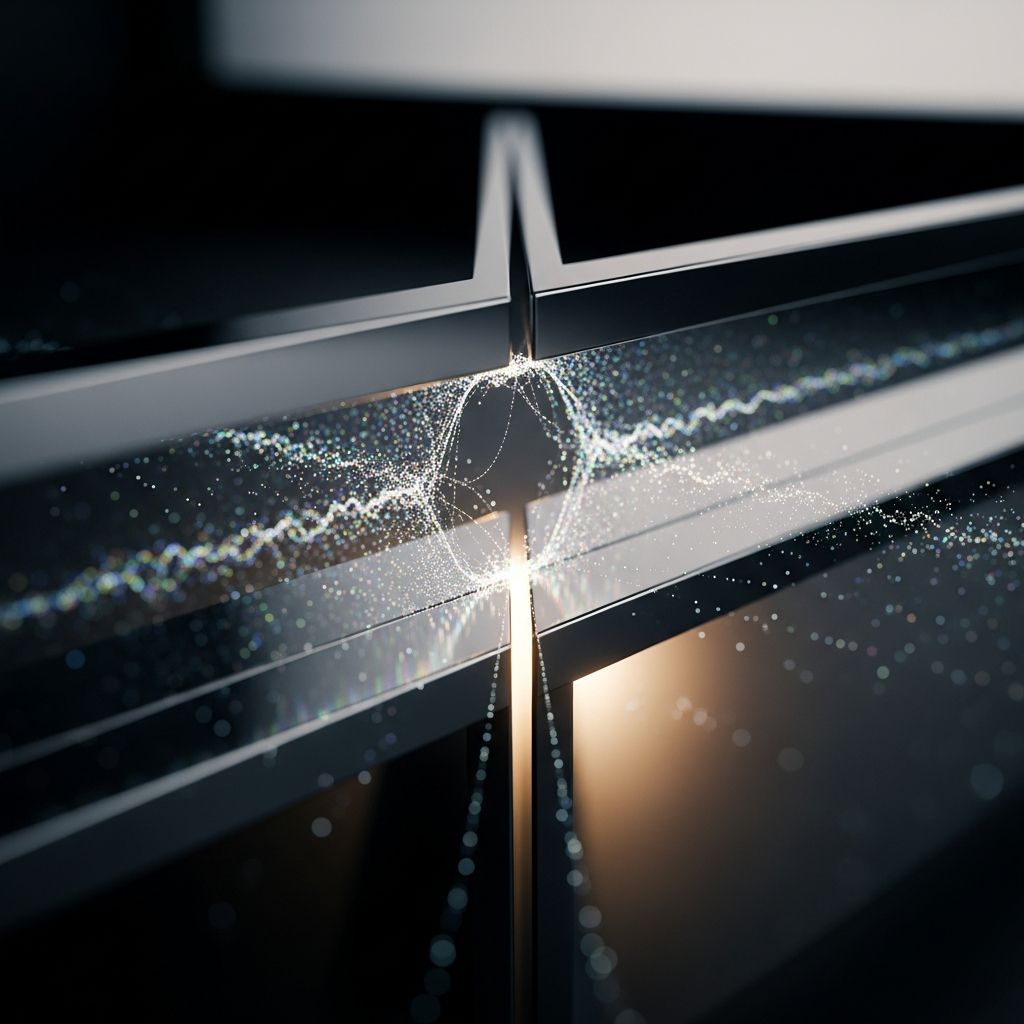
The Casimir effect demonstrates that even empty space is alive with energy, producing a measurable attractive force between two uncharged, parallel conducting plates placed very close together. This phenomenon, rooted in quantum field theory, arises from fluctuations in the quantum vacuum and has been experimentally confirmed, challenging classical intuitions about nothingness.
Origins in Quantum Field Theory
In quantum field theory, the vacuum is not truly empty but teems with virtual particles that constantly appear and disappear. These fluctuations give rise to zero-point energy, the lowest possible energy state of a quantum system. Hendrik Casimir, a Dutch physicist, predicted in 1948 that two closely spaced metal plates would experience a force due to differences in this vacuum energy inside versus outside the gap.
Casimir’s insight came while working at Philips Research Laboratories. Alongside Dirk Polder, he extended the idea to atoms near surfaces, leading to the Casimir-Polder force. The core principle: boundary conditions imposed by the plates restrict allowable electromagnetic modes between them, reducing the vacuum energy density compared to free space, thus creating a pressure imbalance that pushes the plates together.
How Vacuum Fluctuations Create Force
Imagine the quantum vacuum as a sea of virtual photons with all possible wavelengths. Between the plates, only wavelengths that fit as standing waves—multiples of half the plate separation—are permitted. Outside, all wavelengths exist freely. This mode mismatch means fewer quantum fluctuations inside, lowering energy density and generating an attractive force.
- Key Mechanism: Virtual photons with wavelengths too long to fit between plates bombard the outer surfaces unequally.
- Distance Dependence: Force strength scales inversely with the fourth power of separation, making it negligible at macroscopic scales but dominant at nanoscale (e.g., ~1 atm at 10 nm).
- Bosons vs. Fermions: Photons (bosons) contribute attractively; fermions would repel, but the net effect is attractive in standard setups.
This force vanishes in classical physics (as ℏ → 0) and highlights quantum mechanics’ unique predictions.
Mathematical Foundation of the Casimir Force
The attractive pressure F/A between ideal parallel plates separated by distance a is given by:
\[ F/A = -\frac{\pi^2 \hbar c}{240 a^4} \]
Here, ℏ is the reduced Planck’s constant, c is the speed of light. This inverse-quartic law, derived by regularizing infinite vacuum energies via differences at varying separations, is strikingly different from gravity’s inverse-square.
| Separation (a) | Force per Area (relative to 1 atm) | Context |
|---|---|---|
| 1 μm | ~0.001 atm | Weak, lab-detectable |
| 100 nm | ~0.1 atm | Significant for MEMS |
| 10 nm | ~1 atm | Dominant nanoscale force |
This table illustrates why the effect matters in micro- and nano-engineering.
Experimental Verification and Challenges
The first precise measurement came in 1997 by Steven Lamoreaux at the University of Washington, using a torsion pendulum to detect forces between a plate and curved surface (approximating parallel plates). Results matched theory within 5%, confirming quantum vacuum effects.
Subsequent experiments refined this: atomic force microscopy in 1998, and microresonators showing dynamic Casimir effects via photon pair creation from moving boundaries. Challenges include surface roughness, thermal effects, and material imperfections, which modify the force in real setups.
Beyond Perfect Conductors: Real-World Variations
Real materials introduce dielectrics, permeability, and finite conductivity, leading to the Casimir-Lifshitz effect. Dispersion forces (van der Waals at short range) blend into Casimir at larger separations.
- Repulsive Casimir: Possible with certain geometries or metamaterials, flipping the force direction.
- Dynamic Casimir Effect (DCE): Rapidly changing boundaries (e.g., via refractive index modulation) produce real photons from vacuum, observed in superconducting circuits and Bose-Einstein condensates.
These extensions broaden applications beyond static attraction.
Implications for Technology and Engineering
At submicron scales, Casimir forces dominate uncharged interactions, critical for microelectromechanical systems (MEMS) and nanoelectromechanical systems (NEMS). Stiction—plates snapping together—poses design challenges, but controlled harnessing could enable new sensors or actuators.
In nanotechnology, it influences particle assembly and colloid stability. Future quantum devices may exploit DCE for on-chip photon sources.
Casimir Effect and Fundamental Physics Puzzles
The effect evidences negative energy densities in quantum fields, bounded but real relative to free vacuum. This ties to cosmology: vacuum energy should gravitate, yet the observed cosmological constant is tiny, fueling quantum gravity research.
Speculations include stabilizing wormholes (Hawking, Thorne) via exotic matter with negative energy. It also tests supersymmetry: unbroken SUSY would cancel bosonic/fermionic contributions, but the observed force implies broken symmetry if SUSY exists.
Debates persist on zero-point energy’s “reality”—Casimir as a one-loop QED effect, expressible via S-matrix without invoking vacuum per se.
Quantum Vacuum: Not So Empty After All
Casimir proves the vacuum’s dynamism, altering our view of space-time’s ground state. From Hendrik Casimir’s 1948 prediction to modern labs, it bridges theory and experiment, promising tech revolutions while probing universe’s deepest mysteries.
Frequently Asked Questions (FAQs)
What exactly causes the Casimir force?
The Casimir force stems from quantum vacuum fluctuations: restricted electromagnetic modes between plates reduce energy density inside, creating outward pressure imbalance.
Is the Casimir effect measurable in everyday life?
No, it’s only significant at nanoscale separations (<1 μm); at larger distances, it drops rapidly.
Can the Casimir force be repulsive?
Yes, in specific geometries, materials, or with chiral metamaterials, reversing the attraction.
How does Casimir relate to van der Waals forces?
Van der Waals are short-range atomic; Casimir is the retarded, long-range macroscopic limit.
What are applications of the Casimir effect?
Key in MEMS/NEMS design, nanotechnology, and potential quantum photonics via dynamic Casimir.
References
- Casimir effect – Wikipedia — Wikipedia contributors. 2023-10-01. https://en.wikipedia.org/wiki/Casimir_effect
- The Casimir Effect — John Baez, UC Riverside Math Dept. 1997-01-01. https://math.ucr.edu/home/baez/physics/Quantum/casimir.html
- Casimir effect | Quantum Vacuum, Zero-Point Energy — Encyclopædia Britannica. 2023-11-15. https://www.britannica.com/science/Casimir-effect
- Casimir Effect – What causes this force? — Veritasium (YouTube). 2021-01-20. https://www.youtube.com/watch?v=OgJj49ws478
- Science and technology of the Casimir effect — Physics Today (AIP). 2011-10-01. https://physicstoday.aip.org/features/science-and-technology-of-the-casimir-effect
- The Casimir Effect — Purdue University Engineering (PDF). 2010-01-01. https://engineering.purdue.edu/wcchew/Dai%20Qi%20The%20Casimir%20Effect.pdf
- The Casimir Effect: How Empty Space Proved Quantum Reality — TU Eindhoven. 2025-09-12. https://www.tue.nl/en/news-and-events/news-overview/09-12-2025-the-casimir-effect-how-empty-space-proved-quantum-reality

Medha Deb is an editor with a master's degree in Applied Linguistics from the University of Hyderabad. She believes that her qualification has helped her develop a deep understanding of language and its application in various contexts. Medha specializes in the areas of beauty, health, sports, and wellness and is committed to ensuring that the content on the website is…