
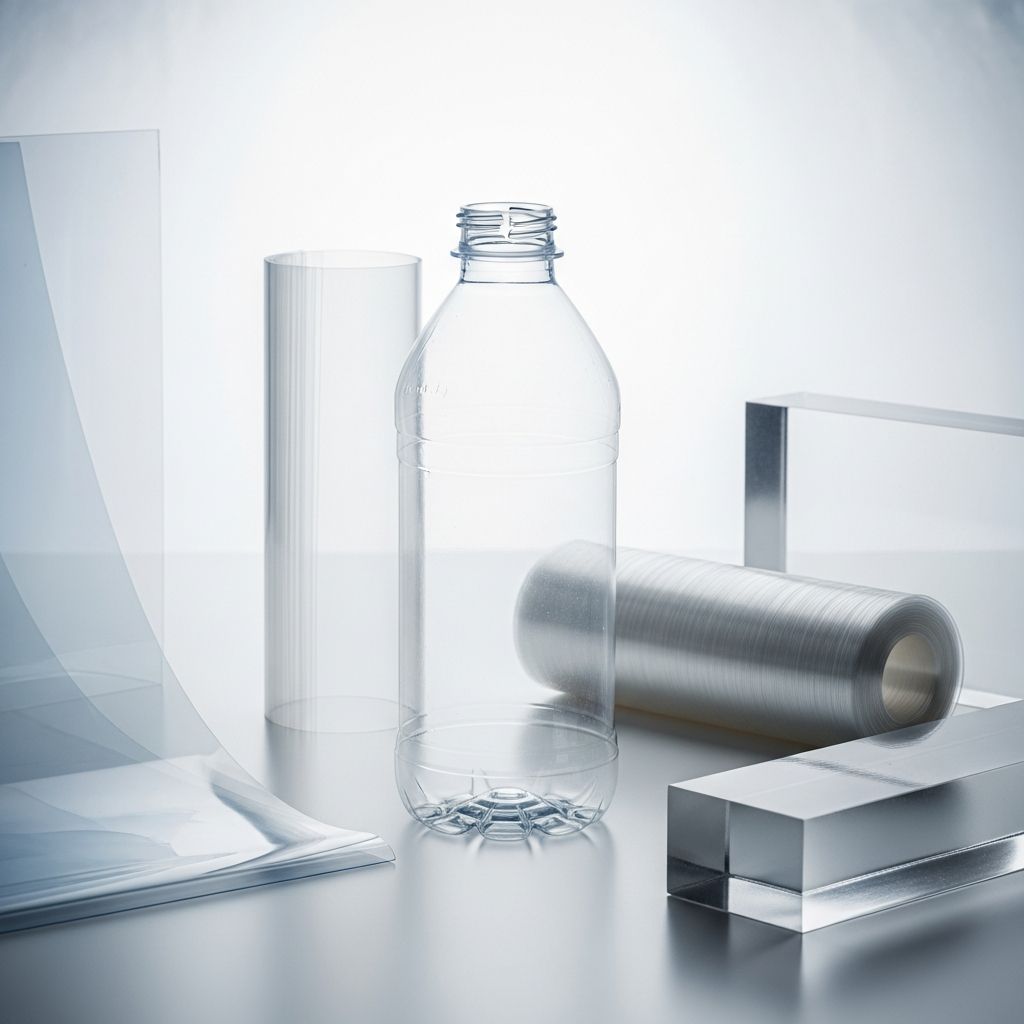
Polyethylene terephthalate, commonly known as PET or PETE, stands as one of the most widely utilized thermoplastics in contemporary manufacturing. Renowned for its clarity, strength, and versatility, PET plays a pivotal role in packaging, textiles, and engineering sectors. This article delves into its composition, physical and chemical attributes, production methods, diverse uses, environmental considerations, and future prospects.
Understanding the Fundamentals of PET
PET belongs to the polyester family of polymers, formed through the condensation polymerization of terephthalic acid and ethylene glycol. This process yields a robust, semicrystalline material capable of existing in both amorphous and crystalline states, influencing its transparency and rigidity. PET’s molecular structure features ester linkages that confer excellent tensile strength and thermal stability, making it suitable for demanding applications.
The polymer’s adaptability stems from its ability to be processed into films, fibers, sheets, and molded products. In its biaxially oriented form (BOPET), PET exhibits enhanced barrier properties against gases and moisture, crucial for food preservation. Manufacturers often modify PET with additives like glycol (PETG) to improve flexibility or impact resistance for specialized needs.
Key Physical and Mechanical Properties
PET demonstrates impressive mechanical characteristics, including a Young’s modulus of 2800–3100 MPa and tensile strength ranging from 55–75 MPa. These values enable it to endure significant stress without deformation, ideal for thin-walled containers and structural components. Its glass transition temperature sits between 67–81°C, with a Vicat softening point around 82°C, allowing dimensional stability up to moderate temperatures.
Thermal properties include a melting point of 255–265°C, facilitating processes like hot-filling without compromising integrity. PET’s low water absorption (0.16% per ASTM standards) and minimal linear expansion coefficient (7×10⁻⁵ K⁻¹) ensure reliability in humid or varying thermal environments. Chemically, it resists most acids and solvents but can hydrolyze under alkaline conditions.
| Property | Value | Notes |
|---|---|---|
| Young’s Modulus | 2800–3100 MPa | High stiffness for structural use |
| Tensile Strength | 55–75 MPa | Supports thin-wall applications |
| Melting Point | 255–265°C | Enables thermal processing |
| Glass Transition Temp | 67–81°C | Affects flexibility |
| Water Absorption | 0.16% | Low moisture uptake |
Chemical Composition and Production Process
Producing PET involves two primary routes: the dimethyl terephthalate (DMT) process or the purified terephthalic acid (PTA) process. In the PTA method, ethylene glycol reacts with PTA under high temperature and vacuum to form PET prepolymer, followed by solid-state polymerization to achieve high molecular weight. This results in a material with intrinsic viscosity tailored for specific uses, such as 0.60–0.70 for films or 0.78–0.85 for carbonated bottles.
Reinforcements like glass fibers can elevate PET’s strength for engineering plastics, while crystallization controls enhance opacity or rigidity. The process emphasizes energy efficiency and recyclability, aligning with global sustainability goals.
Diverse Applications Across Industries
Packaging Innovations
PET dominates the packaging sector, particularly for beverages and foods, due to its lightweight nature, optical clarity, and barrier properties. Single-serve bottles for soft drinks and juices leverage PET’s CO₂ retention and shatter resistance. Flexible films, including metallized BOPET, protect snacks and extend shelf life by blocking oxygen.
- Beverage Bottles: High clarity and strength for carbonated drinks.
- Food Trays: Microwave-safe with grease resistance.
- Pharma Blisters: Moisture-proof for tablets.
Textile and Fiber Production
Over half of PET production converts into polyester fibers for apparel, upholstery, and industrial textiles. Known under brands like Dacron or Terylene, these fibers offer wrinkle resistance, durability, and quick-drying capabilities. Blends with cotton or wool enhance fabric performance in clothing and tire cords.
Engineering and Construction Uses
In engineering, PET serves in electrical insulators, gears, and bearings thanks to its wear resistance and low friction. Construction employs PET films for roofing membranes and insulation barriers, providing tensile reinforcement against weathering. Automotive components and photovoltaic modules also benefit from its thermal endurance.
Emerging Roles in Technology
PET finds niche applications in 3D printing filaments (PETG variants), high-pressure gas cylinders as liners, and medical devices. Its biocompatibility supports uses in surgical tools and imaging equipment.
Advantages Driving PET’s Popularity
PET’s appeal lies in its balanced profile: cost-effective production, superior mechanical strength, and processability. It molds easily into complex shapes, recycles efficiently, and maintains clarity rivaling glass at a fraction of the weight. Gas barrier enhancements via orientation or coatings make it indispensable for perishables.
- Lightweight yet robust for shipping efficiency.
- Excellent optical properties for branding.
- Thermal stability for hot-fill operations.
Challenges and Limitations
Despite strengths, PET absorbs moisture at elevated temperatures, potentially causing warping during processing. It’s susceptible to UV degradation over time and not ideal for high-alkali environments. Compared to PLA, PET excels in thin-wall durability but lags in full biodegradability.
| Aspect | PET | PLA |
|---|---|---|
| Thin-Wall Strength | Superior | Moderate |
| Biodegradability | Recyclable | Compostable |
| Heat Resistance | High (255°C melt) | Lower (~150°C) |
Sustainability and Recycling Efforts
PET leads in recyclability, with the #1 resin identification code enabling mechanical recycling into new bottles or fibers. Chemical recycling breaks it down to monomers for virgin-quality resin. Initiatives like bottle-to-bottle programs reduce landfill waste, conserving resources. Global efforts promote rPET in textiles and packaging, cutting virgin PET demand by up to 30% in some markets.
Bio-based PET from plant-derived ethylene glycol further lowers carbon footprints without sacrificing properties. Challenges include sorting contamination and downcycling losses, but advancements in AI sorting and enzymatic depolymerization promise improvements.
Future Directions for PET Technology
Ongoing research focuses on enhancing barrier properties through nanocomposites, improving recyclability with mono-material designs, and developing bio-PET hybrids. In electronics, conductive PET films support flexible displays, while medical-grade variants advance implants. As sustainability pressures mount, PET’s evolution ensures its relevance in a circular economy.
Frequently Asked Questions (FAQs)
What is the melting point of PET?
PET melts between 255–265°C, depending on crystallinity, supporting hot-fill packaging.
Is PET safe for food contact?
Yes, PET is FDA-approved with low migration and inertness to foods.
Can PET be recycled indefinitely?
Mechanical recycling is viable multiple times, though quality degrades; chemical methods restore purity.
How does PET compare to glass for bottles?
PET is lighter, shatterproof, and recyclable at lower energy cost than glass.
What are PET fibers used for?
Polyester fibers from PET make durable clothing, ropes, and geotextiles.
References
- Polyethylene Terephthalate: Definition, Properties, and Uses — Xometry. 2023. https://www.xometry.com/resources/materials/polyethylene-terephthalate/
- Properties of Polyethylene Terephthalate Polyester (PET, PETP) — AZoM. 2003-10-23. https://www.azom.com/article.aspx?ArticleID=2047
- Polyethylene terephthalate — Wikipedia. 2026. https://en.wikipedia.org/wiki/Polyethylene_terephthalate
- Polyethylene Terephthalate: Structural Configuration, Property and Its Chemical Uses — Walsh Medical Media. 2020. https://www.walshmedicalmedia.com/open-access/polyethylene-terephthalate-structural-configuration-property-and-its-chemical-uses.pdf
- PET Plastic, Chemical Resistance & Properties — Curbell Plastics. 2023. https://www.curbellplastics.com/materials/plastics/pet/
- An Introduction to PET (polyethylene terephthalate) — PETRA. 2023. https://petresin.org/an-introduction-to-pet/

Medha Deb is an editor with a master's degree in Applied Linguistics from the University of Hyderabad. She believes that her qualification has helped her develop a deep understanding of language and its application in various contexts. Medha specializes in the areas of beauty, health, sports, and wellness and is committed to ensuring that the content on the website is…